
Osprey Acquisition Corp. III: SPAC Fundamentals, Execution Risk, and the Search for a Target
Osprey Acquisition Corp. III remains in its pre-acquisition phase, with reported liquidity position and no operating business or revenue to date. The company’s future now hinges on its ability to identify and execute a suitable business combination before regulatory deadlines force a wind-down.
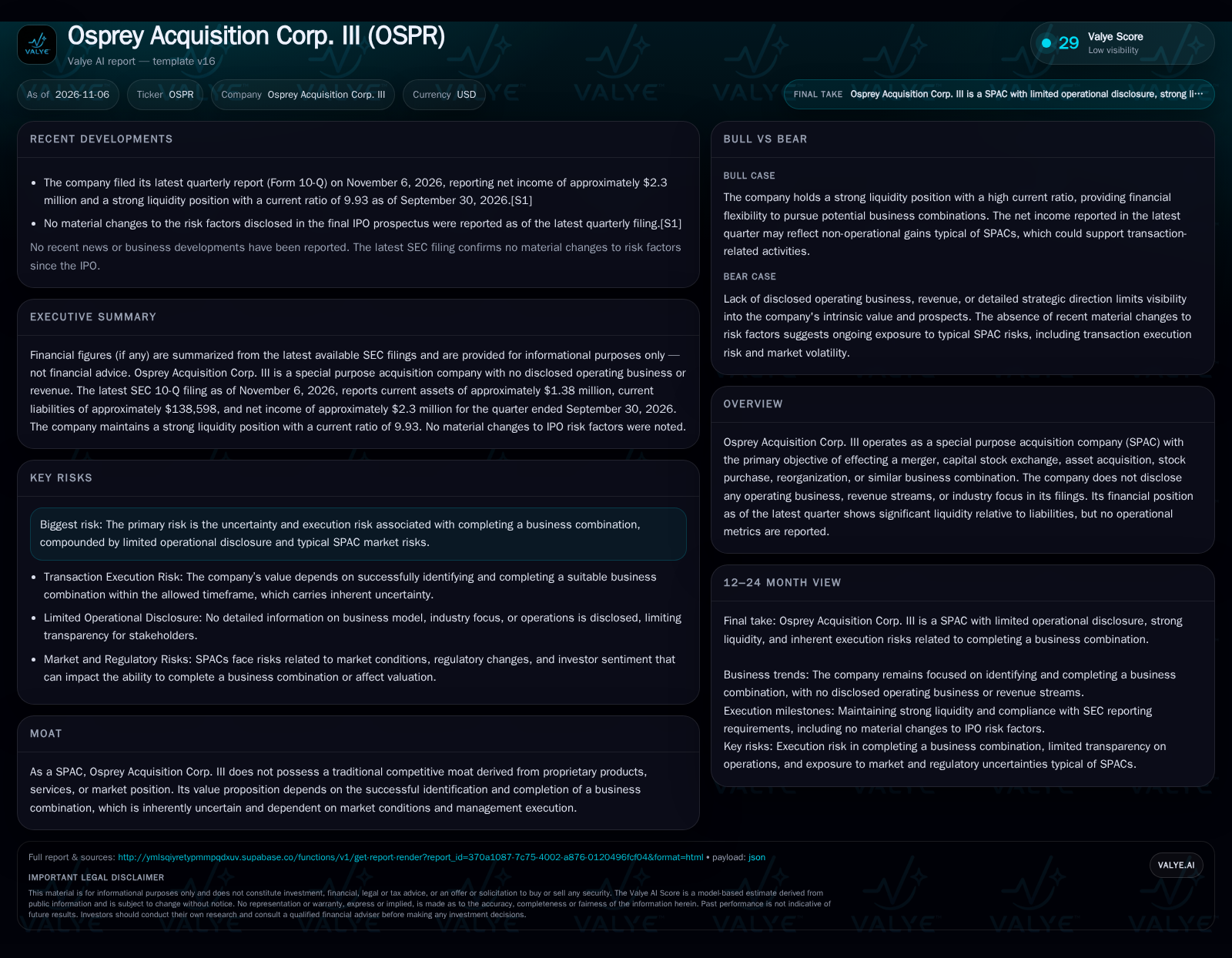
Osprey Acquisition Corp. III is a recently listed SPAC with no operating business or revenue as of September 30, 2026. The company's value proposition is tied entirely to the successful identification and completion of a business combination—a process fraught with execution and market risk.[S1]
Osprey Acquisition Corp. III exemplifies the classic SPAC playbook: a newly public blank-check company, flush with IPO proceeds and sponsor capital, but with no business operations or revenue as of its September 30, 2026 SEC filing. Its recent net income is purely a function of interest earned on trust account assets, not operating activity. Investors face the binary outcome inherent to the SPAC structure: the upside of a successful business combination, or the downside of capital return if no deal materializes. As Osprey enters its post-IPO search phase, the fundamental question is whether its management can convert this financial shell into a durable operating business before the clock runs out.[S1]
Liquidity Snapshot and the Absence of an Operating Business
As of September 30, 2026, Osprey Acquisition Corp. III reported current assets of approximately $1.38 million and current liabilities of about $138,598, resulting in a current ratio of 9.93.[S1] This reflects a reported liquidity position, typical for a SPAC that has completed its IPO but not yet executed a business combination. The company posted net income of $2.3 million for the quarter, which stemmed from interest income on trust account investments rather than business operations.[S1] No operating business, revenue streams, or sector focus have been disclosed, and there have been no material changes to the risk factors since the IPO as per the latest SEC filing.[S1] The main fact pattern is that Osprey remains a financial vehicle in search of a deal, with its value proposition entirely contingent on future M&A execution.
The liquidity snapshot, while robust at face value, also underscores the inherent temporal risk embedded in SPACs like Osprey Acquisition Corp. III. The capital held in trust is effectively a ticking clock, as administrative expenses and opportunity costs steadily erode the principal over time. This dynamic creates a delicate balance for management between conducting thorough due diligence and acting with sufficient speed to secure a transaction before the trust diminishes materially. Moreover, the absence of any operating business or revenue stream means there is no internal cash flow cushion to extend the search horizon, making the timing and quality of the eventual deal critical to preserving shareholder value.
Trust Account Earnings and the Economics of a Blank-Check Structure
SPACs like Osprey Acquisition Corp. III are structured to raise capital through an IPO, place the proceeds in a trust account, and then seek an acquisition target. During the pre-acquisition phase, the only income is typically interest or dividend income from the trust assets, as evidenced by Osprey’s $2.3 million net income for the quarter, all of which was attributable to investment returns rather than operations.[S1] The economics of the SPAC at this stage are defined by minimal operating expenses (legal, regulatory, diligence) and the imperative to preserve capital for the eventual business combination. There is no operating leverage or recurring revenue until a target is acquired and integrated. Capital needs are largely fixed, with the trust balance providing the main source of value and the only real cost being the time-value erosion from administrative expenses and potential market volatility affecting trust asset returns.
The economics of the blank-check structure inherently create a misalignment of incentives that can influence deal outcomes. Since the SPAC sponsors typically receive founder shares at a nominal price, their upside is disproportionately linked to completing a transaction regardless of quality, potentially encouraging riskier or lower-quality deals. Conversely, public shareholders retain the right to redeem their shares, which can pressure management to offer more attractive terms to close a deal. This interplay affects negotiation dynamics, as sponsors must balance the desire to consummate a transaction with the need to avoid excessive redemptions that would reduce the transaction’s capital base. Hence, the trust account’s performance and the cost structure during the search phase directly impact the economics and feasibility of the eventual business combination.
SPAC Landscape: Differentiation and the Race for Deals
In the current SPAC environment, Osprey faces competition from a large cohort of similar blank-check companies all seeking attractive targets. The absence of a disclosed sector focus or operating differentiation means Osprey’s competitive position is primarily determined by the quality of its sponsor team, its ability to source proprietary deals, and its willingness to offer attractive terms to potential targets. Unlike operating businesses, SPACs do not have traditional moats—no intellectual property, customer base, or cost advantage. Their only edge lies in speed, flexibility, reputation, and the ability to convince a target company to choose a public-listing transaction over alternatives like traditional IPOs or private funding. With many SPACs chasing a finite pool of targets, the risk of overpaying or failing to close a deal is structurally high.
In a crowded SPAC market, differentiation through sponsor reputation and deal sourcing capabilities becomes paramount. Sponsors with established networks and sector expertise can access proprietary deal flow, reducing competition and potentially securing targets at more favorable valuations. Without a disclosed sector focus, Osprey’s ability to leverage such advantages is less clear, increasing reliance on transactional agility and financial incentives. Additionally, market cycles and investor sentiment toward SPACs can amplify competitive pressures, as a downturn may compress valuations and reduce the pool of willing sellers, while a frothy market can inflate target prices and complicate due diligence. Therefore, Osprey’s competitive positioning is contingent not only on internal capabilities but also on external market dynamics shaping deal availability and pricing.
Catalyst from a High-Quality Acquisition: What Would Unlock Value
The most favorable outcome for Osprey is the identification and successful closing of a business combination with a high-growth, well-managed private company. Such a transaction could rapidly convert Osprey from a financial shell into a public operating entity with credible revenue and growth prospects. Upside would be amplified if the target operates in a sector with strong secular tailwinds or if the transaction terms are favorable to existing SPAC shareholders. Evidence that would confirm this scenario includes the announcement of a binding merger agreement with a target exhibiting robust historical growth, positive EBITDA, and a clear path to public-market scalability. A strongly positive market reaction to deal terms, accompanied by minimal redemptions from SPAC shareholders, would further validate the upside.
Most Likely Outcome: Prolonged Search, Rising Execution Pressure
The most plausible path for Osprey involves an extended search for a suitable target, with ongoing administrative costs gradually eroding the trust account while the company faces increasing time pressure as its post-IPO window advances. In this scenario, Osprey may eventually announce a business combination, but the target could be less differentiated or the deal terms less attractive due to competition from other SPACs and shifting market sentiment. Confirmation would come from regular SEC filings reporting no material progress or only preliminary non-binding discussions with potential targets. Falsification would occur if Osprey either quickly announces a high-quality deal or, conversely, signals major difficulties in sourcing any credible targets at all.
Deal Failure or Forced Liquidation: Risks of Inaction and Market Cycles
The principal risk for Osprey is failure to identify and close a business combination within the regulatory timeframe, leading to a mandatory liquidation and return of trust proceeds to shareholders, less any permitted expenses. This outcome could be triggered by unfavorable market conditions, deteriorating SPAC sentiment, regulatory headwinds, or simply an inability to find a willing and qualified target. Confirming evidence would include explicit SEC disclosures about approaching deadlines, rising redemption requests, or the announcement of a planned wind-down. Additional downside could materialize if trust assets underperform or if administrative/legal costs escalate, further diluting the eventual return to shareholders.
Milestones That Will Determine Osprey Acquisition Corp. III's Trajectory
Announcement of a definitive agreement with a merger or acquisition target, including disclosed sector, financials, and deal terms.
Updates on the remaining time before mandatory business combination deadlines or extensions, if disclosed.
Levels of SPAC shareholder redemptions upon deal announcement or closing, as this directly affects cash available for the target.
Changes in trust account balance, including interest income and erosion from administrative or diligence costs.
SEC filings or press releases mentioning progress (or lack thereof) in identifying or negotiating with potential targets.
Market and regulatory developments affecting SPAC structures or the attractiveness of de-SPACing as a path to public markets.
If disclosed, the sponsor’s willingness to add capital or backstop redemptions in support of a proposed transaction.
Disclaimer: This is research-only, informational analysis and not investment advice. It may include AI-generated interpretation and general industry context. Always verify important details using primary sources.

Comments