
Crane Harbor Acquisition Corp. II: SPAC Execution Window, Management Leverage, and the Challenge of Deal Quality
With $345 million in trust and an experienced SPAC management team, Crane Harbor Acquisition Corp. II faces a defined two-year deadline to find and consummate a business combination in technology, real assets, or energy. The company’s future hinges on sourcing and closing a high-quality deal before mandated liquidation, with execution risk, conflicts of interest, and sponsor incentives as central variables.
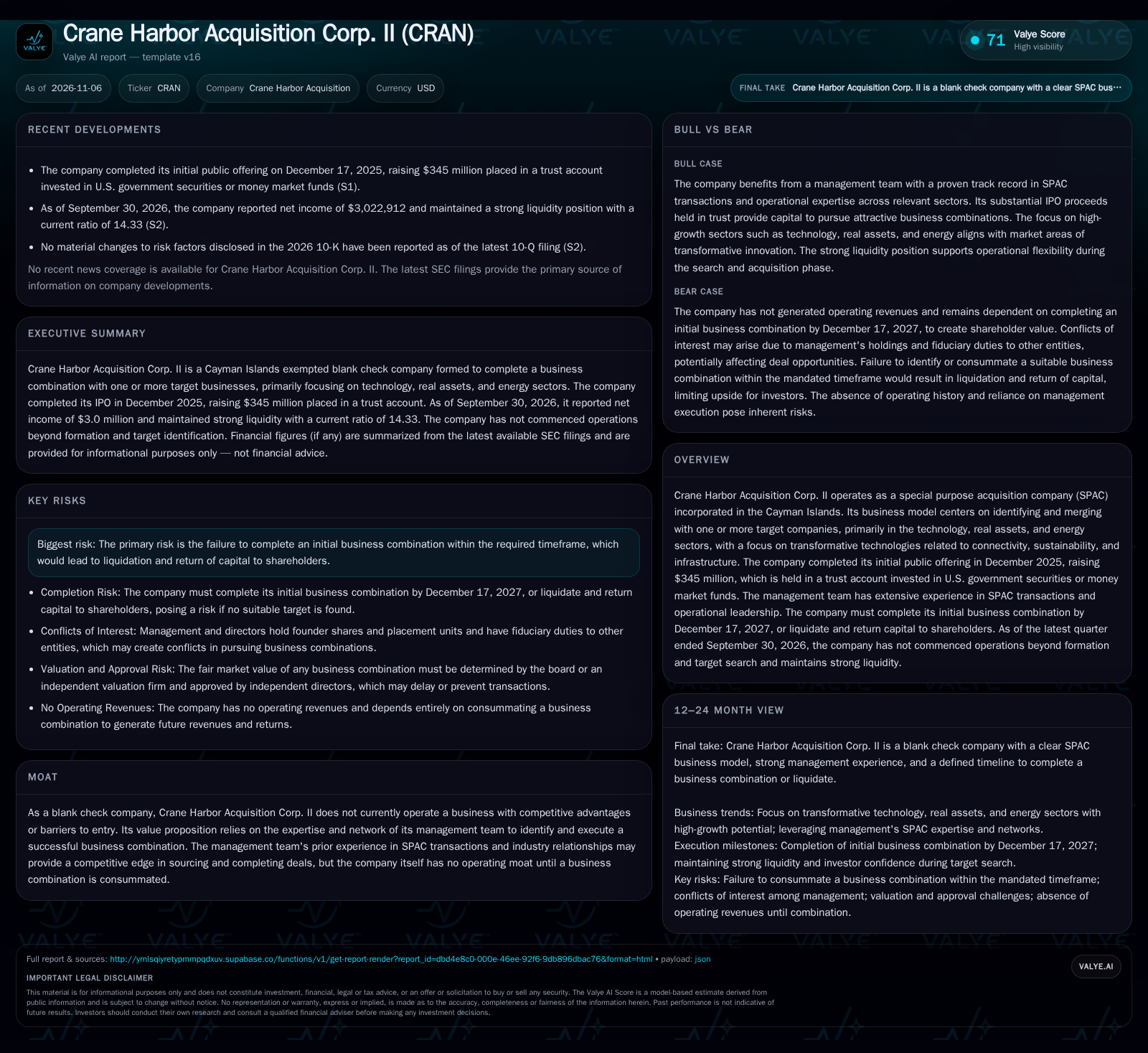
Crane Harbor Acquisition Corp. II is a blank check company that raised $345 million in its December 2025 IPO and must complete a business combination by December 2027 or return capital to shareholders. The company’s only income to date is trust interest, and its value proposition relies entirely on management’s ability to execute an attractive merger, particularly in sectors like technology and energy. Execution risk, target quality, and sponsor alignment are key to the investment thesis. [S1] [S2]
Crane Harbor Acquisition Corp. II sits at the classic SPAC crossroads: flush with $345 million in trust from its December 2025 IPO, but with no operating revenues or active business as of September 2026. The company’s two-year runway to complete a merger in technology, real assets, or energy means its entire value proposition is predicated on management’s ability to source and close a high-quality deal. The binary nature of SPAC outcomes—successful combination or forced liquidation—puts execution, sponsor incentives, and target selection under the microscope, making the next 12-18 months decisive for long-term investors.
IPO Proceeds, Trust Structure, and Two-Year Merger Mandate Shape the Current State
The most material facts defining Crane Harbor Acquisition Corp. II’s present context are its $345 million in IPO proceeds held in a trust account, the absence of operating revenues, and the ticking clock to complete a business combination by December 17, 2027. As of September 30, 2026, the company’s balance sheet shows current assets of $1,766,371 and current liabilities of $123,279, with net income for the recent quarter derived entirely from interest on trust assets—not business operations. [S1] [S2]
The SPAC structure dictates that if a deal is not consummated within the allotted window, capital must be returned to shareholders. This binary outcome—deal or liquidation—frames all current and prospective risk/reward for stakeholders.
How the SPAC Model Creates—and Limits—Value for Crane Harbor
The economics of Crane Harbor Acquisition Corp. II are entirely determined by the mechanics of the SPAC model. Until a merger is completed, the company’s only cash inflows are interest on trust assets, while outflows are limited to public company expenses and sponsor costs. There are no operating revenues, product sales, or recurring business activities prior to a deal. [S1] [S2]
Upon a successful merger, the economics shift dramatically: the combined entity may inherit a growth-stage or mature business with its own revenue, margin, and capital structure, but until then, investors are effectively underwriting the management team’s deal-sourcing skill. Sponsor incentives—such as founder shares and private placement units—create strong motivation to close a deal, but can also lead to misalignment if management pursues suboptimal transactions simply to avoid liquidation.
Operating leverage is latent until a merger occurs. If Crane Harbor acquires a business with scalable technology or infrastructure assets, post-merger economics could feature high fixed-cost leverage and potential for margin expansion. Conversely, if a lower-quality or capital-intensive target is selected, the combined company could face margin pressure and capital needs that dilute initial investor value.
Deal Sourcing and Sponsor Reputation as the Only Moat—For Now
Crane Harbor Acquisition Corp. II currently has no operating moat or defensible market position—it is one of many SPACs competing for a finite pool of attractive targets in technology, infrastructure, and energy. Its only differentiator at this stage is the management team’s experience with prior SPACs and industry relationships, which could provide an edge in accessing proprietary deal flow or negotiating favorable terms. [S1]
However, competition is fierce: dozens of other SPACs, private equity funds, and strategic acquirers are seeking deals in similar sectors. Target companies with strong growth prospects or transformative technology often command high valuations, increasing the risk of overpaying or settling for a less compelling asset. The absence of a pre-existing operating platform means Crane Harbor’s comparative advantage is entirely reputational until a merger is completed.
Should the company execute a combination with a high-quality target, post-deal competitive position will depend on the acquired business’s own market structure, barriers to entry, and technological differentiation. Until then, Crane Harbor’s competitive standing is purely a function of its sponsor network and capital availability.
Transformative Target, Favorable Deal Terms, and Sponsor Alignment Drive Outperformance
The optimal scenario for Crane Harbor Acquisition Corp. II is the identification and consummation of a merger with a high-growth, differentiated company in technology, energy, or infrastructure—ideally at a reasonable valuation and with terms that favor public shareholders. If the management team leverages its network to access proprietary deal flow, avoids excessive dilution, and secures a business with sustainable margins and clear secular tailwinds, the post-merger entity could see re-rating and operational upside.
Evidence that would confirm this scenario includes announcement of a definitive agreement with a well-regarded, growth-stage target; clear disclosure of favorable deal structure (minimal dilution, strong alignment of interests); and positive market or analyst reception to the proposed transaction. Early operational results—such as revenue growth, retention, or margin expansion—would further validate the upside thesis.
Most Likely Outcome: Conventional Deal, Moderate Valuation, and Public Market Scrutiny
The most plausible outcome for Crane Harbor is the successful execution of a business combination within the mandated window, but with a target that is neither a breakout winner nor a clear disappointment. The deal may involve a mid-cap company in technology or infrastructure with credible but unproven growth prospects, acquired at a valuation consistent with recent SPAC norms.
This scenario would be confirmed by the announcement of a merger with a target that has some proprietary technology or asset base, but faces competitive or execution risks. Shareholder approval, SEC clearance, and eventual closing would follow, but post-merger trading could be volatile as the market digests financial projections and integration challenges. Evidence of modest revenue growth, manageable dilution, and stable post-merger governance would support this base case.
Deal Failure, Sponsor-Driven Misalignment, or Forced Liquidation Threaten Shareholder Value
The adverse scenario for Crane Harbor involves either failure to secure a business combination by the December 2027 deadline or the pursuit of a poor-quality deal due to sponsor incentives or time pressure. In the former case, the trust is liquidated and capital returned, resulting in opportunity cost and loss of optionality for investors. In the latter, a suboptimal merger—whether due to overvaluation, weak business fundamentals, or excessive dilution—could destroy value and lead to poor post-merger performance.
Confirmation of this scenario would come from repeated extensions without a credible merger announcement, shareholder dissent or failed votes, or the selection of a target with questionable financials or misaligned incentives. Negative market reaction, high redemption rates, or post-merger underperformance would further validate downside risk.
Milestones and Disclosures That Will Define the Crane Harbor SPAC Thesis
Announcement of a letter of intent or definitive agreement with a target company, including sector, valuation, and deal terms.
Disclosure of any material conflicts of interest, sponsor incentives, or related-party considerations in the proposed transaction.
Shareholder redemption rates and voting outcomes at the time of merger approval—high redemptions may signal lack of confidence.
SEC review progress and any regulatory or legal challenges to the proposed business combination.
Post-announcement trading dynamics and market/analyst commentary on the quality and prospects of the chosen target.
If disclosed, details on projected post-merger revenue, margin profile, and capital requirements of the target company.
Any extensions of the merger deadline or changes to trust structure, which may indicate deal execution risk.
Disclaimer: This is research-only, informational analysis and not investment advice. It may include AI-generated interpretation and general industry context. Always verify important details using primary sources.

Comments