
Viasat’s Growth Versus Profitability Dilemma: Satellite Economics in a Shifting Connectivity Market
Viasat’s modest revenue growth in Q2 FY27 underscores the resilience of its satellite connectivity business, yet widening net losses highlight persistent cost and competitive pressures.
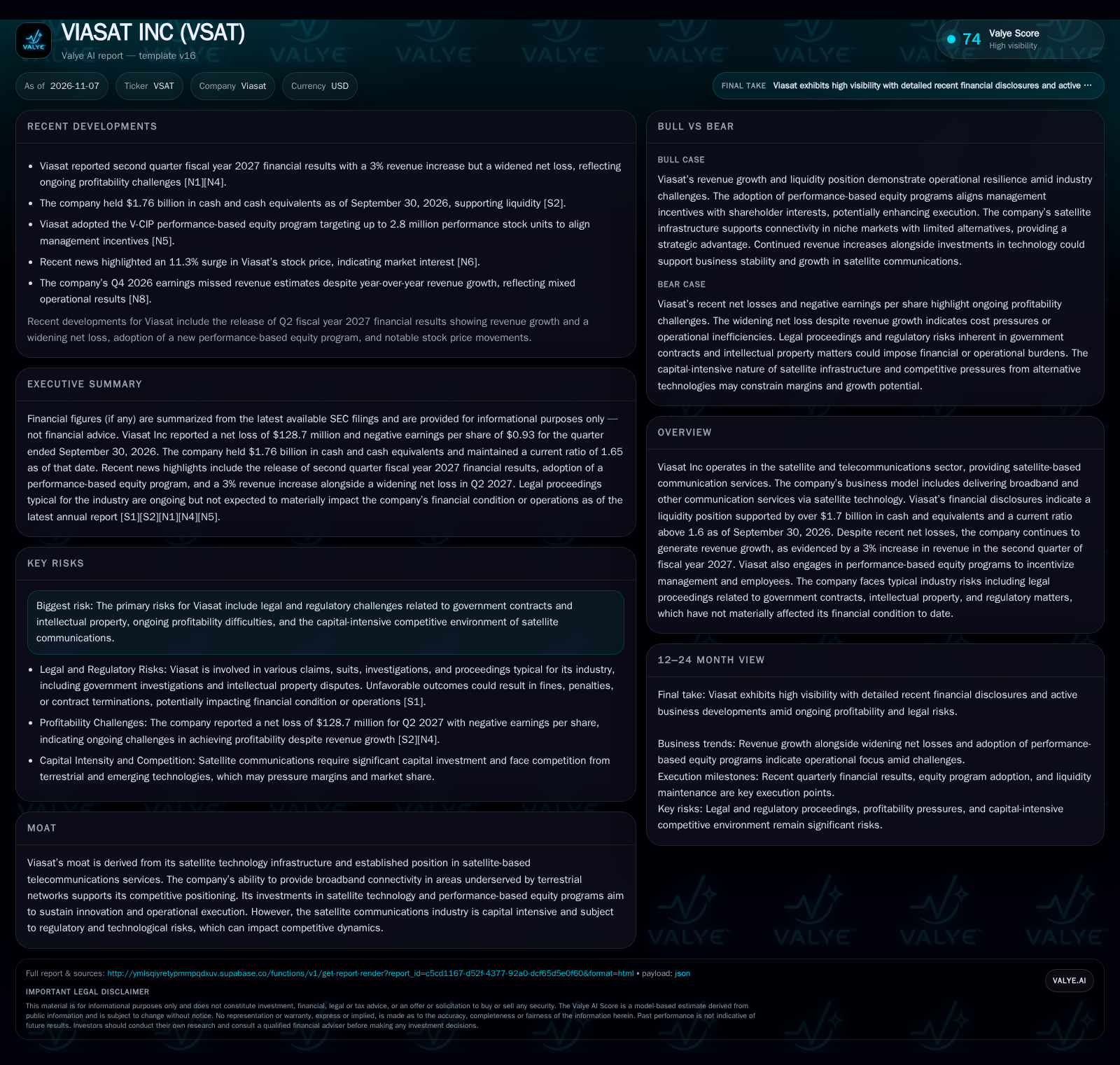
Viasat posted 3% revenue growth in Q2 FY27 but saw its net loss widen to $128.7 million, despite holding $1.76 billion in cash and launching a performance-based equity program. These results reflect the company’s struggle to translate scale into profitability amid a capital-intensive, competitive satellite communications market. The core question is whether operational leverage, technology investments, or strategic pivots can reverse margin pressure while maintaining growth momentum. [S2] [N1] [N4] [N5]
Viasat’s latest results present a familiar conundrum for satellite communications: the company continues to grow the top line, with a 3% revenue increase in the second quarter of fiscal 2027, yet profitability has moved further out of reach as net losses widen. Despite holding substantial cash and current assets, ongoing cost pressures and the capital intensity of satellite infrastructure underscore the challenge of converting scale into sustainable earnings. The introduction of a performance-based equity program signals a push for tighter alignment between management incentives and shareholder value, but the crucial test will be whether the company can achieve operational leverage before competition and technology substitution further intensify.
Recent Results Highlight the Growth-Profitability Tradeoff
Viasat reported a 3% year-over-year revenue increase in the second quarter of fiscal year 2027, but its net loss widened to $128.7 million for the period, with basic and diluted earnings per share of -$0.93. As of September 30, 2026, the company held $1.76 billion in cash and cash equivalents, with a current ratio of 1.65 and a cash ratio of 0.94. The adoption of a performance-based equity program targeting up to 2.8 million performance stock units suggests a focus on aligning management incentives with shareholder outcomes. These developments matter because they frame the company’s operational resilience—continued revenue growth and liquidity—with the persistent challenge of unprofitable operations and the need for better execution to achieve sustainable margins. [S2] [N1] [N4] [N5]
Satellite Service Economics: Fixed Costs, Scale Ambitions, and Margin Pressures
Viasat’s core business model relies on leveraging heavy upfront capital investment in satellite infrastructure to deliver broadband and communications services, particularly to geographies underserved by terrestrial networks. This model is characterized by high fixed costs—launching, maintaining, and upgrading satellites—while variable costs per additional customer are relatively low once infrastructure is in place.
Revenue growth is typically driven by subscriber additions, bandwidth pricing, and specialized government or enterprise contracts. However, the widening net loss despite revenue growth suggests that incremental revenue is not yet sufficient to absorb fixed costs or offset rising operating expenses, which may include satellite launches, network maintenance, R&D, and customer acquisition.
Economically, operating leverage is central: as the installed base grows, incremental margins should improve, but this is counteracted by ongoing capital needs for next-generation satellites and competition-driven pricing. The ability to generate positive free cash flow depends on reaching a critical mass of high-value contracts or consumers, while managing the risk of technological obsolescence and asset write-downs if expected demand fails to materialize.
Competitive Landscape: Capital Intensity Meets Technology Substitution
Viasat’s main competitive advantages derive from its satellite network, which enables connectivity in rural and remote areas where terrestrial broadband is economically unviable. This market segment is relatively defensible in the near term, but competitive threats are intensifying.
On one side, traditional satellite competitors continue to invest in new constellations and capacity. On the other, emerging low Earth orbit (LEO) satellite entrants and terrestrial fiber or wireless broadband providers are narrowing the historical gap in coverage, latency, and price. The capital-intensive nature of satellite deployments can be a double-edged sword: it creates barriers to entry but also exposes incumbents to technological leapfrogging and asset risk.
Switching costs for customers are mixed—higher for government or enterprise contracts with bespoke requirements, but lower for consumer broadband as hardware and service portability improve. Viasat’s ability to defend market share will depend on its pace of innovation, cost control, and ability to offer differentiated service levels or bundled solutions.
What Could Unlock Margin Expansion and Sustainable Growth?
A favorable scenario for Viasat would involve accelerating adoption of satellite broadband—driven by ongoing rural connectivity needs, incremental government contracts, and successful upselling of higher-margin services. If the company can leverage its fixed-cost infrastructure by expanding its subscriber base or capturing large, multi-year government or enterprise deals, operating leverage could drive a swing to profitability. Continued investment in next-generation satellites could yield improved performance and capacity, enabling premium pricing in select markets.
Confirmation would come from sequential improvements in operating margin, positive free cash flow, and evidence of sticky, recurring high-value contracts. Disproving this scenario would be persistent net losses despite growing revenues, or evidence that incremental revenues are consistently offset by rising costs or competitive price compression.
Incremental Growth, Margin Headwinds, and a Slow March Toward Scale
The most plausible path for Viasat is continued modest revenue growth, primarily from niche and underserved markets, but with ongoing margin pressure as capital expenditures and competition erode profitability. The company is likely to maintain liquidity in the near term, but absent a step-change in operating efficiency or a major contract win, net losses may persist.
Confirmation would come from stable or modestly rising revenues, paired with little improvement—or even deterioration—in operating margins. If disclosed, flat or negative free cash flow alongside stable cash balances would reinforce the base case. If Viasat demonstrates a sudden improvement in margins or lands a transformative contract, the thesis would need to be revisited.
Margin Compression and Capital Constraints Trigger Strategic Stress
In a negative scenario, Viasat could face mounting cost pressures from new satellite launches, accelerated technology cycles, or increasing price competition from LEO and terrestrial alternatives. If revenue growth stalls or declines, and fixed costs remain high, the company could see its net losses deepen, potentially leading to cash burn and the need for external financing or asset sales.
This would be confirmed by sequential declines in revenue, sharply negative cash flow, or a deteriorating cash position (if disclosed). Additional evidence would include the loss of key contracts, inability to fund future satellite investments, or a shift in legal or regulatory environment that increases compliance costs or restricts operations.
Signals That Will Define Viasat’s Profitability and Strategic Trajectory
Quarterly operating margin trends: Is there evidence of margin improvement as revenue grows, or are losses widening?
Net subscriber additions and churn rates (if disclosed): Are customer counts growing, especially in target rural/enterprise markets?
Free cash flow generation and cash balance changes: Does the company begin to generate positive cash flow, or is cash burn accelerating?
Major new contract wins or renewals: Are there announcements of multi-year government or enterprise deals that would enhance revenue visibility?
Capital expenditure commitments for future satellite launches: Is Viasat able to fund next-generation infrastructure without stressing its balance sheet?
Competitive pricing dynamics and ARPU (if disclosed): Are average revenue per user and pricing power holding up in the face of LEO and terrestrial competition?
Legal/regulatory developments: Do any new proceedings or rulings materially affect the company’s ability to operate or raise costs?
Management commentary on the impact of the V-CIP equity program: Is there evidence of improved execution or cost discipline attributed to the new incentive structure?
Disclaimer: This is research-only, informational analysis and not investment advice. It may include AI-generated interpretation and general industry context. Always verify important details using primary sources.

Comments