
Aehr Test Systems: AI Demand and Wafer-Level Testing Shape Semiconductor Equipment Outlook
Aehr Test Systems is capitalizing on surging AI and advanced semiconductor markets with its modular, patented test and burn-in solutions—yet faces the perennial risks of industry cyclicality, evolving technology, and concentrated product revenues. The company’s ability to convert short-term demand spikes into sustainable growth will hinge on continued innovation, operational scaling, and resilience to sector fluctuations.
Aehr Test Systems has seen its revenues and outlook surge in late 2026 on the back of strong AI-driven demand for wafer-level test and burn-in, supported by a robust balance sheet. However, the company remains exposed to the volatility of semiconductor capital spending, concentrated product lines, and the need for ongoing technical differentiation to defend its position as device architectures evolve. Monitoring the durability of AI-related orders, customer diversification, and product innovation will be critical to understanding whether recent momentum can translate into long-term value.
Aehr Test Systems, a long-standing provider of semiconductor test and burn-in equipment, is riding a wave of AI-fueled demand that has driven both its revenues and forward outlook sharply higher in late 2026. Its patented FOX systems and wafer-level innovations are well positioned for markets such as AI processors, EV power semiconductors, and advanced memory. However, the company’s revenue concentration in full wafer contact products and the inherently cyclical nature of semiconductor capital spending mean that sustainability beyond this surge hinges on continued product relevance and operational agility. The next phase for Aehr will test whether its technology and balance sheet strength can convert momentum into durable advantage—or if it remains at the mercy of industry cycles and shifting customer needs.
AI Demand Growth and Product Mix Shape Aehr’s Near-Term Performance
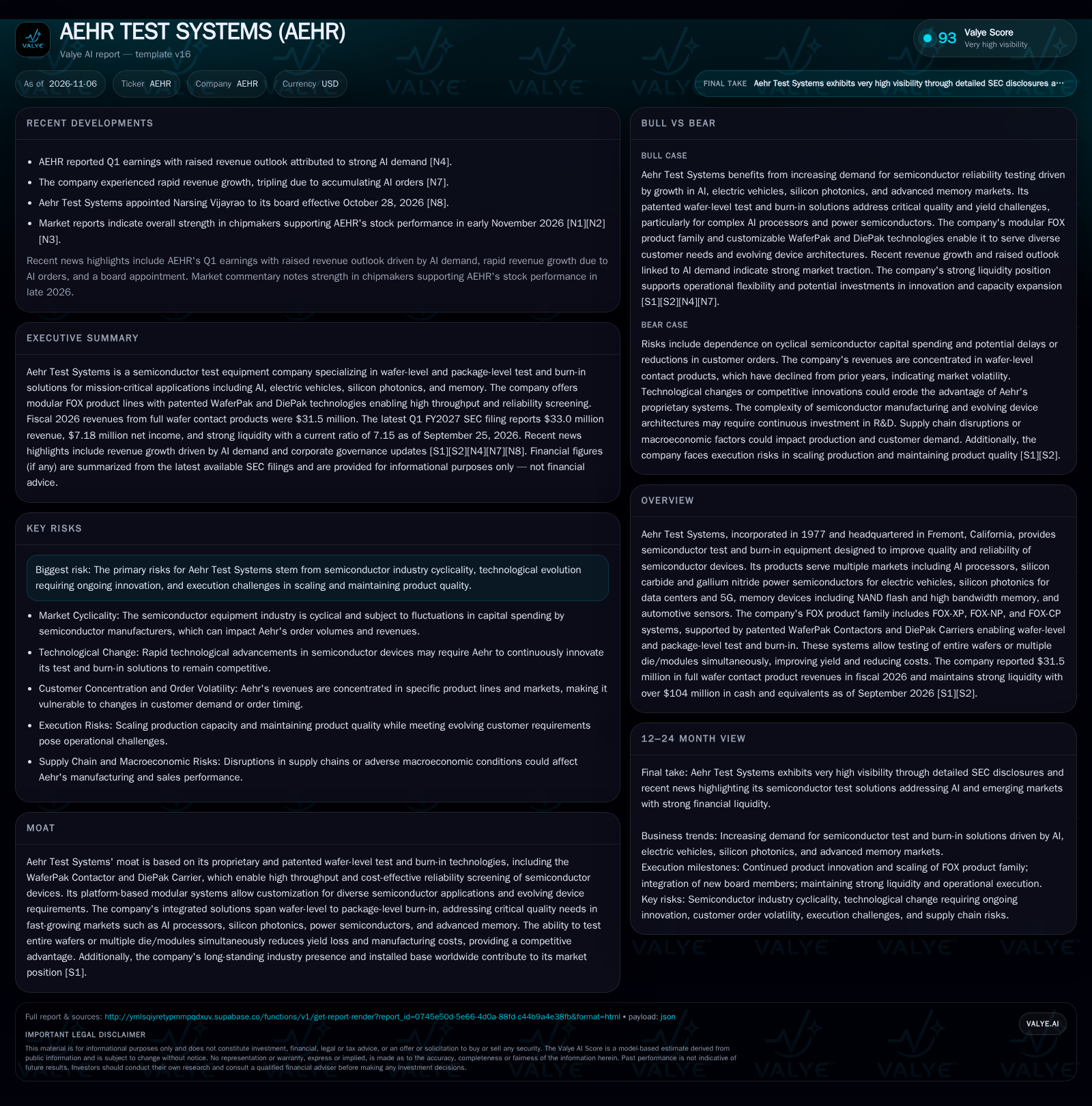
Aehr Test Systems reported $33.0 million in revenue and $7.18 million in net income for Q1 FY2027, a result that management and recent news attribute to a sharp increase in orders from AI-related customers [S2] [N4] [N7]. This surge has prompted the company to raise its revenue outlook, reflecting both robust short-term demand and heightened visibility in its pipeline. However, the company’s core full wafer contact product line, while still dominant at 63% of total FY2026 revenues, has declined in contribution from a peak of 98% in FY2024, signaling both the success and inherent risk of product concentration [S1]. The company reported cash and liquidity metrics for the period; these figures do not by themselves establish operating runway, investment capacity, financial flexibility, or financing capacity. [S2] The company also announced the appointment of Narsing Vijayrao to its board, signaling ongoing governance evolution [N8].
Capturing Value Through Wafer-Level Testing in Complex Semiconductor Markets
Aehr’s business model centers on selling high-throughput, modular test and burn-in systems—primarily the FOX family—that support both wafer-level and package-level screening. Wafer-level burn-in provides a clear economic value proposition to customers: it reduces downstream yield loss and costs by screening out defective devices before expensive packaging or stacking, particularly critical for complex AI processors, silicon photonics, and advanced memory like HBM [S1]. The company’s patented WaferPak Contactors and DiePak Carriers, customizable to specific device types, are designed for product longevity and recurring replacement revenue over 2-7 year lifecycles, though the precise mix of upfront system sales versus consumables/recurring revenue is not disclosed.
Pricing in the semiconductor equipment industry is typically driven by the complexity and throughput of the system, with higher-value AI and automotive applications commanding premium burn-in and test requirements. Operating leverage is plausible as utilization and installed base scale, especially if consumables and service revenues grow as a proportion of the mix. However, the capital intensity of customer purchases and the cyclical nature of semiconductor investment mean that revenue timing can be lumpy.
Maintaining Edge in a Rapidly Changing Test Equipment Industry
Aehr’s competitive position is rooted in its proprietary wafer-level test and burn-in technologies, which are particularly relevant for applications where device reliability is mission-critical—AI accelerators, power semiconductors for EVs, silicon photonics, and automotive sensors [S1]. The ability to test entire wafers simultaneously and support both wafer and package-level screening is a differentiator, potentially reducing customer costs and improving yield. However, the broader semiconductor test equipment market is fragmented, with numerous established and emerging players offering alternatives ranging from traditional package-level burn-in to advanced probe cards and system-level test solutions.
Competitive threats may emerge from larger diversified test equipment vendors with greater R&D budgets, as well as from in-house solutions developed by major foundries or IDMs seeking tighter integration. There is also the risk that advances in device design—such as improved intrinsic reliability or new packaging approaches—could reduce the need for extensive burn-in, eroding the value proposition of Aehr’s systems. Price competition and the pace at which competitors can match or surpass wafer-level throughput will also shape the company’s relative advantage.
Multi-Year Growth and Margin Expansion from AI and Power Semiconductor Demand
In a favorable scenario, the current surge in AI processor and power semiconductor demand proves durable, with continued investment in data centers, automotive electrification, and advanced memory translating into robust multi-year orders for wafer-level burn-in and test. Aehr’s FOX systems and consumables gain traction as the potentially leading standard for reliability screening in these fast-growing segments, while the company successfully diversifies its customer base across geographies and device types.
Operating leverage would materialize if consumables and after-sale services grow as a share of total revenue, improving gross margins and smoothing volatility from lumpy capital equipment orders. Evidence supporting this scenario would include a sustained backlog of AI and EV-related orders, a rising share of recurring consumables/service revenues (if disclosed), and announcements of follow-on orders or design wins from leading-edge semiconductor manufacturers. This scenario could be falsified if AI/EV capital spending slows, major customers insource test or shift to competing technologies, or if Aehr’s systems fail to keep pace with changing device architectures.
Growth Moderates as Demand Normalizes and Competition Increases
The most plausible trajectory is that Aehr’s revenue growth moderates after the current AI-driven spike, as semiconductor capital spending returns to a more typical pattern of cycles and customer order timing. The company continues to serve a diversified set of markets (AI, automotive, photonics, memory), but faces periodic volatility in order flow as customers adjust to end-market demand and technology transitions.
Aehr’s product differentiation remains relevant, but competitive pressures from larger test equipment firms and evolving device designs force ongoing investment in R&D and occasional price concessions. The mix of system sales versus consumables may stabilize, providing some margin support, but revenue concentration in wafer contact products remains a vulnerability. Evidence confirming this scenario would be quarterly revenue and order trends that track with broader semiconductor equipment cycles, stable (but not accelerating) margins, and incremental—not transformative—product launches or customer wins.
Revenue Concentration and Margin Pressure from Order Volatility and Tech Changes
In a negative scenario, the sharp AI-driven demand proves to be a short-lived spike rather than a new baseline. Semiconductor capital spending contracts due to macroeconomic headwinds or overcapacity, leading to order pushouts or cancellations—particularly painful given Aehr’s revenue concentration in full wafer contact products [S1]. At the same time, rapid advances in device reliability, packaging, or alternative test approaches reduce the necessity or value of Aehr’s core solutions.
Margin pressure mounts as competitors undercut pricing or customers develop in-house systems, while fixed costs for R&D and production scale become harder to leverage in a downturn. Evidence for this scenario would include a steep drop-off in order backlog, declining utilization rates for installed systems, negative margin trends, or a spike in inventory and receivables. Falsification would require clear evidence of diversified, recurring revenue streams and continued customer adoption despite industry headwinds.
Key Developments That Will Illuminate Aehr’s Trajectory After the Demand Surge
Quarterly order backlog and visibility into the duration and composition of AI- and EV-related demand surges.
Breakdown of revenue by product line—specifically, the mix between initial system sales and recurring consumables/services—if disclosed.
Customer concentration metrics and the emergence of new design wins or geographic expansion beyond existing large customers.
Gross margin trends, particularly as they relate to product mix shifts and competitive pricing pressures.
R&D expenditure levels and cadence of new product introductions or upgrades to the FOX platform.
Utilization rates or installed base growth for FOX systems, if disclosed, as a proxy for long-term customer engagement.
Supply chain stability and lead times for critical system components, especially amid industry-wide disruptions.
Board and management changes impacting strategic direction or execution capability, as evidenced by recent appointments.
Disclaimer: This is research-only, informational analysis and not investment advice. It may include AI-generated interpretation and general industry context. Always verify important details using primary sources.

Comments