
Rayonier: Timberland Economics, Real Estate Leverage, and the Resilience Challenge
The key question is whether the company can convert its resource base and capital discipline into sustained profitability amid commodity cycles and regulatory headwinds.
Rayonier reported a Q1 2026 net loss but maintains reported liquidity position and continues to pay dividends. Q3 2026 results exceeded expectations, suggesting operational resilience. The company’s diversified timberland and real estate segments provide multiple revenue streams, but commodity price volatility and environmental regulations remain central risks. The focus is on whether Rayonier can achieve consistent profitability while managing capital and market cycles.
Rayonier Inc stands out in the timberland and real estate sector for its blend of resource scale, financial discipline, and transparent shareholder policies. Recent Q3 results suggest operational momentum, yet the business remains exposed to commodity cycles and regulatory constraints. The next phase for Rayonier hinges on demonstrating that its diversified model can consistently generate cash flow and defend against the inherent volatility of natural resource markets.
Recent Financials Highlight Contrasts Between Liquidity and Profitability
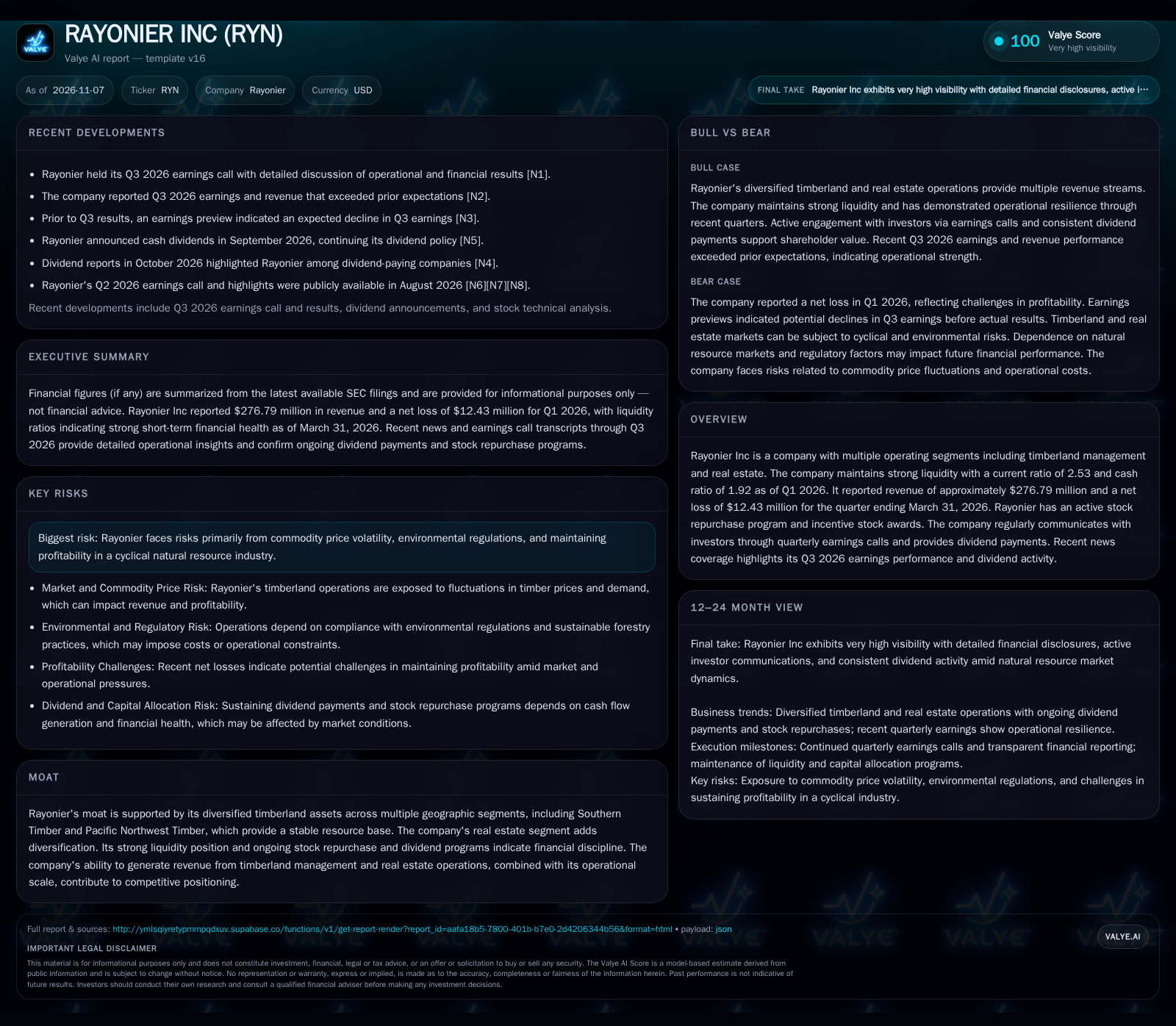
Rayonier’s financial position entering Q4 2026 is defined by a reported liquidity position cushion—cash and cash equivalents of $681.66 million, a current ratio of 2.53, and a cash ratio of 1.92 as of March 31, 2026 [S2]. However, the company posted a net loss of $12.43 million for Q1 2026 on revenue of $276.79 million [S2]. This contrast between balance-sheet strength and income-statement pressure underscores the challenge of generating sustainable profitability in a cyclical sector. Notably, Q3 2026 earnings and revenue surpassed expectations, suggesting that operational execution may be improving [N2]. The cited source reports dividend-related activity; that disclosure alone does not establish dividend-policy continuity, management confidence, or a material constraint on capital flexibility. [N4] [N5]
How Timberland and Real Estate Economics Shape Rayonier’s Earnings Power
Rayonier’s revenues stem primarily from owning and managing timberlands—harvesting and selling timber, leasing land, and occasionally selling parcels for higher-value real estate use. Timber sales are typically tied to contracted volumes and spot market prices, both of which are highly sensitive to housing starts, construction activity, and export demand. This introduces inherent volatility: while land ownership provides a long-term asset base, realized earnings are highly levered to commodity cycles and pricing power is limited when timber supply exceeds demand.
The real estate segment offers higher-margin opportunities, especially when land can be repositioned for development, conservation, or recreational use. However, these transactions are episodic and lumpy, often dependent on local market conditions and regulatory approvals. The capital intensity of the business is moderate, with ongoing silviculture investment but relatively low operating leverage compared to more industrial models. Funding needs are driven by land acquisitions, replanting, and periodic capital returns to shareholders. The company reported cash and liquidity metrics for the period; these figures do not by themselves establish operating runway, investment capacity, financial flexibility, or financing capacity.
The cyclical nature of timber markets means that Rayonier must strategically balance harvest timing and inventory levels to optimize revenue without eroding long-term asset value. This requires sophisticated forecasting of demand drivers such as housing market trends, interest rates, and international trade policies. Additionally, the company's ability to integrate silvicultural best practices can influence yield quality and rotation periods, thereby impacting future cash flows. Capital allocation decisions must weigh the trade-offs between reinvesting in land and forest management versus returning capital to shareholders, especially given the episodic nature of real estate transactions and the capital-intensive requirements of sustainable forestry.
Timberland Scale and Geographic Diversification: Buffer or Burden?
Rayonier’s competitive position rests on its diversified timberland holdings across the Southern U.S. and Pacific Northwest, which reduces exposure to regional weather, pest, and regulatory events. This scale provides some negotiating leverage with mills and industrial buyers, and geographic spread enables the company to shift harvests in response to localized market signals. However, timberland is a commoditized asset: pricing is largely set by broader supply-demand dynamics rather than individual company action.
The real estate segment offers differentiation, as the company can selectively monetize land for non-timber uses, but competitors in this space include both large timberland REITs and regional land developers. Environmental compliance and sustainable forestry certifications are increasingly important, particularly for access to premium buyers and export markets. Substitutes for timber—such as steel, concrete, or engineered wood—can dampen demand, while changes in building codes or consumer preferences may alter long-term consumption patterns.
Geographic diversification, while mitigating localized risks, also introduces complexity in operational management and cost structures. Variations in regional labor markets, transportation logistics, and regulatory environments can affect harvest efficiency and profit margins differently across the portfolio. Moreover, the commoditized nature of timber means Rayonier’s pricing power is largely influenced by macroeconomic factors and competitor actions, limiting its ability to differentiate on price. However, the company’s scale may enable economies of scale in procurement and marketing, potentially lowering per-unit costs. The interplay between timber and real estate segments requires careful coordination to avoid cannibalizing value or overextending capital resources.
Unlocking Value Through Strategic Land Sales and Commodity Tailwinds
A favorable scenario for Rayonier would combine rising timber prices (driven by increased housing starts, infrastructure spending, or export demand) with opportunistic high-margin land sales in the real estate segment. If the company can leverage its geographic diversity to maximize harvests in strong markets while deferring in weaker areas, margin improvement would follow. Upside could also come from successful cost containment or the ability to secure conservation easements and carbon credits, providing incremental revenue streams.
Confirmation of this scenario would require evidence of sustained improvement in operating margins, a reduction in quarterly earnings volatility, and announcements of large-scale, high-value land transactions. Additional signals would be regulatory approval for new development projects or notable wins in conservation or carbon offset markets. Falsification would be persistent losses despite strong timber pricing or if land sales fail to materialize in a robust real estate environment.
Core Operations Deliver Stability, but Cyclicality Remains Embedded
The most plausible path is that Rayonier remains a stable, dividend-paying timberland and real estate operator—delivering lumpy, range-bound earnings with periodic swings tied to commodity cycles. Timber revenues fluctuate with market demand, while real estate transactions provide sporadic boosts rather than a steady stream.
Prolonged Commodity Weakness and Regulatory Shocks Erode Earnings
The primary risk for Rayonier is a prolonged downturn in timber prices, possibly triggered by a housing market slowdown, oversupply, or reduced export demand. In this scenario, lower harvest volumes and weaker pricing erode revenue, while fixed land and compliance costs limit the ability to flex expenses downward. If environmental regulations tighten or adverse weather events increase, operational costs could rise further, compressing margins.
Downside confirmation would be a string of quarterly net losses, negative operating cash flow, or a reduction in dividend payouts. Additional red flags would include forced asset sales, delays or cancellations of planned land transactions, or regulatory penalties. Falsification would require evidence of resilience in the face of weak markets—such as stable or growing dividends, positive cash flow, or new revenue sources offsetting timber weakness.
In a prolonged downturn, the fixed costs associated with land maintenance and regulatory compliance become more burdensome relative to shrinking revenues, pressuring margins and cash flow. The illiquid nature of timberland assets can constrain the company’s ability to quickly raise capital or divest under unfavorable market conditions, potentially forcing distress sales at depressed prices. Regulatory shocks, such as stricter environmental mandates or carbon sequestration requirements, could increase operational complexity and costs, while also limiting harvest flexibility.
Testing Rayonier’s Resilience: What Will Determine Sustainable Value Creation?
Quarterly net income and operating cash flow trends—stability or improvement would indicate progress toward earnings resilience; continued losses would signal deeper challenges.
Volume and realized price of timber sales by geographic segment, if disclosed—tracking whether Rayonier can shift harvests to maximize value.
Announced and closed real estate transactions—frequency, size, and margin of land sales provide insight into episodic value capture.
Regulatory developments or environmental compliance costs—new rules or penalties could impact margins or limit harvesting flexibility.
Progress on alternative revenue streams, such as conservation easements or carbon credits—if disclosed, these would diversify cash flow and reduce dependence on timber cycles.
Disclaimer: This is research-only, informational analysis and not investment advice. It may include AI-generated interpretation and general industry context. Always verify important details using primary sources.

Comments