
TriCo Bancshares: Profitability, Portfolio Breadth, and the Realities of a Tech-Driven Banking Landscape
TriCo Bancshares posted strong Q3 2026 earnings, underpinned by a diversified loan portfolio and consistent dividend payments. The company’s core challenge is balancing operational strength and regulatory discipline with the rising costs and risks of technology-driven banking.
The cited source reports dividend-related activity; that disclosure alone does not establish dividend-policy continuity, management confidence, or a material constraint on capital flexibility. The cited source reports dividend-related activity; that disclosure alone does not establish dividend-policy continuity, management confidence, or a material constraint on capital flexibility. The question is whether TriCo can translate its franchise strengths into digital competitiveness without eroding margins or operational resilience.
TriCo Bancshares’ recent quarter showcased robust profitability, a broad-based lending portfolio, and dividend continuity—hallmarks of a stable regional banking franchise. However, the company’s future trajectory will be shaped less by legacy strengths than by its ability to navigate the accelerating demands of digital banking, regulatory scrutiny, and cybersecurity. As the sector’s technology arms race intensifies, TriCo’s challenge is to sustain earnings and operational discipline while investing in digital capabilities and risk controls that could materially alter its cost base and customer dynamics.
Recent Earnings Outperformance and Portfolio Diversification Define TriCo’s 2026 Position
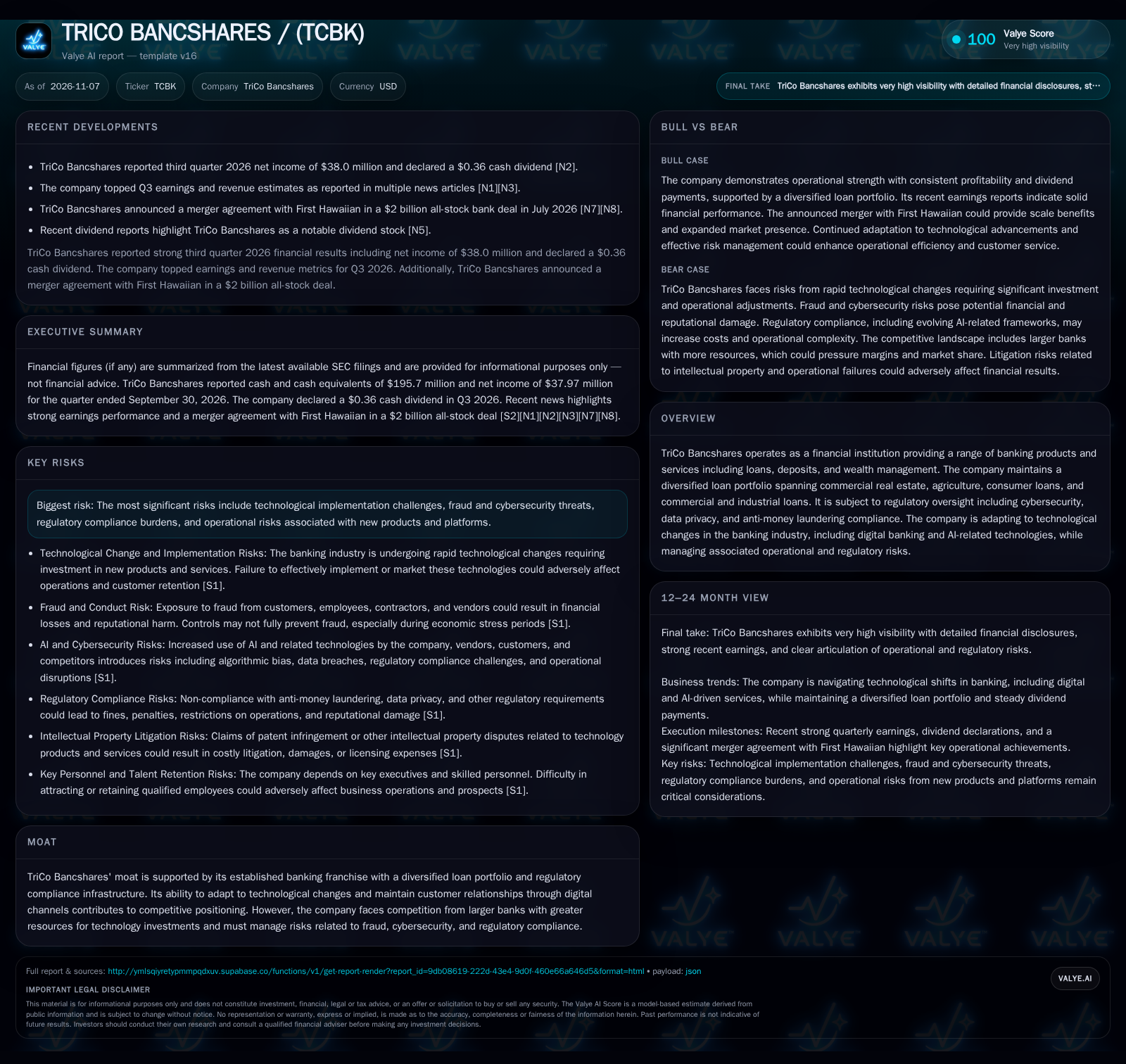
TriCo Bancshares reported net income of $38.0 million for Q3 2026, with cash and cash equivalents at $195.7 million as of September 30, 2026 [N2] [S2]. The company declared a $0.36 per share dividend for the quarter, maintaining its track record of shareholder payouts [N2] [N5]. Notably, TriCo’s loan portfolio remains broad, spanning commercial real estate, agriculture, consumer loans (including home equity and single-family mortgages), commercial and industrial loans, construction lending, and finance leases [S2]. This diversification provides some buffer against sector-specific shocks, but also exposes the company to a wide range of credit and operational risks. Recent news coverage highlights that TriCo topped Q3 earnings and revenue expectations, reinforcing operational momentum heading into year-end [N1] [N3].
How TriCo’s Revenue Streams and Cost Structure Could Shift in a Digital Banking Era
TriCo’s core economic engine is net interest income derived from its diversified loan book, supplemented by fee-based offerings such as deposit services and wealth management. The breadth of its lending activities—commercial, agricultural, consumer, and industrial—provides some margin stability, as credit cycles and rate environments affect these segments differently.
However, as with most regional banks, TriCo’s operating leverage is sensitive to both interest rate volatility and the fixed costs of compliance, technology, and branch infrastructure. The push toward digital banking introduces new fixed and variable costs: technology investments, cybersecurity, digital product development, and ongoing regulatory compliance. These expenditures could compress efficiency ratios if not offset by revenue growth or cost reductions elsewhere.
Deposit pricing and retention also become more competitive in a digital-first landscape, where switching friction is lower and rate-sensitive customers can move funds rapidly. While TriCo’s legacy relationships may support some pricing power locally, larger banks and fintechs with superior digital platforms could erode traditional advantages unless TriCo accelerates its own technology adoption.
Competitive Pressures Intensify as Larger Banks and Fintechs Redefine Customer Expectations
TriCo’s established franchise, diversified loan portfolio, and regulatory compliance infrastructure provide a measure of stability and local customer loyalty. However, the competitive landscape is shifting as national banks and fintech entrants deploy more advanced digital products, AI-driven underwriting, and seamless user experiences.
Larger banks benefit from economies of scale in technology investment, marketing, and compliance, enabling them to roll out new features and risk controls more rapidly than regional peers. Fintechs, meanwhile, often target niche customer segments with frictionless onboarding and personalized services, raising the bar for customer expectations.
TriCo’s ability to defend or grow its market share will depend on its capacity to modernize digital channels, enhance data security, and deliver competitive products without diluting margins or exposing the bank to outsized operational risks. The risk of customer attrition rises if TriCo’s digital offerings lag or if regulatory or cybersecurity incidents erode trust.
If Digital Investments Drive Efficiency and Customer Growth, Margin Expansion Is Plausible
A favorable scenario for TriCo would see technology investments yielding measurable gains in operating efficiency, customer acquisition, and retention. If digital banking platforms attract younger and more tech-savvy customers—while enhancing cross-sell of deposit and loan products—TriCo could achieve revenue growth that outpaces the incremental costs of digital transformation.
Margin expansion could materialize if automation reduces back-office expenses, and if improved data analytics enable better risk pricing and credit selection. Enhanced cybersecurity and compliance frameworks would be necessary to support this growth without increasing exposure to fraud or regulatory penalties.
Evidence that would confirm this scenario includes accelerating digital account openings, higher fee income from digital channels, improvement in efficiency ratios, and sustained or improved net interest margin despite technology outlays. Conversely, persistent cost inflation, customer attrition, or regulatory setbacks would undermine the upside thesis.
Franchise Stability Persists, but Margin Pressure Gradually Builds Amid Ongoing Tech Transition
The bank continues to serve its core markets effectively, leveraging established customer relationships and regulatory discipline.
However, as customer expectations shift toward digital-first solutions, TriCo is compelled to invest in technology, cybersecurity, and compliance at a pace that may outstrip near-term revenue benefits. This could result in a modest deterioration in efficiency ratios and flat to slightly declining net interest margins, unless offset by loan growth or successful fee-generation initiatives.
Confirmation of this scenario would include continued profitability, stable (but not expanding) dividends, rising technology and compliance expenses, and mixed progress in digital adoption metrics. A falsifier would be either a rapid acceleration in digital engagement and margins, or a sharp deterioration in credit quality or regulatory standing.
Technology Stumbles or Regulatory Setbacks Could Trigger Margin Compression and Franchise Erosion
In a negative scenario, TriCo struggles to keep pace with the technology curve, leading to customer attrition, elevated fraud or cybersecurity losses, and escalating compliance costs. If digital banking rollouts are delayed or poorly executed, the bank risks losing deposit share to larger and more agile competitors, while still bearing the fixed costs of legacy infrastructure.
A significant cybersecurity incident, regulatory fine, or operational failure related to new product launches could amplify reputational damage and trigger higher expenses for remediation and litigation. In this environment, net interest margin could compress further, dividend stability could come into question, and the company might need to scale back growth initiatives or raise additional capital.
Downside confirmation would include rising credit losses, declines in core deposits, negative operating leverage (cost growth outpacing revenue), and any disclosure of material regulatory or cybersecurity events. Conversely, resilience in customer metrics and successful digital adoption would challenge this scenario.
What Will Determine TriCo’s Digital Banking Trajectory and Margin Sustainability?
Digital account origination and digital transaction volume growth—if disclosed—would provide evidence of customer adoption and competitive positioning.
Efficiency ratio trends, especially as technology and compliance spending rises, will signal whether digital investments are translating into productivity gains.
Net interest margin evolution in the face of changing deposit pricing dynamics and loan mix shifts will be crucial to watch.
Credit quality metrics (e.g., non-performing loans, charge-offs) are essential, given the breadth of the loan portfolio and potential sector-specific stress.
Trends in core deposit balances and customer retention rates will indicate franchise resilience as digital competition intensifies.
Any material cybersecurity or regulatory compliance incidents, including litigation or fines, would directly impact operational risk and reputation.
Talent recruitment and retention in technology and compliance roles—if disclosed—may affect TriCo’s ability to accelerate its digital transformation.
Disclaimer: This is research-only, informational analysis and not investment advice. It may include AI-generated interpretation and general industry context. Always verify important details using primary sources.

Comments