
BankUnited's Capital Returns and Earnings Stability Mark 2025 Financial Results
BankUnited, Inc. maintained steady net income and enhanced shareholder returns through dividend payments and share repurchases in 2025.
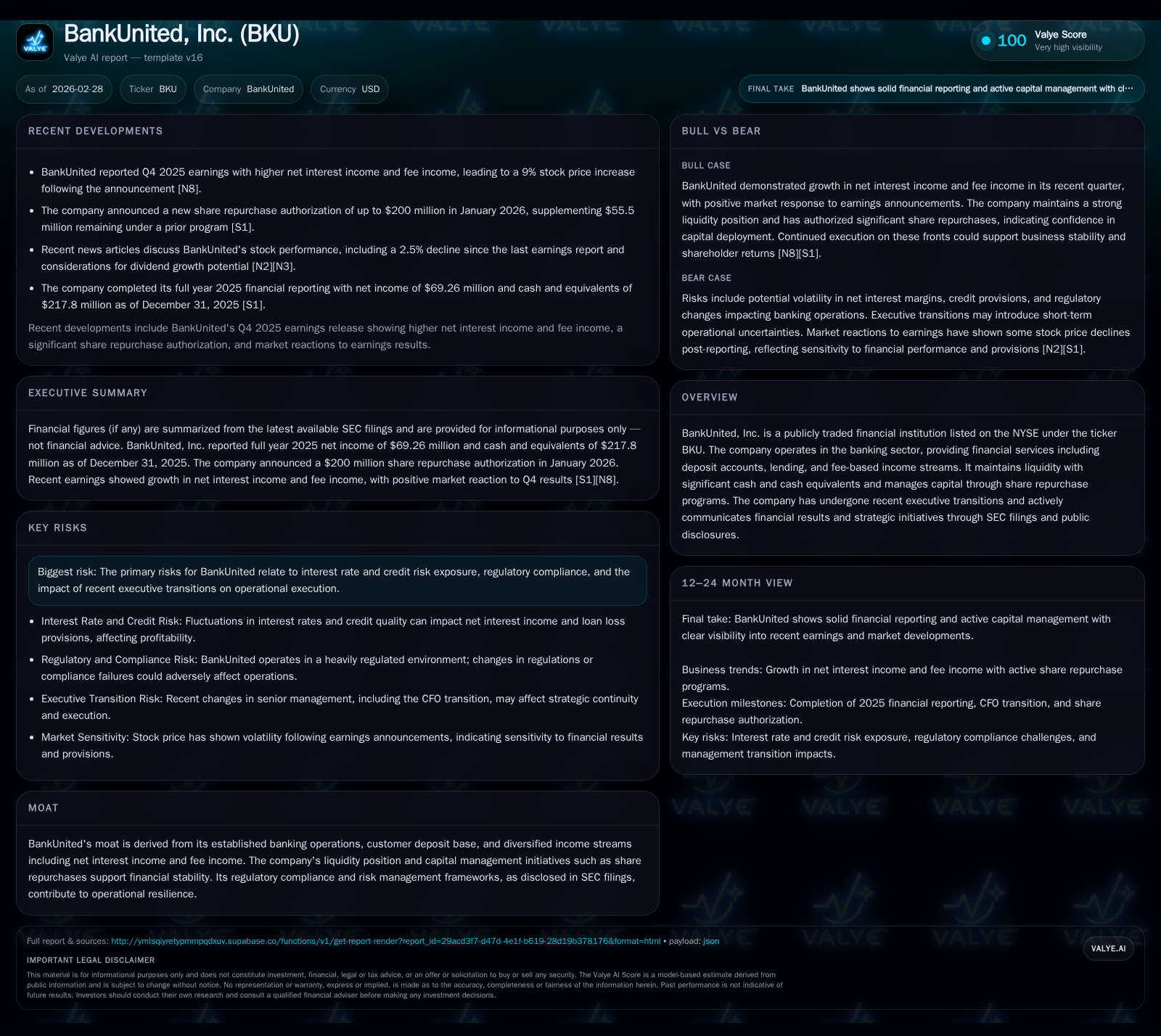
BankUnited posted nearly flat net income in 2025 at approximately $69.3 million, continuing a pattern of earnings stability after a significant increase from 2023 levels. Operating cash flow declined year-over-year, but free cash flow remained robust. The company sustained disciplined capital allocation, increasing dividends and resuming share repurchases after a pause in 2024. Executive leadership transitioned in late 2025, potentially impacting operational continuity. Future growth depends on managing interest rate and credit risks amid regulatory demands.
Overview
BankUnited, Inc. (NYSE: BKU) operates primarily as a financial services provider delivering deposit accounts, lending solutions, and fee-based services. Throughout 2025, the company demonstrated financial steadiness amid competitive banking industry dynamics by maintaining stable net income and focusing intensely on capital return measures such as dividends and buybacks. The firm also navigated leadership changes that could influence future operational execution.
Historical Performance
Examining BankUnited’s financial trajectory over recent years reveals important trends. The company’s net income surged profoundly from $20.8 million in FY2023 to roughly $69.3 million by FY2024 — an indication of meaningful improvements possibly driven by expanded loan portfolios or higher net interest margins. However, from FY2024 to FY2025, net income remained flat at about $69.26 million ([F1]), suggesting a stabilization phase.
Operating cash flow metrics reflect more volatility. In FY2025, CFO fell approximately 17% to around $358.6 million compared with the prior year’s $433.8 million ([F1]). This decline could be attributed to changes in working capital or shifts in loan repayments versus originations — key factors for banks managing liquidity amid fluctuating interest rates.
Capital expenditures are modest relative to cash flows; the latest available figure is roughly consistent with prior years' low capex levels ([F1]). The calculated free cash flow (CFO minus capex) remains strong at about $335 million for FY2025.
The bank's equity base expanded steadily from approximately $2.44 billion in 2022 to over $3 billion by end-2025 ([F1]), underpinning its capacity for growth and regulatory capital requirements.
Historical performance (annual)
| FY | Net ($mm) | CFO ($mm) | Net YoY |
|---|---|---|---|
| 2025 | 69 | 359 | -0.1% |
| 2024 | 69 | 434 | +233.0% |
| 2023 | 21 | 657 | -67.6% |
| 2022 | 64 | 1294 |
Source: SEC companyfacts cache [F1].
Capital returns and efficiency (annual)
| FY | Div ($mm) | Buybacks ($mm) | ROE% |
|---|---|---|---|
| 2025 | 92 | 45 | 2.3 |
| 2024 | 86 | 0 | 2.5 |
| 2023 | 79 | 55 | 0.8 |
| 2022 | 79 | 401 | 2.6 |
Source: SEC companyfacts cache [F1].
Note: Capex values are not shown due to lack of recent annual data.
Capital Allocation and Returns
Capital stewardship emerged as a notable theme during the fiscal year ended December 31, 2025:
- Dividend payouts increased modestly from $85.5 million in FY24 to nearly $92 million in FY25 ([F1]).
- After a pause on share repurchases during much of FY24, BankUnited resumed buybacks totaling approximately $44.8 million by end-2025 ([F1]).
- Importantly, an additional share repurchase authorization for up to $200 million was granted by the Board early in January 2026 without a defined timeline ([S9]).
These moves indicate a commitment to returning capital while preserving flexibility given evolving market conditions.
The approximate return on equity (ROE) stands near a restrained level of roughly 2.3%, calculated from net income relative to shareholders’ equity ([F1]). While modest compared to larger national banks or peer regional players with higher ROEs, this figure aligns with BankUnited’s conservative capital posture.
Executive Leadership Changes
A significant development occurred when long-serving Chief Financial Officer Leslie N. Lunak stepped down effective November 10, 2025 following a tenure since at least 2013 ([S25]). Leslie Lunak transitioned into advisory roles through early January then beyond as Special Advisor under specific terms affecting equity awards and restrictive covenants ([S20], [S24]).
Her successor James G. Mackey joined earlier mid-2025 as Senior EVP of Finance before officially assuming CFO duties upon Lunak’s departure ([S25], [S26]). This leadership handover represents a pivotal point that may influence BankUnited’s strategic financial management going forward.
Liquidity & Capital Structure
At fiscal year-end December 31, BankUnited maintained substantial liquidity with cash and equivalents totaling approximately $217.8 million ([F1]). This sizeable liquidity buffer supports lending capacity and regulatory requirements.
The company successfully redeemed its entire outstanding $400 million senior notes due in August of the prior year ahead of maturity within agreements outlined earlier ([S16], [S18]). This repayment reduces debt leverage risk though the company continues managing debt carefully as per disclosures.
Continued strong capitalization is evidenced by growing shareholder equity now exceeding $3 billion ([F1]), helping absorb potential loan losses or economic downturn effects.
Risk Environment
BankUnited identifies key risks typical for commercial banks focused on retail deposits and lending:
- Interest rate fluctuations impacting net interest margins,
- Credit risk exposure related to borrower performance,
- Regulatory compliance complexity,
- Risks associated with executive management transitions affecting continuity ([S4], [S5], [S7]).
The firm emphasizes robust risk management frameworks embedded across underwriting and compliance functions; however, external macroeconomic factors remain critical variables influencing future performance.
Growth Opportunities and Challenges
Looking ahead, BankUnited has potential levers for revenue growth including:
- Expansion of net interest income driven by rising or sustained interest rates,
- Growth of fee-based offerings reflecting broader customer engagement,
- Continued leveraging core deposit bases within its regional footprint.
That said, external constraints such as tightening credit conditions or competitive pressures primarily from larger institutions may cap return expansion.[N7], [N8]
Quarterly earnings reports preceding full-year results noted positive trends in net interest income alongside increased provision expenses reflecting cautious credit risk management [N7],[N13]. Investors often gauge these moves cautiously due to tradeoffs between growth ambitions and risk control.
Conclusion
BankUnited's fiscal year ended December 31, 2025 reflected measured progress characterized by earnings stabilization after sharp prior gains alongside deliberate capital returns via dividends and new share repurchase authorizations.[F1],[S9] Leadership transitions at the CFO level concluded smoothly but bear watching for strategic impact.[S25] Sustained liquidity reserves underpin stability while ongoing regulatory compliance efforts navigate sector complexities.[S4]
Future developments worth monitoring include BankUnited’s ability to grow core interest income despite tightening credit conditions,[N7] potential impacts from macroeconomic headwinds,[N2] and effective execution under new financial leadership.
This analysis summarizes publicly available information including SEC filings (Forms 10-K, Qs, and current reports), recent investor communications and reputable news sources referenced herein without expressing investment opinions or recommendations.
Disclaimer: This is research-only, informational analysis and not investment advice. It may include AI-generated interpretation and general industry context. Always verify important details using primary sources.

Comments