
CEA Industries: BNB-Focused Digital Asset Treasury Meets Execution and Ecosystem Risk
CEA Industries’ strategic pivot toward BNB token treasury management offers unique public market exposure to the Binance blockchain, but exposes the company to pronounced digital asset volatility, ecosystem concentration, and operational uncertainty amid leadership and legal transitions.
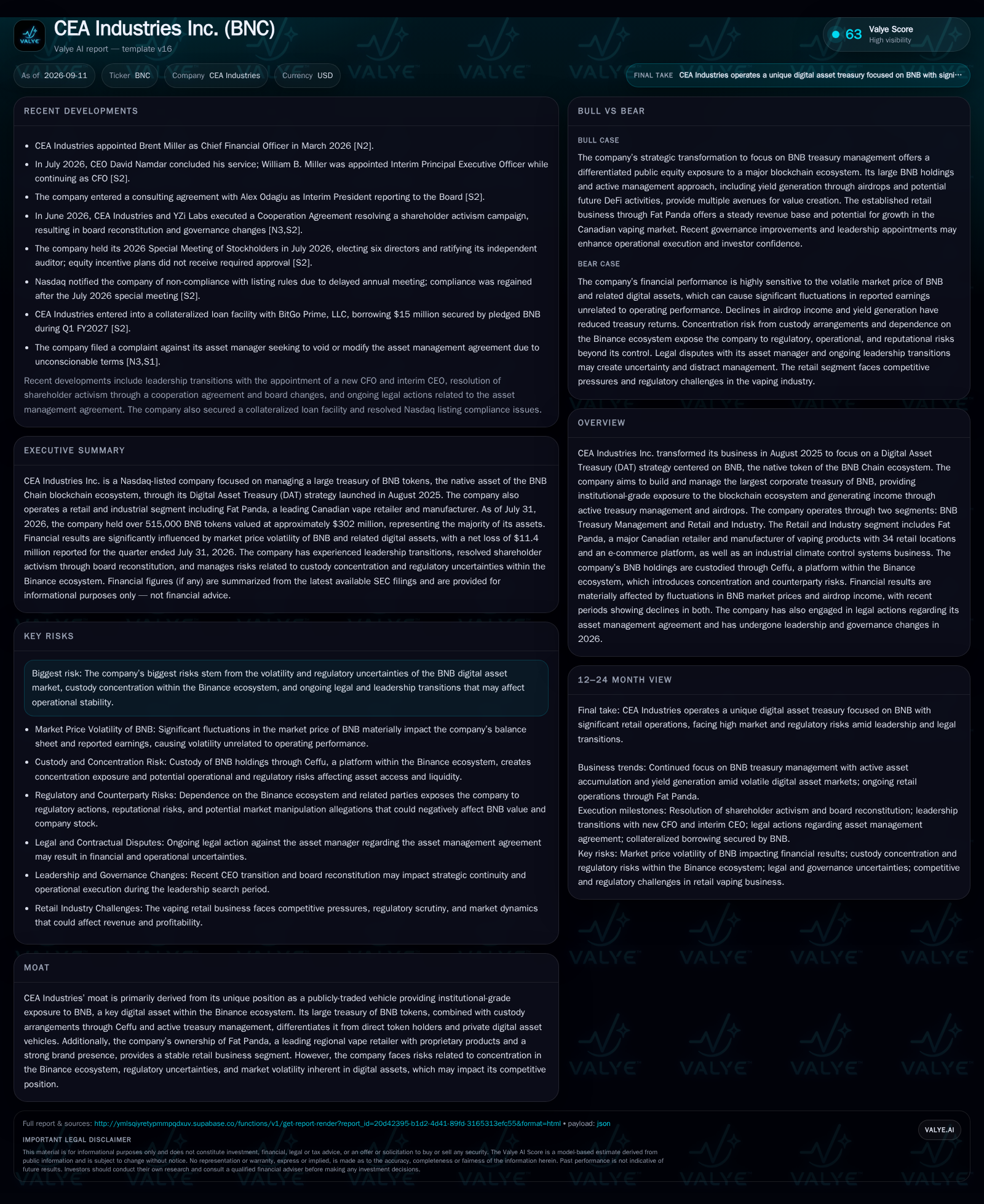
CEA Industries now operates as a hybrid digital asset treasury and retail conglomerate, holding over 515,000 BNB tokens (valued at ~$302 million as of July 31, 2026) as the core of its new strategy. Financial outcomes are tightly linked to BNB market movements and airdrop income, with the most recent quarter showing an $11.4 million net loss. Risks are amplified by custody concentration within the Binance ecosystem, ongoing legal disputes regarding asset management, and leadership turnover. The Fat Panda retail segment provides diversification but faces its own regulatory and market headwinds. The thesis pivots on whether CEA can deliver sustainable yield and manage counterparty and regulatory exposures inherent to its digital asset focus. [S2]
CEA Industries Inc. has undergone a substantial transformation, shifting from a diversified industrial operator to a digital asset-centric enterprise focused on building and managing the largest BNB treasury among public companies. This pivot, initiated in August 2025, positions CEA as a unique vehicle for institutional exposure to the Binance blockchain ecosystem, but also binds its fortunes to the volatile BNB token and the operational stability of the Binance/Ceffu infrastructure. With recent leadership changes, board reconstitution after shareholder activism, and legal disputes over asset management agreements, the company faces both significant upside potential and pronounced execution, regulatory, and ecosystem risks. The Fat Panda retail business offers diversification, but the core value proposition now rests on the success and resilience of the BNB treasury strategy. [S2]
BNB Treasury Strategy Redefines Asset Base and Risk Exposure
CEA Industries’ business model is now dominated by its digital asset treasury strategy, with over 515,000 BNB tokens (valued at approximately $302 million as of July 31, 2026) comprising the majority of its assets. This concentration has made the company’s financials highly sensitive to BNB price volatility, as evidenced by a reported net loss of $11.4 million for the quarter ended July 31, 2026. [S2]
The company’s BNB is custodied via Ceffu, an entity within the Binance ecosystem, introducing material concentration and counterparty risks. Any operational or regulatory disruption at Binance or Ceffu could severely impact CEA’s asset access and liquidity.
Recent corporate developments include executive turnover—CEO David Namdar’s departure and William B. Miller’s interim CEO appointment—board reconstitution after shareholder activism, and ongoing legal action to modify or void an asset management agreement perceived as unfavorable. [S2] [N2] [N3]
To enhance liquidity, CEA entered a $15 million collateralized loan facility with BitGo Prime, secured by its BNB holdings, further intertwining its capital structure with digital asset valuations. [S2]
How CEA Industries Could Generate Value from a Digital Asset Treasury
CEA Industries’ economics are now determined largely by the appreciation, yield, and liquidity of its BNB holdings. The company seeks to generate income through active treasury management—including capturing airdrops and potentially participating in decentralized finance (DeFi) protocols. However, the report notes recent declines in both BNB prices and airdrop income, highlighting the inherent volatility and unpredictability of digital asset yield sources. [S2]
Unlike a traditional operating business, CEA’s revenue and earnings can fluctuate dramatically based on external market dynamics rather than internally controlled operations or customer demand. This limits the effectiveness of traditional operating leverage, as fixed costs may not be offset by predictable revenue streams.
The collateralized loan facility with BitGo Prime suggests that CEA is willing to use leverage to enhance capital efficiency or fund operations. If BNB prices decline, however, margin calls or forced asset sales could amplify downside risk.
The Fat Panda retail and manufacturing segment offers a more conventional revenue base, with potential for positive cash flow and steadier economics. However, this segment is exposed to regulatory scrutiny, shifting consumer preferences, and competitive pricing pressures characteristic of the vaping industry.
Unique Public Proxy for BNB Exposure, but Ecosystem Risks Loom Large
CEA Industries’ primary competitive differentiation is its status as a publicly traded vehicle offering institutional-grade exposure to BNB, a top-5 blockchain token by market capitalization. This positioning is difficult for most public companies to replicate, as it requires both risk tolerance and specialized digital asset infrastructure.
However, this uniqueness is double-edged: the company’s moat is inextricably tied to the success, regulatory posture, and operational resilience of the Binance ecosystem. Any regulatory crackdown, technical failure, or reputational damage at Binance or Ceffu could undermine CEA’s core value proposition.
In the retail segment, Fat Panda’s scale (34 locations plus e-commerce) and proprietary branding provide some regional advantage, but the Canadian vaping market is highly competitive and subject to evolving legal restrictions. Larger retail chains, online platforms, and regulatory interventions all represent ongoing threats.
Ultimately, CEA’s defensibility relies on its ability to manage digital asset-specific operational, regulatory, and counterparty risks more effectively than potential imitators or direct token holders.
BNB Ecosystem Growth and Yield Innovation Drive Outperformance
If BNB appreciates materially and the Binance ecosystem remains robust, CEA’s NAV could rise rapidly, providing both asset appreciation and the potential for increased yield from airdrops or participation in new DeFi protocols. The public equity wrapper could attract institutional investors seeking compliant, liquid exposure to digital assets without direct custody or regulatory complexity.
A favorable resolution to the asset management legal dispute could improve cost efficiency and allow for more agile treasury operations. If Fat Panda sustains or grows its cash flow, it may further stabilize overall results.
Evidence confirming this scenario would include: consistent growth in BNB price and ecosystem activity; rising airdrop/yield income; successful onboarding of additional institutional investors; and improved operating margins or revenue growth from the retail segment.
Navigating BNB Volatility While Maintaining Dual-Segment Stability
The most plausible scenario is continued high sensitivity to BNB price volatility and airdrop income, with periodic swings in reported earnings. Fat Panda provides some diversification, but its contribution is likely to remain secondary relative to the digital asset treasury.
Operational execution could improve with leadership stabilization and legal issues resolved, but the company will remain exposed to Binance ecosystem risks and regulatory scrutiny. Leverage from the BitGo Prime loan may enhance returns in stable or rising markets but introduces additional risk if BNB prices fall sharply.
This scenario would be confirmed by ongoing earnings volatility tied to BNB, modest but positive retail segment performance, and incremental progress in resolving legal and governance uncertainties.
Ecosystem Disruption or Regulatory Shock Triggers Value Erosion
A major regulatory intervention against Binance or Ceffu, loss of custody access, or a sharp decline in BNB price could rapidly erode CEA’s asset base and trigger liquidity or solvency challenges—especially given the collateralized loan structure.
If legal disputes remain unresolved or governance instability persists, operational distractions could compound the impact of adverse market events. In the retail segment, new vaping regulations or intensifying competition could compress margins or force store closures.
This outcome would be confirmed by substantial declines in reported NAV, forced asset sales, legal or regulatory disclosures indicating material risk to asset access, or negative developments in Fat Panda’s revenue and profitability.
Milestones That Will Define CEA Industries’ BNB-Driven Thesis
Quarterly changes in BNB holdings and their USD value, including any net accumulation, disposition, or impairment events.
Airdrop and yield income from BNB and related digital asset activities—if disclosed, tracking both level and sustainability would help test yield-generation assumptions.
Operational and regulatory developments at Binance and Ceffu, including any changes to custody arrangements, legal status, or access terms.
Progress and resolution of the asset management agreement legal dispute, including any cost savings or operational flexibility gained.
Leadership continuity and the outcome of the CEO search, as well as board composition stability following recent activism.
Fat Panda segment performance—store count, same-store sales, e-commerce growth, and regulatory headwinds in the Canadian vaping market.
Utilization and terms of the BitGo Prime collateralized loan, especially in response to BNB price fluctuations and potential margin calls.
Disclosure of risk management frameworks or contingency plans for digital asset custody, regulatory, or operational disruptions.
Disclaimer: This is research-only, informational analysis and not investment advice. It may include AI-generated interpretation and general industry context. Always verify important details using primary sources.

Comments