
Liberty Star Uranium & Metals: Exploration Ambition Collides with Funding and Resource Uncertainty
With early-stage drilling showing geological promise but no confirmed reserves, Liberty Star Uranium & Metals faces a classic junior mining dilemma: capital scarcity, technical risk, and the long road from mineralization hints to commercial extraction.
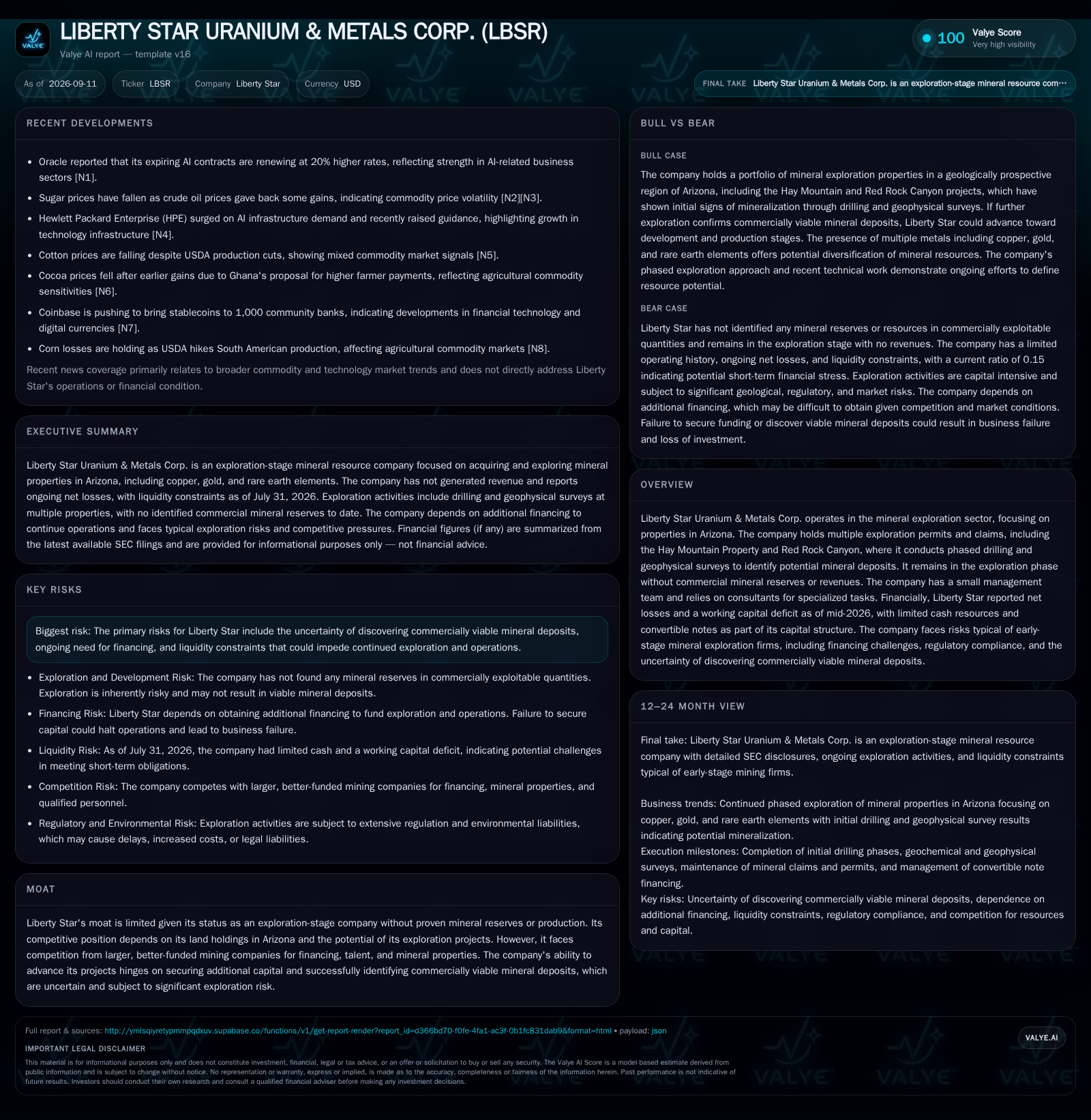
Liberty Star Uranium & Metals Corp. holds mineral exploration properties in Arizona, including Hay Mountain and Red Rock Canyon, where initial exploration indicates potential but no proven commercial reserves. The company has not generated revenue, posts ongoing net losses, and faces acute liquidity constraints as of July 2026. Its future depends on securing additional financing and successfully advancing exploration to resource definition—a path fraught with geological and financial risk. Investors face a high-risk, high-uncertainty proposition typical of early-stage mineral explorers [S1] [S2].
Liberty Star Uranium & Metals Corp. exemplifies the speculative nature of junior mineral explorers: it controls promising land in Arizona and has surfaced initial geological signals of copper and gold mineralization, yet remains far from confirming a commercially viable resource. The company’s acute funding shortfall, reliance on convertible debt, and lack of revenue highlight the existential risks facing pre-resource explorers. The outcome will hinge on Liberty Star’s ability to both attract new capital and deliver tangible exploration milestones—each a significant challenge in today’s capital markets [S1] [S2].
Early Drilling Results and Liquidity Constraints Define the Present
As of September 2026, Liberty Star Uranium & Metals remains firmly in the exploration stage, with no commercial mineral reserves identified and no operating revenues. The company’s Hay Mountain project has completed two initial drill holes; one encountered alteration and mineralization consistent with a copper porphyry system, suggesting geological potential but not yet establishing economic viability. At Red Rock Canyon, rock chip sampling and geophysical surveys indicate possible gold mineralization, but these remain preliminary signals [S1] [S2].
Financially, Liberty Star’s position is precarious. At July 31, 2026, cash and cash equivalents were just $42,272, with total current assets of $89,209 against current liabilities of $594,264, resulting in a current ratio of 0.15 and a cash ratio of 0.07. The company reported a net loss of $289,301 for the quarter and $404,296 for the half year, and continues to rely on convertible promissory notes to fund operations [S2]. These facts underscore both the technical uncertainty and financial fragility that currently define Liberty Star’s outlook.
Exploration Economics: High Fixed Costs, No Revenue, and Capital Intensity
Liberty Star’s business model is typical of junior mineral explorers: value is created by acquiring prospective land, conducting geological and geophysical work, and seeking to delineate a resource that can either be developed or sold to a larger partner. The economics at this stage are entirely negative—exploration activities such as drilling, sampling, and permitting are capital-intensive with no offsetting operating income. Fixed costs include annual land payments, regulatory compliance, and a small but necessary technical and administrative team, while variable costs scale with exploration activity.
The company’s funding needs are acute and ongoing. With no revenue and negative cash flow, Liberty Star is dependent on periodic capital raises—typically through equity or convertible debt. The use of convertible promissory notes introduces dilution risk, particularly if new equity is issued at distressed valuations. There is no operating leverage until (and unless) a resource is delineated and advanced to development, at which point the economics shift dramatically but require far larger capital commitments. Until then, the company’s financial trajectory is defined by cash burn, funding gaps, and the binary risk of exploration success or failure.
Land Position and Project Pipeline Versus Sector Headwinds
Liberty Star’s main competitive asset is its portfolio of mineral claims in Arizona, a geologically prospective region for copper, gold, and rare earth elements. The Hay Mountain permits and Red Rock Canyon sampling results offer potential diversification and optionality if meaningful discoveries are made. However, as an exploration-stage company, Liberty Star lacks the scale, technical depth, and financial resources of major mining peers. It competes for both capital and talent against larger, better-funded companies and faces the ever-present risk of losing ground to competitors with stronger balance sheets or more advanced projects.
The company’s ability to maintain its land package and advance exploration is constrained by its financial position. If Liberty Star cannot keep up with required claim payments or meet work commitments, it risks forfeiting key assets. The broader sector is also highly cyclical—investor appetite for early-stage exploration fluctuates with commodity prices, risk tolerance, and capital market conditions. Furthermore, substitutes are not direct (since mineral deposits are unique), but the opportunity cost for investors is high, with many competing exploration stories globally.
A Discovery Breakthrough and Funding Influx Could Transform Prospects
The most favorable outcome for Liberty Star would be the confirmation of a commercially viable mineral resource at Hay Mountain or Red Rock Canyon. If further drilling validates significant copper or gold mineralization, the company could attract interest from strategic partners or larger mining companies, enabling either a joint venture, asset sale, or a substantial equity raise at more favorable terms. This path would require clear, repeatable drill results showing size, grade, and continuity of mineralization, followed by a technical report (such as a 43-101 resource estimate) to support project advancement.
Confirmation of such a discovery would likely be accompanied by a re-rating of the company’s shares and improved access to capital. Evidence supporting this scenario would include: successful multi-hole drilling campaigns with strong assay results, release of a formal resource estimate, new investment by reputable mining funds or industry players, and a balance sheet shift from convertible debt to equity funding. Conversely, continued inconclusive drill results or inability to finance additional exploration would quickly falsify this scenario.
Incremental Progress with Persistent Risk and Funding Pressure
The most plausible path for Liberty Star is a continuation of incremental exploration, punctuated by periodic funding rounds and operational delays. The company may complete additional drilling phases at Hay Mountain and Red Rock Canyon, potentially generating more geological data but not yet achieving a resource large enough to justify development or partnership. In this scenario, Liberty Star remains in the pre-revenue stage, with ongoing net losses and liquidity constraints necessitating further convertible note issuance or discounted equity raises.
This middle path would be confirmed by slow but steady technical updates (e.g., additional drill holes, sampling programs), continued regulatory filings showing negative cash flow, and frequent disclosures regarding financing efforts. Falsification would occur if the company either fails to secure the capital needed to maintain operations, leading to asset forfeiture or bankruptcy, or if a breakthrough discovery propels it into the upside scenario.
Funding Shortfall and Exploration Disappointment Trigger Value Erosion
The adverse scenario is one where Liberty Star is unable to secure sufficient financing to continue exploration or maintain its claims. Given the current cash and working capital deficit, even modest delays or cost overruns could force the company to suspend operations, relinquish key properties, or restructure under duress. If further exploration fails to deliver meaningful mineralization, investor support could evaporate, leaving the company unable to service its convertible debt or pay required fees.
Evidence of this outcome would include: missed claim payments, abrupt reductions in exploration activity, default or distressed restructuring of convertible notes, and a lack of substantive technical progress in public disclosures. A sharp drop in reported cash balances or the absence of new financing announcements would further confirm this scenario.
Milestones to Test the Liberty Star Exploration and Funding Thesis
Results from ongoing and future drilling campaigns at Hay Mountain and Red Rock Canyon—especially assays and geological interpretations that might indicate a resource of interest.
Cash burn rate and quarter-end cash balances, which will show whether Liberty Star is approaching a funding cliff or has secured new capital (if disclosed).
Status of claim and permit payments; evidence of forfeiture or distress here would be a major red flag.
Updates on convertible note conversions, terms, and any new financing arrangements, especially if they imply severe dilution or distressed conditions.
Release of any technical reports (e.g., NI 43-101 resource estimates), which would signal progress toward resource definition and potential de-risking.
Management disclosures regarding joint venture discussions, asset sales, or strategic partnerships.
Regulatory filings or press releases concerning environmental or permitting setbacks, which could materially delay or halt exploration.
If disclosed, the composition and turnover of the technical team and consultants, as loss of key expertise could hinder project advancement.
Disclaimer: This is research-only, informational analysis and not investment advice. It may include AI-generated interpretation and general industry context. Always verify important details using primary sources.

Comments