
Reformation Inc.: Brand Loyalty, Sustainability Premium, and the Test of Discretionary Demand
Reformation’s financial health and customer retention position it well in the sustainable fashion segment, but economic sensitivity and supply chain complexity remain persistent challenges. The next phase hinges on converting brand equity into resilient, margin-accretive growth while navigating operational and reporting risks.
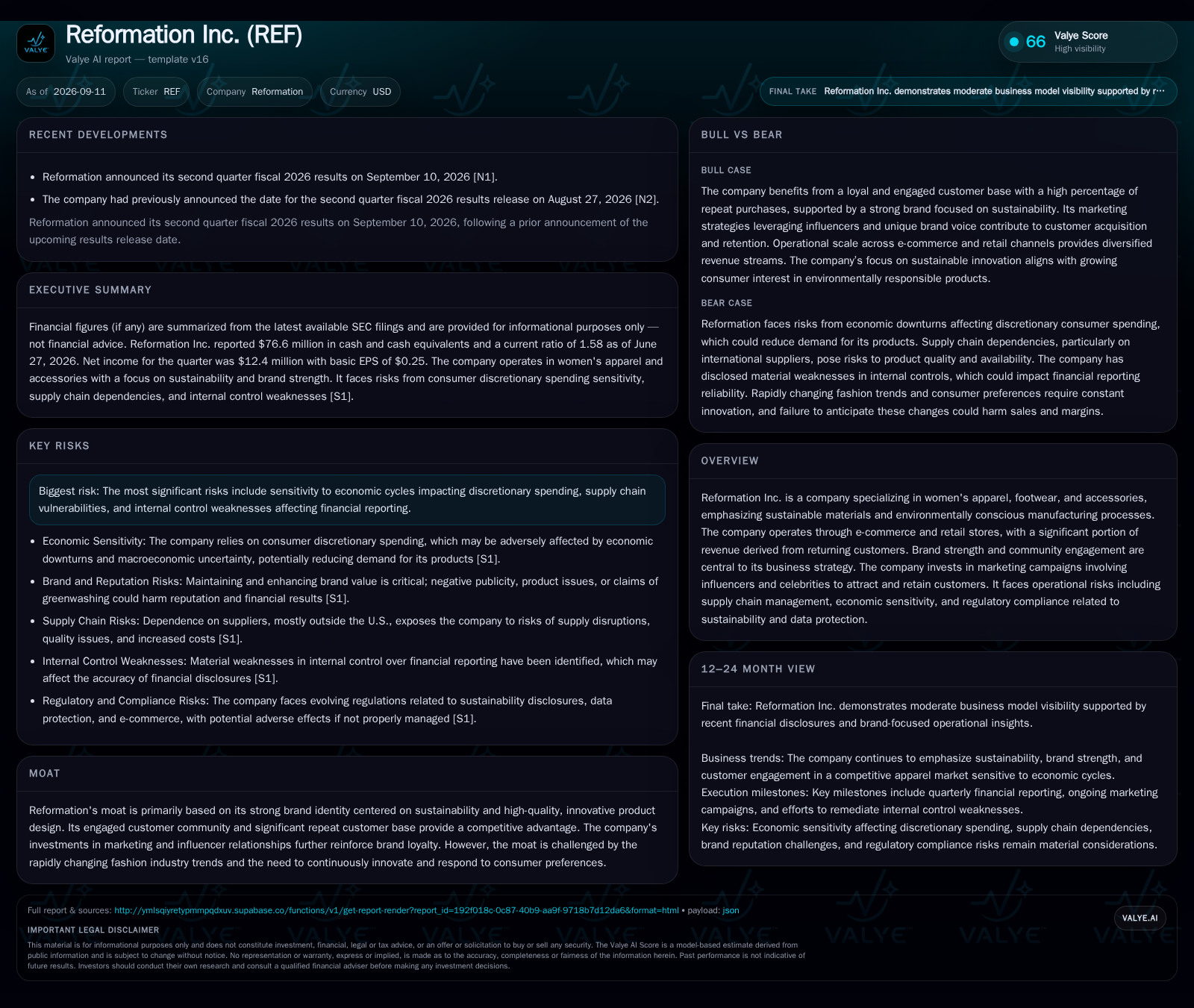
Reformation Inc. reported $12.4 million in net income for the June 2026 quarter, with substantial repeat purchases (nearly 70% of DTC net revenue in 2025) and $76.6 million in cash. The brand’s sustainability focus and marketing investment underpin customer loyalty, but macroeconomic exposure, supply chain reliance, and material internal control weaknesses present ongoing risks. The company’s ability to sustain growth and margins amid these headwinds will be the central test over the next 12-24 months. [S1] [N1]
Reformation Inc. stands at a crossroads familiar to disruptive consumer brands: its strong sustainability ethos and high repeat-customer revenue suggest robust brand equity, yet its exposure to macroeconomic cycles and operational risks could test its durability. With $12.4 million in quarterly net income and a solid cash position, the company’s immediate financial footing appears sound. However, the interplay between discretionary demand, supply chain complexity, and the need to address internal control weaknesses will define whether Reformation can translate its current momentum into sustainable, scalable profitability. The next year will reveal if its brand-centric strategy can withstand the volatility inherent in both fashion and global consumer spending.
Recent Financials and Customer Retention Set the Stage
Reformation Inc. reported net income of $12.4 million for the quarter ended June 27, 2026, with basic earnings per share of $0.25 and a diluted EPS of $0.23. The company’s cash and cash equivalents stood at $76.6 million, and the current ratio was 1.58, indicating adequate liquidity for near-term obligations. Notably, returning customers contributed nearly 70% of direct-to-consumer net revenue in 2025, underscoring high customer loyalty and the importance of brand engagement to the business model. These facts suggest a brand with immediate financial stability and a loyal customer base, but also highlight the premium placed on sustained consumer attachment in a cyclical sector. [S1] [N1]
How Sustainability and Brand Drive Reformation’s Margin Equation
Reformation’s business generates revenue through both e-commerce and retail channels, targeting fashion-forward women seeking sustainable apparel and accessories. The economics of this model depend on the company’s ability to charge a premium for environmentally conscious products, supported by brand differentiation and strong marketing spend. Fixed costs include retail leases, logistics, and technology infrastructure, while variable costs are driven by sourcing, production, and fulfillment. The high percentage of repeat purchases implies lower customer acquisition costs over time, potentially supporting higher margins if retention persists.
Operating leverage is plausible as the company scales, especially if store productivity and e-commerce conversion rates improve. However, sustainability initiatives—such as using eco-friendly materials and ethical manufacturing—can inflate cost of goods sold relative to traditional fast fashion, putting pressure on gross margins unless consumers remain willing to pay a premium. The company’s expansion into new markets and continued investment in brand and technology will require ongoing capital, but the current balance sheet provides flexibility for measured growth. If discretionary spending weakens, the business could face negative operating leverage, with fixed costs outpacing revenue.
A critical dimension in Reformation’s margin dynamics is the elasticity of consumer willingness to pay a sustainability premium amid varying economic conditions. If consumers prioritize eco-consciousness even during downturns, the company may sustain pricing power; however, if price sensitivity increases, the premium could compress, pressuring margins. Additionally, the interplay between fixed and variable costs suggests that scale benefits hinge on efficient supply chain management and inventory optimization. Any inefficiencies or excess inventory could exacerbate margin volatility. The company’s investment in technology infrastructure might also enable better demand forecasting and customer personalization, potentially reducing acquisition costs and improving conversion rates, which are essential levers for margin enhancement.
Brand, Community, and the Challenge from Fast Fashion and Luxury
Reformation’s primary competitive advantage lies in its brand identity—rooted in sustainability, quality, and community engagement. The company’s significant repeat customer revenue is a positive indicator of switching frictions, as consumers invested in the brand’s values may be less likely to defect to competitors. Marketing via influencers and celebrities amplifies brand reach and aspirational appeal, supporting customer acquisition and reinforcing loyalty.
However, the brand operates in a crowded market where fast fashion players can undercut on price and established luxury brands can compete on design and exclusivity. The proliferation of sustainability claims across the industry erodes the uniqueness of Reformation’s positioning, making continued innovation and credibility in environmental practices critical. The risk is that price-sensitive segments may trade down in downturns, while aspirational consumers could be lured by more established luxury or emerging eco-conscious brands. Barriers to entry in sustainable fashion are moderate, as supply chain knowledge, design talent, and marketing spend are replicable by well-funded incumbents.
The competitive landscape’s evolution will critically influence Reformation’s ability to maintain differentiation. As sustainability becomes mainstream, the brand must continuously innovate not only in materials and manufacturing processes but also in storytelling and community engagement to preserve distinctiveness. The risk of commoditization is heightened if competitors replicate sustainable practices without meaningful transparency or authenticity, diluting consumer perception of premium value. Furthermore, shifts in consumer demographics and values could alter the brand’s target market size or preferences, requiring agile marketing and product adaptation. Strategic partnerships or collaborations might also serve as mechanisms to reinforce exclusivity and deepen community ties, thus enhancing switching costs and competitive moats.
Premiumization and Market Expansion Fuel Durable Growth
If Reformation successfully leverages its brand equity to sustain premium pricing and drives further international and domestic expansion, the business could achieve above-peer growth and margin resilience. Continued high repeat purchase rates would validate strong customer lifetime value and lower acquisition costs. Expansion into new categories or geographies, if managed without diluting brand identity, could unlock additional revenue streams.
Confirmation of this scenario would come from sustained or rising gross margins, growing revenue per customer, and increased contribution from new markets. Evidence of improving internal controls and seamless supply chain execution would reduce operational risk and support higher valuation multiples. Falsification would occur if premium pricing erodes, repeat purchase rates fall, or international expansion leads to operational missteps or brand dilution.
Sustaining Brand Loyalty in a Choppy Consumer Environment
The most plausible near-term outcome is steady growth driven by the existing customer base, with incremental gains from marketing and operational improvements. The company is likely to experience modest margin expansion if it can offset higher input costs with pricing power and efficiency gains. However, the discretionary nature of the product means that macroeconomic headwinds could periodically slow topline momentum.
Supporting evidence would include stable or gradually improving operating margins, continued strength in repeat purchase metrics, and progress on remediating internal control weaknesses. This scenario would be challenged by a sharp downturn in consumer spending, negative PR events, or persistent supply chain disruptions that affect product availability or brand reputation.
In this scenario, operational discipline will be paramount. The company’s ability to manage cost inflation through supply chain efficiencies and selective pricing adjustments will determine margin resilience. Incremental improvements in digital marketing effectiveness and customer experience could sustain engagement levels, mitigating churn risks. However, the inherent cyclicality of discretionary spending implies that revenue growth may be uneven, necessitating flexible cost structures and capital allocation strategies. Monitoring customer cohort behavior over time would provide early signals of shifting loyalty or spending patterns. Additionally, steady progress in internal control remediation would reduce financial reporting risk, improving stakeholder confidence and potentially lowering the cost of capital for future investments.
Economic Downturn and Operational Missteps Erode Brand Equity
In the adverse scenario, a recession or sharp drop in discretionary spending could significantly reduce demand, especially if price-sensitive consumers shift to lower-cost alternatives. Supply chain disruptions—stemming from over-reliance on international suppliers—could lead to inventory shortages or quality lapses, damaging brand trust. If material weaknesses in internal controls are not remediated, financial reporting credibility may be impaired, further eroding investor and customer confidence.
Evidence for this scenario would be declining revenue and margins, rising inventory or markdowns, negative customer sentiment, or regulatory scrutiny over sustainability claims and reporting quality. Falsification would come from resilience in revenue and customer retention metrics despite macro headwinds, or rapid resolution of operational and reporting issues.
Operational missteps could compound the impact of economic downturns, particularly if supply chain disruptions lead to inconsistent product availability or quality issues that undermine brand trust. The concentration of suppliers in specific geographies increases vulnerability to geopolitical or logistical shocks, which may necessitate costly contingency measures or inventory write-downs. Failure to remediate internal control weaknesses could result in regulatory penalties or reputational damage, further eroding investor and consumer confidence. In such an environment, the company might face intensified competitive pressures from lower-cost fast fashion brands, accelerating customer attrition. Effective risk management practices and transparent communication would be critical to mitigating these threats and preserving long-term brand equity.
Milestones That Will Test Reformation’s Brand-Led Growth Ambitions
Quarterly trends in gross and operating margins, which will reveal the company’s ability to pass on costs and maintain premium pricing.
Repeat purchase rates and customer lifetime value (if disclosed), as indicators of brand loyalty and retention economics.
Progress reports on remediation of internal control weaknesses, particularly any updates from auditors or management on timeline and effectiveness.
Revenue growth in new geographies or product categories, as a sign of successful expansion without brand dilution.
Inventory turnover rates and markdown levels, which would help test supply chain resilience and demand forecasting accuracy.
Sustained or improving net promoter scores or customer satisfaction metrics (if disclosed), as early warnings of potential brand erosion.
Public perception and regulatory developments regarding sustainability claims, which could impact brand credibility and compliance costs.
Cash flow from operations and capital expenditure trends, to assess self; these figures do not by themselves establish operating, investment, or financing capacity.
Disclaimer: This is research-only, informational analysis and not investment advice. It may include AI-generated interpretation and general industry context. Always verify important details using primary sources.

Comments