
Boston Omaha Balances Regulatory Commitments and Strategic Divestiture Amid Execution Risks
Boston Omaha’s 2026 second quarter update highlights key regulatory compliance challenges tied to grant programs alongside the pending sale of a major insurance subsidiary, shaping near-term operational and financial dynamics.
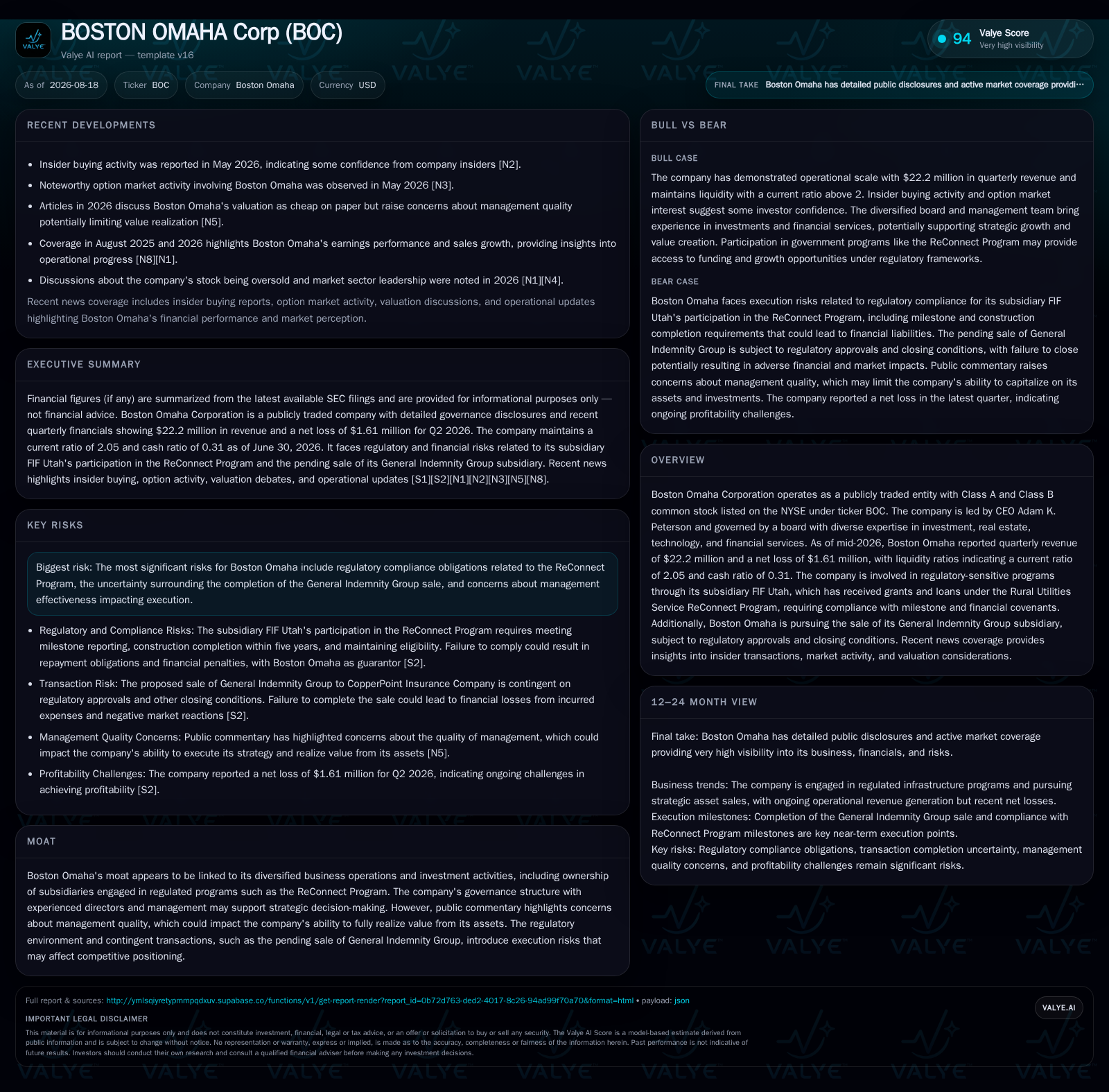
Boston Omaha Corporation’s latest quarterly filing reveals operational risks from its subsidiary FIF Utah's obligations under the Rural Utilities Service ReConnect Program, involving significant grant and loan funding with strict milestone and financial covenants. Concurrently, Boston Omaha is advancing an all-cash sale of General Indemnity Group to CopperPoint Insurance Company, pending regulatory approvals, with execution uncertainty posing market reaction risks. The company reported $22.2 million in quarterly revenue but posted a net loss of $1.61 million. Boston Omaha’s diversified holding company model—spanning regulated infrastructure investments and insurance—exposes it to compliance and execution risks that will influence financial outcomes. Monitoring milestone attainment for ReConnect funding and progress on transaction closing will be crucial going forward.
Recent Operating Update: Regulatory and Transactional Focus
Boston Omaha's second quarter 2026 filings underscore two primary near-term operational priorities that define its risk profile: regulatory compliance tied to its subsidiary FIF Utah’s participation in the Rural Utilities Service ReConnect Program, and advancement toward closing the sale of its General Indemnity Group (GIG) insurance unit.
FIF Utah has secured grants up to $11.5 million along with equivalent loan rights under this federal program aimed at expanding rural broadband infrastructure. This exposes Boston Omaha to over $22 million in combined funding subject to stringent milestone-driven reporting requirements and financial covenants enforceable within a five-year construction deadline [S2][S25]. Failure to meet these conditions could compel repayment of grants or acceleration of loans, risks heightened by external factors such as supply chain delays beyond FIF Utah’s control [S2]. As guarantor for FIF Utah's obligations, Boston Omaha carries contingent liabilities that could impact corporate liquidity if compliance falters.
In parallel, Boston Omaha formalized a definitive agreement on May 18, 2026, to sell GIG entirely to CopperPoint Insurance Company for approximately $84 million in an all-cash transaction structured with customary escrow arrangements extending two years post-closing [S21][S22]. Approximately 93% of net proceeds are expected to flow back to Boston Omaha after transaction costs. However, closing remains conditional on regulatory approval by Nebraska’s Department of Insurance and other standard closing criteria. Any delay or failure in obtaining these approvals risks not only forfeiting anticipated proceeds but also negative market reactions as current equity valuations incorporate expectations of deal completion [S2][S24].
Business Model: Diversified Holding Company Managing Regulated Subsidiaries
Boston Omaha operates as a diversified holding company managing subsidiaries engaged primarily in regulated sectors—rural broadband infrastructure through FIF Utah and insurance operations via GIG [S1]. Its business model centers on capital allocation across these subsidiaries, generating revenue from operating profits, investment income tied to federally funded projects, dividends, and capital gains realized through asset sales.
Revenue from regulated operations like FIF Utah depends critically on milestone achievement linked to federal funding schedules; delays can defer cash flows or incur penalties. Meanwhile, insurance revenues from GIG consist largely of underwriting premiums until divestiture finalizes. The planned sale aligns with strategic portfolio optimization efforts designed to redeploy capital toward potentially higher-growth or less capital-intensive ventures.
Governance mechanisms emphasize compliance with insider trading laws, board oversight equipped with investment expertise, and transparent transaction processes aimed at mitigating execution risk amid complex regulatory environments [S1].
Industry Context and Competitive Positioning
Within the diversified holding company sector—comparable to peers such as Markel Corporation or Alleghany Corporation—Boston Omaha occupies a mid-sized niche focused on select regulated verticals rather than broad conglomerate diversification seen at Berkshire Hathaway or Brookfield Asset Management. This positioning offers agility but entails concentration risks balancing between infrastructure regulatory dependencies and discrete transactional outcomes like asset sales.
Regulatory adherence is pivotal: federal grant programs impose rigorous milestone reporting frameworks affecting cash flow timing; state insurance regulators oversee solvency standards essential for underwriting activities. Boston Omaha must navigate these dual compliance landscapes while executing strategic transactions effectively.
Growth Drivers
Growth opportunities include expanding participation in regulated utility programs where increased grant or loan awards could enhance revenue visibility for FIF Utah. Successful closure of the GIG divestiture would inject significant liquidity enabling reinvestment into accelerated project pipelines or new acquisitions aligned with strategic priorities.
Operational improvements at subsidiaries may gradually improve margin profiles offsetting consolidated net losses currently recorded [F1]. Effective capital allocation supported by strong governance can optimize return on equity through disciplined portfolio management.
External growth catalysts such as favorable government policies promoting rural broadband expansion remain critical demand signals warranting close observation.
Risks and Watchpoints
Primary risks stem from potential regulatory non-compliance linked directly to FIF Utah’s ReConnect Program commitments. Construction delays exacerbated by supply chain disruptions increase execution risk that could trigger grant repayments or loan acceleration [S2][S25]. Given Boston Omaha’s guarantor role, such events could strain corporate liquidity.
The GIG divestiture carries execution risk tied to obtaining timely regulatory approvals; failure or delay could lead to terminated agreements after incurring substantial sunk costs plus adverse market sentiment impacting stock valuation [S24][S25]. Public scrutiny over management effectiveness adds reputational risk influencing investor confidence.
Concentration risk persists given limited diversification; operational setbacks in key subsidiaries may disproportionately affect consolidated performance.
What To Watch Next
Investors should monitor:
- Achievement of critical FIF Utah milestone reporting deadlines within the five-year construction window tied to ReConnect Program eligibility.
- Supply chain developments impacting construction timelines that may elevate repayment risk.
- Progress on obtaining Nebraska Department of Insurance approval for the General Indemnity Group sale and indications around closing timing.
- Quarterly earnings updates providing subsidiary performance insights alongside management commentary addressing operational challenges or strategic shifts.
- Share repurchase activities under existing authorizations as indicators of board confidence amid market volatility [S15]
Financial Profile Discussion
As of June 30, 2026, Boston Omaha holds approximately $15.1 million in cash and equivalents against nominal total debt (~$190 thousand), resulting in a strong current ratio near 2.05 that supports operational flexibility during ongoing subsidiary transitions including grant-funded initiatives [F1]
The balance sheet position appears sound but contingent liabilities as guarantor introduce potential leverage concerns should grant funding compliance issues arise.
This analysis synthesizes publicly reported filings through mid-August 2026 focusing strictly on verifiable facts without speculative extrapolation. It aims to provide a nuanced understanding grounded in regulatory frameworks, transaction mechanics, industry context, and operational realities shaping Boston Omaha's evolving business model.
Disclaimer: This is research-only, informational analysis and not investment advice. It may include AI-generated interpretation and general industry context. Always verify important details using primary sources.

Comments