
Boqii Holding’s Revenue Slide Contrasted with Profitability Gains
Boqii's fiscal 2025 saw a marked revenue contraction alongside improved margins, underscoring the complexities behind its evolving pet ecosystem model and liquidity profile.
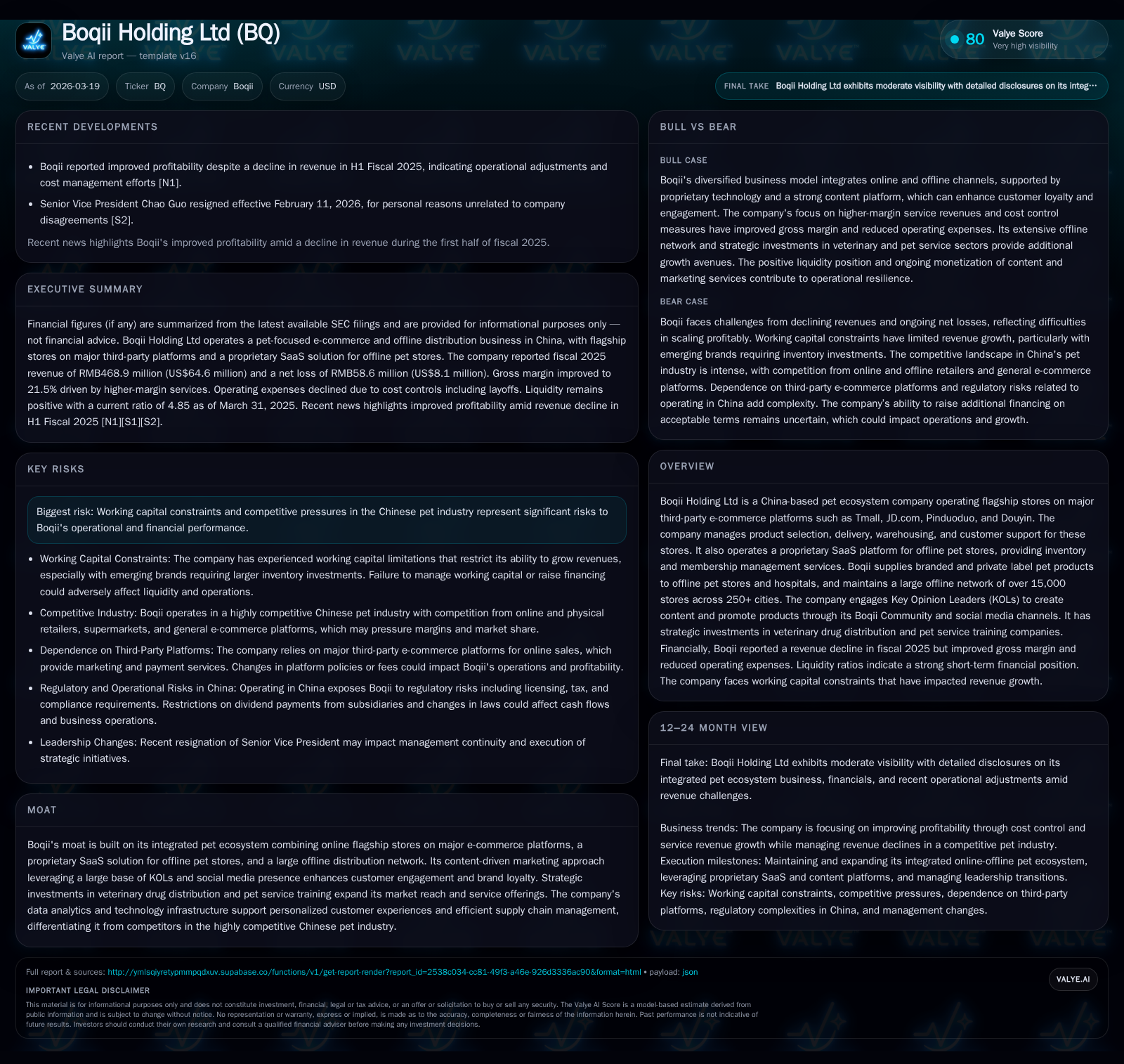
In fiscal 2025, Boqii Holding Ltd experienced a significant 34% decline in revenue to approximately $64.6 million [F1], contrasting with an improvement in gross margin to 21.5% [S8]–[S19]. The company’s integrated strategy leverages online flagship stores on major Chinese e-commerce platforms, a proprietary SaaS offering for offline pet stores, and an extensive offline distribution network spanning over 15,000 stores [S14]. Despite operating losses narrowing slightly and enhanced profitability metrics, Boqii confronts tightening working capital constraints and liquidity pressures, with operating cash flow remaining negative at -$9.2 million [F1]. Going forward, growth is potentially capped by capital availability and competitive intensity in China’s pet sector, while management has not provided explicit forward guidance [N1, S12]. Key governance developments include senior leadership turnover that may influence execution dynamics.
Fiscal 2025 Performance: Revenue Decline Versus Margin Improvement
Boqii Holding Ltd’s financial results for the fiscal year ended March 31, 2025 display a striking divergence between revenue trends and profitability metrics. The company’s top line contracted sharply by approximately 34.2% year-over-year from $98.2 million in FY2024 to $64.6 million in FY2025 as per SEC filings [F1]. This steep decline primarily resulted from a strategic decision to prioritize profitability over sales volume amid intensifying competition in China’s pet retail market and working capital limitations constraining inventory stocking for emerging brands [S19,S4].
Despite lower revenue, gross profit decreased by a smaller proportion (28.5%), and gross margin improved from 19.8% in FY2024 to 21.5% for FY2025 [S19,S8]. This margin expansion was largely attributable to increased contributions from the company's online marketing and information services segment—which commands higher margins—and operational efficiencies gained through SKU rationalization and better inventory turnover dynamics within their SaaS-supported offline channels [S19,S14]. Operating expenses fell by over 21%, aiding in reducing operating losses slightly from approximately -$8.3 million to -$8.2 million while net losses narrowed from -$8.8 million to -$7.5 million year-over-year [F1].
Multi-Channel Ecosystem: Online Flagships, SaaS Services, and Offline Distribution
Boqii’s integrated pet ecosystem constitutes its competitive moat within China’s fragmented pet sector [S14]. The company manages flagship storefronts on dominant third-party e-commerce platforms including Tmall, JD.com, Pinduoduo, and Douyin where it controls product selection, warehousing, delivery logistics, and customer support functions while leveraging these platforms’ marketing engines and payment infrastructures [S14,S20]. For FY2025 alone, this online channel contributed roughly RMB213.2 million (US$29.4 million) in revenues but declined substantially from prior years due to strategic curtailment of volume growth [S14,F1].
Offline operations are bolstered by a proprietary SaaS platform launched initially for free in 2015 that now provides inventory tracking, membership management, pricing updates, and reorder reminders tailored specifically for thousands of small-to-medium independent pet stores and clinics—over 15,000 outlets spanning more than 250 cities domestically by latest counts [S14,S20]. This infrastructure supports rapid SKU rationalization based on localized demand insights enabling efficient replenishment cycles crucial for thin-margin retailers facing high product diversity.
Beyond SaaS innovation lies Boqii's bulk supply relationship with offline retailers where products—including both branded lines and private-label offerings such as Yoken—are sold under supply agreements designed to maintain minimum price thresholds safeguarding brand positioning and retailer margins [S14]. This offline distribution accounted for approximately RMB65.2 million (US$9.0 million) or nearly 14% of total FY2025 revenues before continued pressure due to retrenching spending by smaller partners during recent macroeconomic headwinds.
Monetary Pressures: Working Capital Challenges Impacting Growth
Liquidity constraints define the current operational environment for Boqii as documented extensively within their annual filings . Despite recording positive working capital of about RMB176.5 million ($24.3 million) at fiscal year-end March 31, 2025 down from RMB206 million the prior year — signaling buffer availability — the company concedes such funds have historically limited its ability to aggressively scale emerging brands requiring sizeable initial inventory investments [S4,S7]. Accounts payable primarily relate to vendor brand partners with typical credit terms between 30-60 days; the short turnover window necessitates efficient creditor payment cycles which are under pressure given negative operating cash flows totaling roughly -$9.2 million during FY2025 alone [F1,S4].
Cash reserves deteriorated further with cash and equivalents dropping from about RMB72.7 million (US$10 million) at FY2023's start down to RMB38.7 million (US$5.3 million) at fiscal year-end March 2025 despite minor positive net financing inflows offsetting operational depletion . Short-term borrowings stood modestly at RMB9.1 million ($1.2M) but were largely settled subsequent to reporting date — reflecting ongoing attempts to manage leverage carefully without amplifying interest burdens near term while maintaining operational flexibility [S4,S6].
Boqii's disclosures highlight elevated risks stemming from potential inability to secure timely additional financing on favorable terms should working capital requirements escalate due to market fluctuations or strategic initiatives such as acquisitions or tech enhancements which remain plausible scenarios given investment elsewhere in SaaS infrastructure continues albeit at modest capex levels (RMB3.3 million / US$0.45M in FY2025) relative to previous years' outlays [F1,S19,S28].
Capital Allocation Review: Cash Flows, ROE, and Investment Priorities
A three-year financial compass reveals structural cash flow challenges wrapped around Boqii’s pursuit of technology-driven ecosystem expansion amid persistent net losses.
- Operating cash flows have remained negative each year: -$7.9M (FY2023), -$3.5M (FY2024), extending sharply again to -$9.2M (FY2025) despite cost rationalizations indicating cyclical working capital build or timing effects impacting liquidity negatively rather than permanent improvement trends (see table below) [F1];
- Capital expenditures rose significantly by over five-fold YoY ($0.07M to $0.45M), reflecting reinvestments into SaaS platform capabilities geared towards upgrading backend inventory analytics and membership functionalities essential for offline retailers’ engagement strategies albeit adding short-run cash burn pressure;[S19]
- Equity base contracted moderately during this period mainly due to retained losses accumulating albeit without dilution events recorded recently; standing near $26M end-FY2025 vs $30M prior year;[F1]
- Return on equity remains negative approximately -28%, mirroring ongoing structural deficits not yet addressed via scale economies or robust top-line recovery.
Boqii currently abstains from dividends or share repurchases consistent with its status as a growth-stage entity reliant on preserving capital resources amid operational tightening.[F1]
Historical performance (annual)
| FY | Rev ($mm) | Net ($mm) | CFO ($mm) | OpInc ($mm) | Rev YoY | Net YoY |
|---|---|---|---|---|---|---|
| 2025 | 65 | -7 | -9 | -8 | -34.2% | +15.4% |
| 2024 | 98 | -9 | -4 | -8 | -38.2% | +41.1% |
| 2023 | 159 | -15 | -8 | -15 | -15.0% | +26.1% |
| 2022 | 187 | -20 | -23 | -22 |
Source: SEC companyfacts cache [F1].
Capital returns and efficiency (annual)
| FY | Buybacks ($mm) | FCF ($mm) | ROE% |
|---|---|---|---|
| 2025 | -10 | -28.5 | |
| 2024 | -4 | -29.1 | |
| 2023 | 31 | -8 | -57.7 |
| 2022 | 31 | -24 | -64.5 |
Source: SEC companyfacts cache [F1].
Table: Boqii Historical Financial Summary (Fiscal Years Ended March 31)
Future Outlook: Growth Constraints Amid China’s Competitive Pet Sector
Management commentary captured via filings and recent disclosures suggests Boqii faces entrenched growth limitations principally tied to tight working capital that constrains inventory buildup necessary for broadening emerging brand footprints and new customer acquisition efforts on both online and offline fronts[N1,S12,S23]. The competitive landscape involves not only other specialized pet platforms but also mainstream generalist e-commerce players intensifying price-based battles amid fluctuating consumer demand patterns influenced by broader economic factors.
Absent explicit forward guidance from management in recent forms or press releases[N1], key indicators going forward will revolve around the pace of recovery or stabilization in flagship store order volumes; scalability gains from SaaS subscriber expansions into the burgeoning community of Chinese brick-and-mortar pet retailers; liquidity movements especially concerning accounts payable cycles; and measurable uplift in engagement via KOL-driven content marketing campaigns representing a vital user acquisition vector intrinsic to the firm’s digital ecosystem model[S14,S20,N1].
Key Risks and Corporate Governance Updates
Boqii operates under multi-layered risk exposures typical of foreign-invested enterprises engaging deeply within China’s evolving regulatory regime[S12]:
- Foreign investment laws impose controls requiring adherence to national security reviews especially where control or major equity stakes are involved;
- Consumer protection statutes obligate strict compliance regarding product quality standards across online-offline channels exposed through flagship stores;
- Anti-monopoly regulations recently strengthened impose scrutiny over concentration activities relevant as Boqii grows via alliances or acquisitions;
- Confidentiality provisions linked with overseas listings affect disclosure practices thereby adding complexity.
Governance-wise notable is the Senior Vice President's departure effective February 11, 2026 citing personal reasons without underlying conflicts[S2], but such high-level turnover can disrupt strategic momentum particularly when aligned with challenging macro conditions[S3]. Board oversight maintains standard protocols but execution risk remains elevated given financing flexibility is not yet stabilized[S12,S4].
What to Monitor: Strategic Indicators and Market Signals
Absent company-issued forecasts underscores importance of monitoring key metrics:
- Gross margin trajectories indicate if premium service mix sustains profitability advances;
- Working capital evolution—especially days payable outstanding versus inventory turns—signal operational flexibility or strain progression;
- Cash flow patterns reveal if capex investments yield technology gains without exacerbating liquidity depletion;
- Customer retention statistics within flagship stores demonstrate brand loyalty amid competing alternatives;
- KOL community engagement growth rates offer proxy visibility into marketing effectiveness driving organic demand build.
Any significant deviations across these vectors may presage shifts in Boqii's ability to successfully navigate China’s fragmented yet dynamic pet retail ecosystem.
Disclaimer: This analysis synthesizes publicly available financial data from Boqii Holding Ltd SEC filings, recent news reports as of March 19, 2026 without issuing investment recommendations or price forecasts.
Disclaimer: This is research-only, informational analysis and not investment advice. It may include AI-generated interpretation and general industry context. Always verify important details using primary sources.

Comments