
BurTech Acquisition’s Strategic Path to Public Market Via Blaize Merger
BurTech Acquisition Corp II advances merger execution with Blaize while maintaining strong liquidity and shareholder mandate.
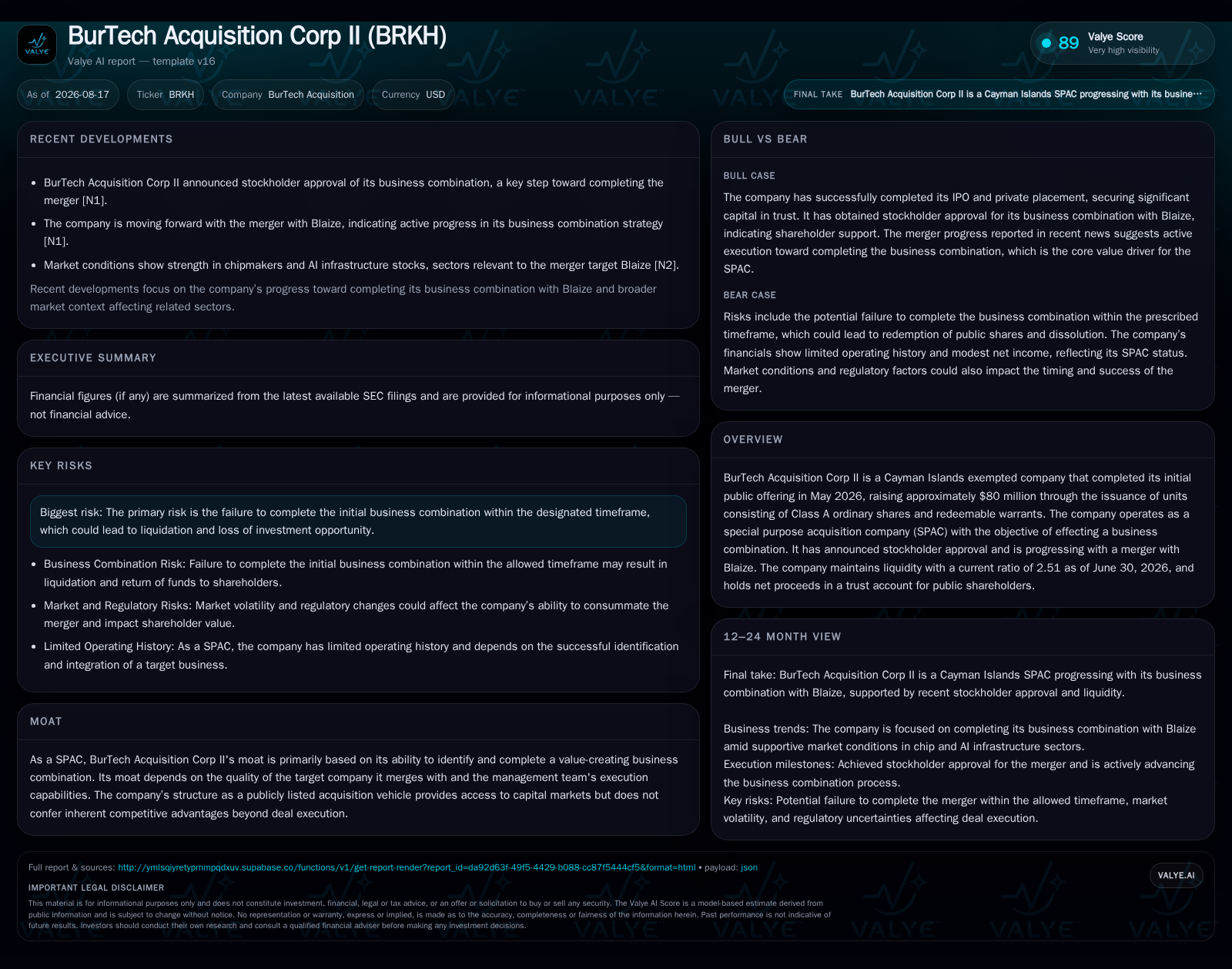
BurTech Acquisition Corp II, a recently formed SPAC, completed an $80 million IPO in May 2026 to fuel its initial business combination. The company secured shareholder approval for its proposed merger with Blaize and maintains robust liquidity, with $80.4 million net proceeds held in trust and a current ratio of 2.51 as of June 30, 2026 [F1][S2][N1]. Unit holders recently gained the ability to separate trading of Class A shares and redeemable warrants, enhancing market flexibility [S3]. As BurTech navigates typical SPAC timing constraints and redemption dynamics, execution risks remain pivotal ahead of de-SPAC completion. The pathway reflects broader industry trends favoring SPAC listings over traditional IPOs amid regulatory scrutiny and capital market volatility.
Merger Progress Updates Frame Near-Term Value Creation Dynamics
BurTech Acquisition Corp II’s second quarter 10-Q filing dated August 14, 2026 confirms that the SPAC maintains a substantial liquidity buffer essential for the successful completion of its initial business combination. The company reported $839,500 in current assets against $335,094 in current liabilities, yielding a current ratio of approximately 2.51 — an indicator of healthy short-term financial stability for this stage of the SPAC lifecycle [F1][S2]. The net proceeds from its May IPO, approximately $80.4 million after expenses and private placements, remain securely held in a U.S.-based trust account dedicated to public shareholders [S12]. Parallel to these financial metrics, BurTech announced shareholder approval for its anticipated merger with Blaize, signifying that investors have granted the mandate needed to progress toward operational status beyond the capital vessel phase [N1]. This combination milestone transitions BurTech into a crucial execution window where timing risk intensifies; failure to consummate within the regulatorily mandated period typically culminating near two years post-IPO would trigger liquidation protocols.
Decoding BurTech’s SPAC Business Model: Capital Structure and Deal Economics
BurTech’s IPO structure followed the conventional SPAC archetype by issuing units composed of one Class A ordinary share together with one redeemable warrant exercisable at $11.50 per share upon de-SPAC closing or default period expiry [S6]. These units were priced at $10 each, raising gross proceeds of $80 million across 8 million units offered publicly plus an additional private placement contributing another $2.52 million primarily purchased by the sponsor entity [S12]. Notably, starting July 14, 2026, BurTech enabled a unit separation event that allows holders to trade their underlying ordinary shares (ticker BRKH) and warrants (ticker BRKHW) independently instead of as bundled units (BRKHU) [S3]. This bifurcation is significant since it provides investors additional flexibility to manage exposure amid evolving perceptions of deal value and regulatory environment shifts before final merger completion. Redemption rights embedded within the structure empower public shareholders to redeem their Class A shares prior to closing if dissatisfied with transaction terms or market conditions—directly affecting net cash available for acquisition financing post-merger. Meanwhile, warrant holders could dilute equity value if exercises occur in material volumes at the set strike price. The sponsor promote aligns key insiders’ incentives with deal closure and value creation but typically involves dilutive accounting offsets common across SPAC deals.
Competitive Environment for SPACs Targeting Growth-Stage Private Companies
Within the expanding SPAC ecosystem focused on technology-driven growth companies—a prevalent segment engendering robust investor appetite—BurTech operates at a measured scale relative to marquee peers like Pershing Square Tontine Holdings (PSTH) or Social Capital Hedosophia Holdings Series D (SCHD). Those larger entities boast multi-hundred-million-to-billion-dollar capital raises granting broader acquisition flexibility and perceived deal credibility. Nevertheless, BurTech’s more modest raise still situates it competitively among smaller issuance vehicles targeting mid-market private companies seeking expedited public listings without incurring traditional IPO rigmarole such as extensive roadshows or prolonged SEC review cycles. The quality and depth of BurTech’s deal pipeline alongside management expertise will therefore be paramount differentiators in securing attractive acquisition terms within increasingly crowded SPAC markets experiencing heightened regulatory scrutiny and investor selectivity.
Shareholder Redemption Implications on Deal Capital and Dilution Risk Factors
Shareholder redemption rights constitute a pivotal determinant of BurTech's net available capital for completing its announced Blaize merger. Although specific redemption rates have not been disclosed for this deal phase, high redemption levels can materially reduce funds in trust thereby compelling supplementary PIPE financing or sponsor capital injections to bridge funding gaps—a costly proposition that may also depress post-merger share valuation [S2][S3]. Conversely, low redemption enhances deal certainty through secured purchase funds but risks reducing shareholder optionality early in the process. Complementing this dynamic is the warrant exercise feature; given warrants are priced at an $11.50 strike above unit IPO price ($10), incentives encourage exercise predominantly if post-merger share prices exceed this threshold sufficiently above exercise costs after accounting for transaction fees. Merit exists for potential dilution concerns if exercised volumes accelerate following de-SPAC listing or PIPE rounds boosting outstanding equity counts beyond original projections. Consequently, investors monitoring BurTech should track evolving unit split volumes alongside post-approval shareholder voting insights as leading liquidity consumption indicators.
Regulatory Oversight and Timing Challenges in SPAC Lifecycle Execution
SPACs operate under rigorous timing constraints dictated by Securities Exchange Commission rules commonly permitting up to 18-24 months from IPO closing to consummate an initial business combination; extensions require incremental sponsor cash contributions often capped at six months total. This framework forces tight deal sourcing windows concentrating management focus on rapid target identification, due diligence rigor, and consummation maneuvers while preserving compliance with increasingly exacting SEC disclosure mandates promulgated post-2020 to tackle perceived investor protection gaps related to valuation transparency and conflicts interests. BurTech’s recent shareholder approval signals alignment so far but does not eliminate looming expiration risk which intensifies operational velocity imperatives in remaining months before deadline. Additional regulatory developments around enhanced reporting standards may also elevate ongoing compliance costs or delay transaction timelines—factors critical when competitors pursue parallel deals within high-demand segments.
Growth Catalysts Post-Merger: Market Appetite for Alternative Public Listing Routes
There is growing momentum among private growth-stage enterprises opting for SPAC mergers as viable alternatives to traditional IPOs owing to several structural advantages. These include streamlined access to substantial capital pools without heavy marketing overheads or volatile bookbuilding processes characteristic of classic stock launches; opportunities for negotiated valuation premia via sponsor-supplied PIPE investments providing clear funding visibility; and conducive market conditions favoring technology-enabled businesses particularly targeting scalable digital transformation end markets representative of Blaize’s sector affiliation though company-specific details are undisclosed per instructions. Volatile equity markets periodically undermine confidence in conventional IPOs making SPAC-sponsored routes attractive especially during periods when extended regulatory reviews impede speedy public debuts. Hence, BurTech’s positioning leveraging this secular shift aligns well with prevailing market demand drivers.
Navigating Execution Risks: Management Team Track Record and Deal Pipeline Quality
Although detailed management credentials are only partially disclosed in filings regarding board appointments following the May IPO completion [S12], success heavily depends on leadership's ability to source credible targets rapidly while balancing stakeholder communications effectively throughout due diligence phases followed by complex negotiation closures under tight deadlines—typical challenges faced by comparable sponsors operating special purpose vehicles in competitive acquisition landscapes. Previous industry experience gaining traction in this domain often correlates strongly with higher probability of seamless mergers versus last-minute cancellations or value-destroying renegotiations reported elsewhere across broader sector history. Continued monitoring of announced milestones including definitive agreement progress reports alongside shareholder communication cadence will provide market participants tangible touchpoints assessing execution momentum.
Financial Profile Discussion: Liquidity Strength Supports Merger Execution Window Commitment
BurTech’s latest available balance sheet snapshot as of June 30, 2026 reveals total current assets standing at approximately $839,500 against current liabilities near $335,094 evidencing a healthy liquidity position yielding a current ratio of roughly 2.51 indicative of strong working capital coverage proceeding into merger completion phases [F1]. This financial posture reflects prudent management vehicle cash retention consistent with standard SPAC practices holding nearly all proceeds ($80.4 million net) on deposit within segregated trust accounts geared exclusively towards public investor protection until definitive business combination fulfillment or liquidation triggers release conditions as mandated by SEC regulations [S12][S2]. Operating income remains marginally negative reflecting pre-combination overhead expense absorption typical for blank-check vehicles prior to generating operating revenue post-merger [F1]. Absent any debt issuance or refinancing obligations at this stage aligns with standard capital structure conservatism appropriate for such entities aimed solely at acquisition facilitation rather than ongoing operational leverage.
This analysis strictly refrains from speculating on details beyond evidence supplied directly by SEC filings or credible news sources concerning merger valuation specifics or Blaize's market positioning per policy directives. By emphasizing the critical liquidity foundation underpinning BurTech Acquisition Corp II’s de-SPAC trajectory combined with nuanced understanding of SPAC industry mechanics—unit composition intricacies, redemption effects on funding availability, regulatory timing imperatives, peer group contextualization—and recognized sectoral growth drivers informing investor sentiment toward alternative public listing venues, stakeholders can better apprehend both opportunities and inherent risks defining this pivotal juncture.
Disclaimer: This article does not constitute investment advice or research views but provides analytical commentary based on publicly available filings as of August 2026.
Disclaimer: This is research-only, informational analysis and not investment advice. It may include AI-generated interpretation and general industry context. Always verify important details using primary sources.

Comments