
San Juan Basin Royalty Trust Highlights Structural Risks Amid Commodity Price Volatility
The trust’s August 2026 distribution suspension illustrates how commodity price and production cost fluctuations directly impact royalty income and cash flow sustainability.
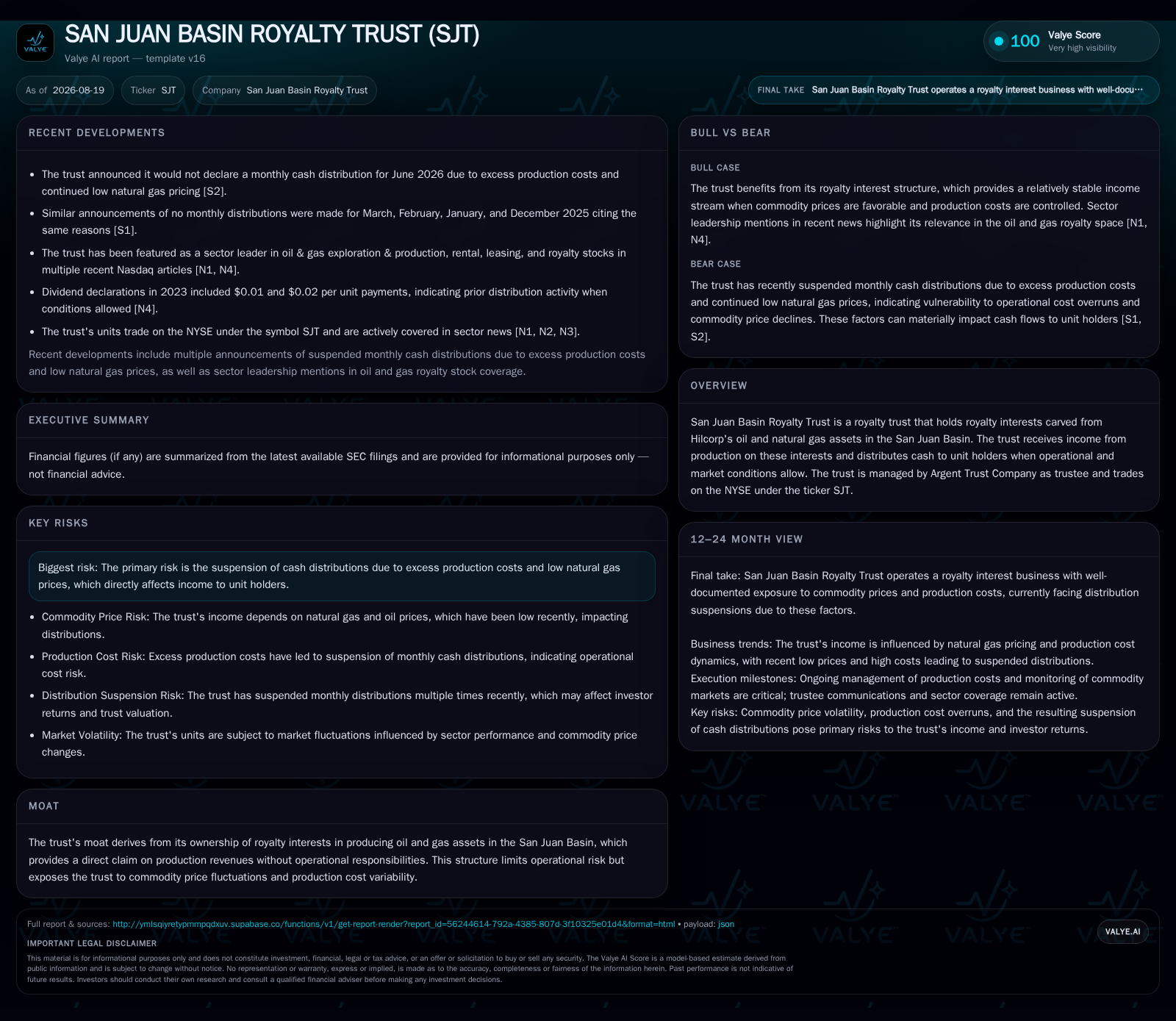
San Juan Basin Royalty Trust (SJT) owns royalty interests carved from Hilcorp’s San Juan Basin oil and natural gas assets, receiving revenue based on production volumes and commodity prices without operational responsibilities. In August 2026, the trust suspended its monthly cash distribution due to excess production costs and continued low natural gas prices, underscoring the structural exposure of its royalty income to commodity price volatility and production cost variability. This suspension signals potential ongoing distribution volatility until market conditions improve or costs decline, reflecting the inherent risks in the trust’s business model.
Trust Business Model and Structural Risks
San Juan Basin Royalty Trust (SJT) holds royalty interests carved out from Hilcorp's oil and natural gas assets in the San Juan Basin [S1]. These interests entitle the trust to a portion of production revenue without operational responsibilities or exposure to production costs, which are borne by the operators. Revenue depends directly on production volumes and realized commodity prices.
The trust’s business model inherently exposes it to commodity price volatility and production cost fluctuations [S1]. Although the trust does not pay production costs, these costs charged by operators reduce the net revenue from which royalty payments are derived. When commodity prices decline or production costs rise, distributable cash flow to unit holders can be materially impacted, potentially leading to suspension of distributions. This structural exposure means the trust's income and distributions depend not only on production volumes but also on the net economics of production, which vary with market conditions.
Recent Distribution Suspension and Operating Environment
On August 21, 2026, the trust filed an 8-K disclosing it would not declare a monthly cash distribution for August 2026 due to excess production costs and continued low natural gas pricing [S3]. This suspension directly reflects the trust’s structural risk exposure, where low commodity prices combined with elevated production costs eroded distributable cash flow to the point that no distribution could be declared.
The latest quarterly 10-Q filing dated August 13, 2026, reaffirms the trust’s exposure to commodity price cycles and production cost variability [S2]. These filings illustrate the structural risk embedded in the trust’s revenue stream, where unfavorable market conditions and cost pressures impair income generation and distribution sustainability. While insulated from operational risks, the trust remains fully exposed to production economics influenced by external market factors beyond its control.
Financial Implications and Cash Flow Sensitivity
The trust’s cash flow is highly sensitive to the interplay between commodity prices and production costs [S3][S2]. Royalty revenue equals production volumes multiplied by realized commodity prices, minus production costs charged by operators. When natural gas prices remain low, revenue declines proportionally. If production costs exceed revenue, distributable cash flow can be zero or negative, necessitating suspension of distributions.
This dynamic underscores the trust’s margin and cash conversion drivers: owning royalty interests without operational responsibilities provides no mitigation against low commodity prices or rising production costs impacting distributable income. The August 2026 distribution suspension exemplifies how these factors constrain cash flow and limit the trust’s ability to allocate capital to unit holders [S2][S3]. The financial bridge from production revenue to distributions is directly influenced by external commodity price cycles and production economics.
Scenario Analysis and Investor Considerations
Several scenarios could unfold based on commodity price and production cost trajectories:
Base Case: Natural gas prices remain near current low levels with production costs stable or modestly declining [S3][S2]. The trust may experience intermittent distribution suspensions but could resume payouts when conditions improve.
Bear Case: Continued depressed natural gas prices combined with rising or sustained high production costs lead to prolonged suspension of distributions, materially reducing trust income and unit holder returns. [S3][S2]
Bull Case: A significant recovery in natural gas prices and/or production cost reductions enable stable or increased cash distributions, improving the trust’s income profile [S3][S2]. Investors should monitor future distribution declarations or suspensions, natural gas price trends, production cost developments in filings, and operational updates from Hilcorp or other operators impacting production volumes. These factors are critical indicators of cash flow sustainability and distribution outlook.
Grounded Watchpoint
A key watchpoint is the trust’s ongoing exposure to production cost inflation and commodity price volatility, which remain outside its control. Since the trust does not operate the underlying assets, it cannot influence production efficiencies or cost management. Sustained increases in production costs or prolonged low commodity prices could continue to pressure distributable cash flow and lead to further distribution suspensions. Monitoring operator disclosures and market conditions is essential to assess future income stability.
In summary, San Juan Basin Royalty Trust’s August 2026 distribution suspension highlights the structural risks inherent in its royalty income model amid commodity price volatility and production cost fluctuations. Understanding these dynamics is essential for assessing the sustainability of cash distributions to unit holders in the current market environment.

Comments