
Radiant Strategies Q1 2027: Early-Stage PR Services with Liquidity Constraints and Competitive Pressures
Radiant Strategies faces significant liquidity challenges and competitive threats from established firms and AI tools amid modest revenue growth in Malaysia’s PR market.
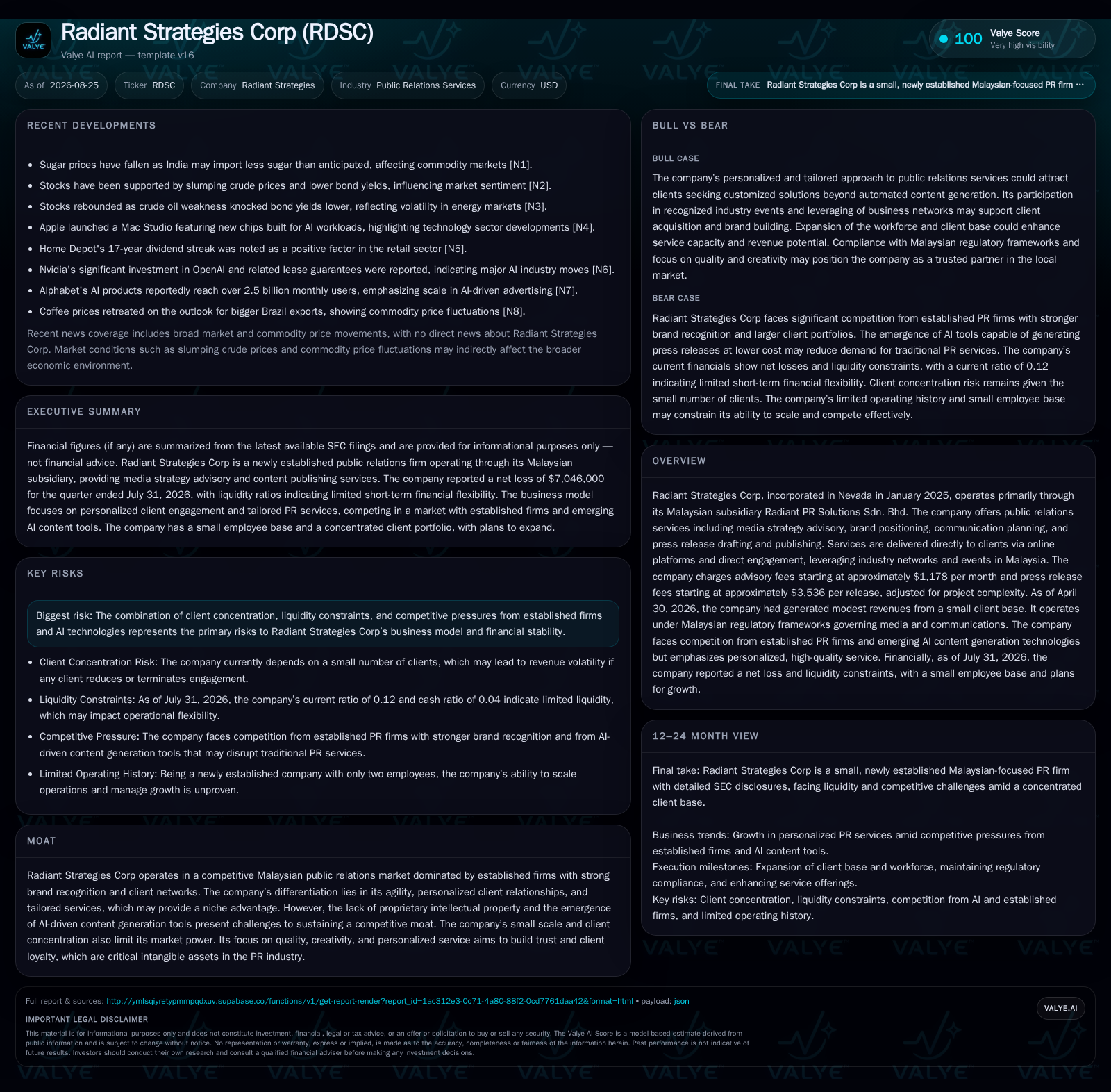
Radiant Strategies Corp, a small Malaysian public relations firm, reported a severely constrained liquidity position as of Q1 2027, with a current ratio of 0.12 and cash of $1.4 million against current liabilities of $31.5 million. The company generated $40,254 in revenue for fiscal 2026 from only four clients, reflecting early-stage commercial traction but limited scale. Competitive pressures from established Malaysian PR firms and emerging AI-driven content generation tools threaten Radiant’s pricing power, client retention, and margin expansion, challenging its ability to build a sustainable competitive position.
Radiant Strategies Corp, operating through its Malaysian subsidiary Radiant PR Solutions Sdn. Bhd., reported a challenging liquidity position as of the first quarter of fiscal 2027, ended July 31, 2026 [F1][S2]. This severe working capital deficit indicates that Radiant’s short-term obligations exceed its liquid assets by nearly eightfold, constraining its operational flexibility and raising concerns about its ability to sustain business activities without additional financing or operational improvements.
The company’s operating cash flows during Q1 2027 were negative, primarily driven by purchases of equipment and repayments of lease liabilities [S2]. These cash outflows contribute to ongoing cash depletion, further exacerbating liquidity pressures and underscoring the need for careful cash flow management or additional financing to maintain solvency.
Radiant’s business model centers on providing public relations services including media strategy advisory, brand positioning guidance, communication planning for campaigns, and the drafting, editing, and publishing of press releases on news and social media platforms [S1]. The company’s advisory fees start at approximately MYR5,000 (about $1,178) per month, billed quarterly in advance, while press release fees begin at MYR15,000 (around $3,536) per release, with pricing adjusted based on project complexity. Clients retain full ownership of approved and published content, which is a standard practice in the PR industry. The company distributes its services directly through its in-house team via online platforms, email communication, and direct client engagement. Additionally, Radiant leverages its director’s business network and participates in recognized industry and networking events in Malaysia, including trade exhibitions at the Malaysia International Trade & Exhibition Centre (MITEC), SME Corp Malaysia programs, and conferences organized by the Malaysian International Chamber of Commerce and Industry (MICCI) [S1].
For the fiscal year ended April 30, 2026, Radiant generated revenue of $40,254 from 4 clients, up from $15,871 from 2 clients in the prior year [S1]. While this growth indicates some early-stage commercial traction, the absolute revenue scale remains modest relative to the company’s liabilities and operational needs. The small client base and limited revenue highlight the challenges Radiant faces in scaling its business to a level that can sustainably cover fixed costs and improve liquidity.
In the Malaysian public relations market, Radiant faces significant competitive pressures. Established PR firms with strong brand recognition and extensive client networks dominate the landscape. These incumbents benefit from scale, reputation, and established client relationships, which can create barriers to entry and limit Radiant’s ability to capture market share. Additionally, emerging AI-driven content generation tools pose a disruptive threat by potentially commoditizing traditional PR content creation, offering faster and lower-cost alternatives [S1]. While AI presents opportunities for efficiency, it also challenges the traditional human-centric approach to PR services. Radiant emphasizes personalized client relationships and human expertise in crafting nuanced, brand-specific messaging, which it views as a differentiator. However, the competitive dynamics may limit its pricing power, client retention, and margin expansion capabilities, thereby constraining long-term profitability.
However, the competitive environment may compress pricing and make client acquisition more challenging.
Analytically, Radiant’s current liquidity position is a significant constraint on its operational flexibility and growth potential [F1][S2]. This financial structure raises concerns about the company’s going concern status if liquidity is not improved.
Furthermore, the company’s modest revenue from a small client base reflects early-stage commercial traction but also underscores the challenge of scaling amid competitive pressures from established firms. The competitive environment includes AI-driven content generation that could commoditize some services, further pressuring Radiant’s ability to grow revenue and maintain margins.
Looking ahead, one plausible base scenario is that Radiant Strategies gradually expands its client base and revenue through its personalized service offerings, stabilizing cash flow but requiring ongoing external financing to manage liquidity constraints [S1][S2][F1]. The company’s niche focus and tailored services may attract incremental clients, but the current financial position necessitates capital support to sustain operations.
Conversely, a bear scenario involves worsening liquidity constraints and intensified competitive pressures from established firms and AI content generation tools, preventing meaningful revenue growth and potentially leading to operational distress or restructuring [S1][S2][F1]. The severe working capital deficit and small client base limit operational runway, and AI-driven disruption may erode Radiant’s service differentiation. Confirmation of this downside would include declining revenue or client count, negative cash flow and depleted cash balances, or disclosures of financial distress or restructuring.
Investors and stakeholders should closely monitor subsequent quarterly disclosures for changes in revenue, client base, liquidity ratios, and operating cash flows. Developments in the competitive landscape, particularly the adoption and impact of AI-driven content generation in the Malaysian PR market, will also be critical in assessing Radiant’s ability to establish a sustainable competitive position.
In summary, Radiant Strategies operates in a structurally competitive PR services market characterized by established players and technological disruption. While personalized service offerings provide some differentiation, the combined pressures of financial constraints and competitive threats from AI tools and established firms create a complex environment for Radiant’s growth and sustainability.

Comments