
HRGN Q2 2026 Update: Orphan Drug Designation Supports Development While Cash Constraints Persist
Harvard Apparatus Regenerative Technology reports ongoing clinical progress and regulatory milestones amid significant liquidity challenges and bridge financing in Q2 2026.
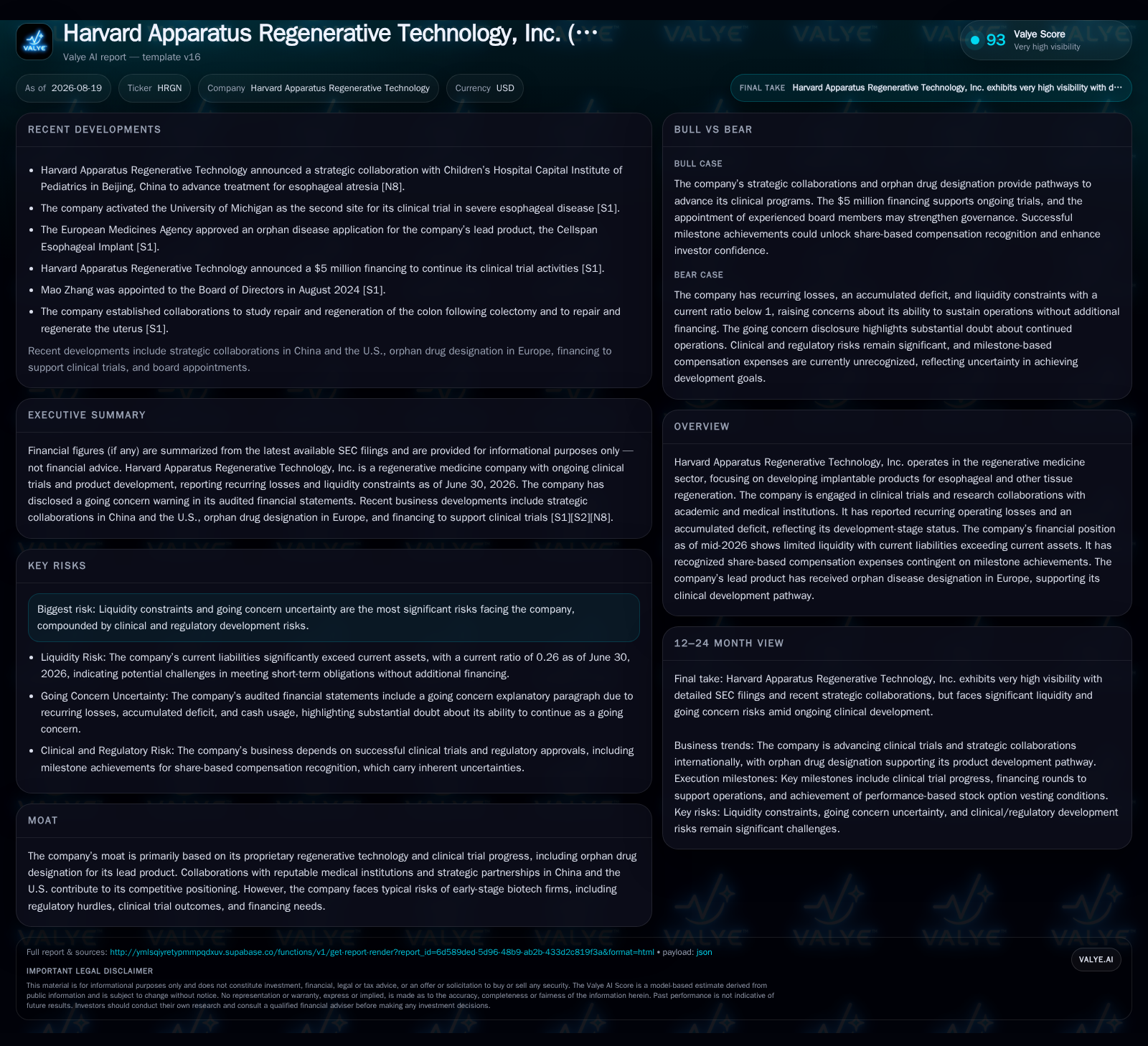
Harvard Apparatus Regenerative Technology, Inc. continues advancing its regenerative medicine pipeline with orphan drug designation in Europe and active clinical trials. However, its Q2 2026 financials reveal a critical liquidity deficit, with current liabilities far exceeding current assets and reliance on $400,000 in bridge notes from the CEO. The company’s near-term viability depends on securing substantial capital raises and achieving clinical milestones to sustain development and operations.
Harvard Apparatus Regenerative Technology, Inc. reported a current ratio of 0.26 as of June 30, 2026, reflecting a significant liquidity shortfall that has necessitated securing bridge notes totaling $400,000 from related parties, including its Chairman and CEO, to support ongoing clinical development and operations [S2][S3]. This reliance on insider bridge financing underscores the company's going concern risks and highlights challenges in funding its product candidates amid early-stage development and limited commercial revenue [S1].
These notes accrue interest at an annual fixed rate of 8% and are structured to be repaid upon the closing of the company’s next capital raise of at least $5 million or by mid-2027, whichever occurs first [S3]. This insider financing underscores the company’s dependence on related-party funding to bridge immediate cash needs, highlighting the urgency of securing larger external capital infusions.
Clinical and Regulatory Progress
Despite financial challenges, HRGN continues to advance its regenerative medicine pipeline. The company’s lead product candidate has received orphan drug designation in Europe, a regulatory status that can facilitate expedited development pathways and confer market exclusivity benefits upon approval [S1]. This designation supports the clinical and commercial value proposition of the product candidate, potentially enhancing investor and partner interest.
HRGN maintains active clinical trials and research collaborations with academic and medical institutions, reflecting ongoing efforts to generate clinical data and validate its implantable regenerative products targeting esophageal and airway tissue regeneration [S1]. These collaborations are critical for advancing the pipeline through clinical phases and regulatory milestones, which are key value drivers in the early-stage biotech sector.
Business Model and Capital Requirements
As a development-stage biotechnology company, HRGN generates negligible revenue to date, consistent with its focus on research and clinical development rather than commercial sales [S1][S2]. Its business model centers on advancing novel regenerative therapies through preclinical and clinical stages, with future revenue expected from product sales following regulatory approvals.
The company’s financial profile reflects typical characteristics of early-stage biotech firms: recurring operating losses, an accumulated deficit, and capital-intensive R&D activities [S1]. Margins and cash conversion remain negative as HRGN invests in clinical trials, regulatory efforts, and manufacturing readiness. Capital allocation prioritizes sustaining these development activities, funded primarily through equity and bridge debt financing.
Successful commercialization depends on achieving regulatory approvals, scaling manufacturing, and market adoption, which remain uncertain at this stage. The orphan drug designation and ongoing clinical progress provide potential competitive advantages, but the company faces constraints including regulatory risks, clinical trial uncertainties, and the critical need for additional capital to continue operations.
Investment Risks and Scenarios
HRGN’s most immediate investment risk is its constrained liquidity position. The current ratio of 0.26 and negative working capital indicate the company cannot meet short-term obligations without new financing [S2][F1]. The CEO’s bridge notes provide temporary relief but are not a long-term solution, as repayment depends on a substantial capital raise [S3].
One plausible scenario is that HRGN successfully completes a capital raise exceeding $5 million within the next 12 months. This would enable repayment of the bridge notes and support uninterrupted clinical development and regulatory activities. The orphan drug designation may enhance investor interest, and continued clinical progress could bolster the company’s valuation and financing prospects [S1][S3]. Confirmation of this scenario would include announcements of significant capital raises and positive clinical or regulatory updates.
A base case scenario is that the company successfully completes a capital raise exceeding $5 million within the next 12 months, enabling repayment of bridge notes and continuation of clinical development without operational disruption. The CEO's bridge notes are structured to be repaid upon such a raise, and the orphan drug designation may enhance investor interest. Confirmation would include announcements of a capital raise exceeding $5 million and positive clinical trial updates or regulatory milestones. Refutation would include failure to raise sufficient capital by mid-2027 or negative clinical trial results or regulatory delays.
Conversely, failure to secure sufficient funding in a timely manner could force HRGN to curtail operations or cease development due to cash exhaustion and inability to repay bridge loans [S2][S3][F1]. This bear case is plausible given the company’s low liquidity, ongoing operating losses, and the inherent risks of clinical and regulatory setbacks.
The company’s orphan drug designation and active clinical trials support the long-term value of its regenerative medicine pipeline. These factors will be pivotal in determining HRGN’s ability to sustain operations and advance its product candidates toward commercialization.
The company’s future hinges on navigating the capital markets successfully while progressing its clinical programs. Additionally, clinical trial milestones and regulatory developments related to the orphan drug designation will materially influence the company’s valuation and financing opportunities [S1]. Failure to achieve these milestones or secure sufficient funding could result in operational curtailment or cessation, underscoring the high-risk nature of investment in this development-stage biotech.
While orphan drug designation and ongoing clinical trials provide strategic value and potential competitive advantages, the company’s near-term viability is contingent on successful capital raises and clinical progress. This dual dependency frames the investment thesis and risk profile for HRGN going forward.

Comments