
Cibus Advances Rice Herbicide Tolerance Program Amid Regulatory Progress but Faces Financial Sustainability Challenges
Cibus is focusing on commercializing its gene-edited Rice traits leveraging a proprietary platform, while managing cash burn and regulatory complexity in agricultural biotechnology.
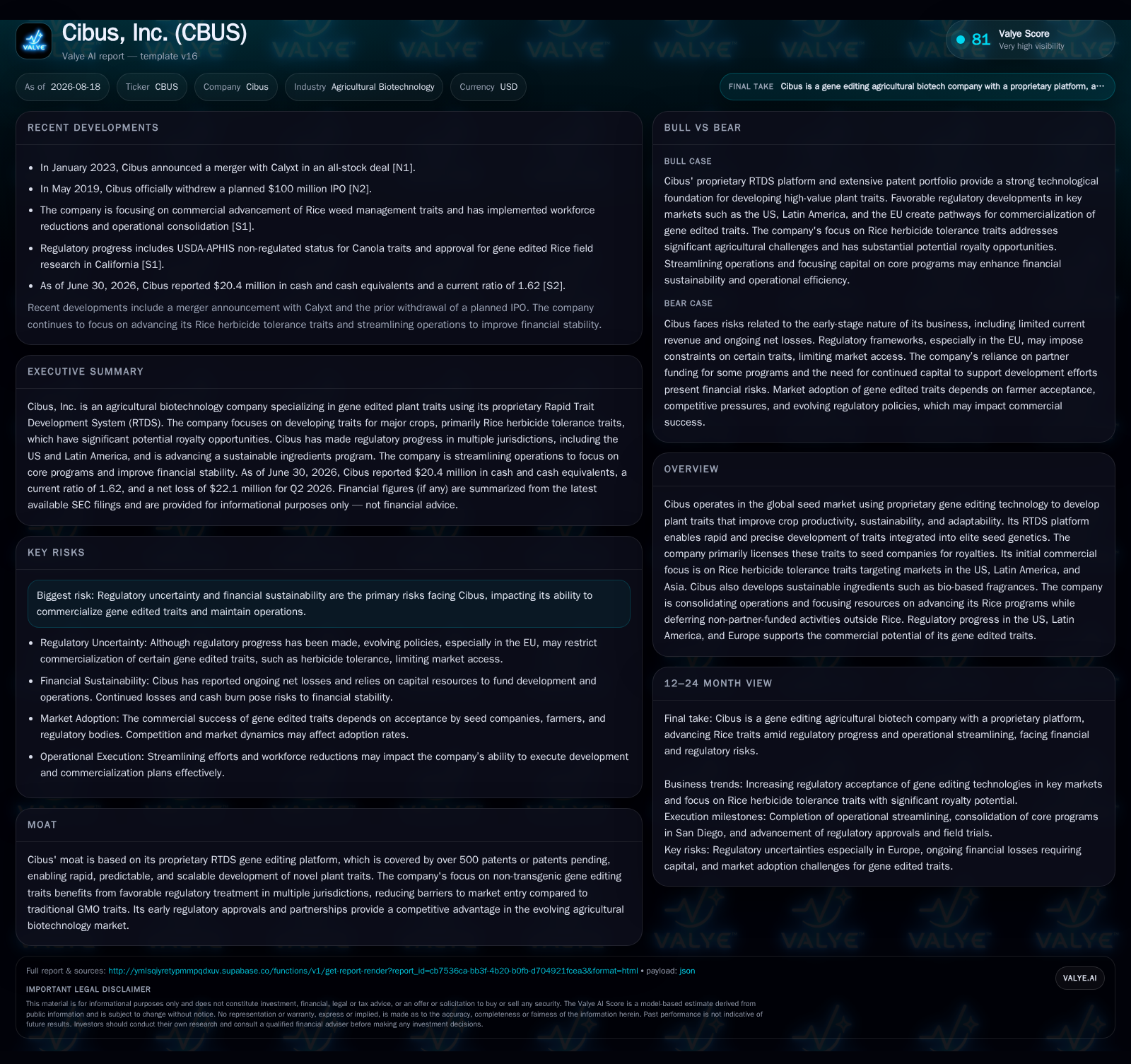
In its latest quarter, Cibus reinforced its strategic pivot to prioritize rice herbicide tolerance traits utilizing its RTDS gene editing technology, securing regulatory validation across key global markets. The company continues operating under a licensing model targeting seed companies, aiming for royalty revenues upon trait adoption. While Cibus benefits from early regulatory approvals and a strong patent moat, ongoing cash burn and lack of current commercial revenue highlight financial sustainability risks. Key near-term milestones hinge on advancing regulatory clearances and closing licensing partnerships to translate R&D into steady royalty streams.
Recent Operating Update Highlights
Cibus’ August 2026 quarterly filing clearly marks a strategic consolidation around its Rice herbicide tolerance (HT) programs by pausing or deferring all other non-partner funded activities outside this core focus area [S2], [S3]. This recalibration reflects a pragmatic response to ongoing operating losses and capital constraints while prioritizing highest-potential commercialization avenues. Revenue from licensing agreements remains nascent with no generating contracts yet delivering royalties; reported revenue primarily consists of smaller collaboration or grant-related income totaling $994 thousand for the quarter ending June 30, 2026 [S2]. Operating expenses remain sizable at nearly $14 million for the quarter driven by personnel costs ($5.2 million), professional fees ($2 million), and other segment expenses including R&D and general administrative costs ($5.2 million) [S4]. The company’s net loss trajectory sustained with $22 million loss recognized in Q2 alone.
Business Model: Licensing Gene Edited Traits to Seed Companies
At the core of Cibus’ business is the RTDS™ (Rapid Trait Development System) platform — a gene editing technology suite designed for precise single-base DNA edits enabling rapid creation of plant traits with agronomic value such as herbicide tolerance without transgenic modifications [S1]. This non-GMO classification significantly reduces costly regulatory hurdles compared to transgenic GMOs, resulting in faster development cycles often under one year from edit to product-ready plant lines.
Cibus commercializes via a royalty-based licensing model where developed traits are integrated into elite seed genetics by seed companies—these partners manage subsequent breeding scale-up and market introduction. Upon commercialization of seeds containing licensed traits, Cibus earns royalties typically structured as a percentage of seed sales revenue. This paradigm mirrors models employed by established agricultural biotech firms like Corteva Agriscience and Bayer Crop Science but differs in focusing on gene editing rather than transgenic approaches.
Notably, Cibus’ current royalty revenue remains embryonic as its priority pipeline centered on Rice HT traits has not reached full commercialization [S1], [S22]. Secondary revenue streams include developing sustainable bio-based ingredients such as lauric oils and bio-fragrances partially funded by partners aligned with consumer-packaged goods companies—although these remain exploratory relative to core trait licensing.
Industry Structure and Cibus’ Competitive Position
Operating upstream in the agricultural value chain, Cibus fits squarely within the agricultural biotechnology developer peer group focusing solely on R&D and trait innovation. Its customers—the midstream seed companies—are responsible for downstream commercial seed production and farmer sales.
The company’s expansive intellectual property estate covering over 500 patents/patents pending related to RTDS provides a meaningful moat supporting competitive differentiation and barriers against replication by CRISPR-based competitors or GMO technology developers [S1]. Furthermore, the company benefits from favorable regulatory classifications as many jurisdictions including the United States, Canada, various Latin American countries (Argentina, Chile, Ecuador), the UK, parts of Africa and Southeast Asia consider its products non-transgenic exempting them from stringent GMO regulations [S26]. This regulatory advantage facilitates quicker field trials approval timelines and commercial introductions driving potential royalty revenue growth.
Peer players such as Corteva or Syngenta engage similar licensing models but possess broader multi-trait portfolios spanning corn, soybeans, wheat alongside rice with established royalty income streams—Cibus remains early-stage comparatively without commercialized trait royalties yet but targets an estimated Potential Annual Addressable Royalties exceeding $200 million from Rice HT traits upon full deployment in initial target markets like Latin America and the US [S1]
Growth Drivers
Cibus' convergence on Rice HT traits coincides with rising global demand for higher crop yields amidst intensifying climate pressures where herbicide tolerance confers critical weed management advantages essential for productivity improvement. The company's ability to develop precise non-transgenic genetic edits affords speed-to-market benefits reducing time-to-commercialization—a crucial KPI in this high R&D cost industry.
Regulatory progress that classifies these traits as conventional breeding-equivalent permits accelerated access especially within Americas jurisdictional regions that comprise substantial rice-growing markets.
Ongoing partnerships with tier-one seed companies represent pivotal traction points enabling trait incorporation into elite germplasm platforms combined with trait stacking approaches to enhance multiple agronomic benefits per variety—driving adoption rates and thus expanding royalty bases over time.
Additional expansion potential exists within emerging markets across Asia (excluding China) and Latin America where modernization of seed genetics adoption is accelerating. Sustainability trends pressuring reductions in chemical inputs favor gene-edited products offering environmental adaptability—a nascent accelerator for Cibus’ secondary sustainable ingredients program incorporating renewable bio-based oils.
Risks and Watchpoints
Key risks loom around continued substantial operating losses fueled by high R&D expenditure coupled with ongoing absence of stable royalty income requiring near-term capital raises to sustain operations given reported net losses of $43.4 million for the first half of 2026 alongside $20.4 million cash balance as of June end that mandates resource discipline or financing actions soon lest going concern horizons worsen [S2], [F1].
Regulatory uncertainty outside primary target regions particularly relating to European Union policies remain notable headwinds creating potential delays or barriers for future expansions.
Execution risks cluster around concluding effective license agreements translating genetic edits into marketed commercial seeds thereby unlocking expected royalty cash flows critical for financial viability.
Intellectual property enforcement challenges present another layer of operational risk typical within high-tech ag biotech sectors.
Finally, market acceptance hinges on farmer recognition of value in gene edited seeds versus legacy GMO or conventional seed options which can affect adoption rates impacting long-term revenue sustainability.
What to Watch Next
Upcoming catalysts include definitive milestones on regulatory approvals beyond initial geographies to broaden market access footprints—E.U. policy clarity would be particularly impactful.
Commercial partner announcements detailing license agreements formally activating royalty streams would materially de-risk the operational outlook.
Monitoring R&D progression velocity especially advancement through required field trials confirming trait efficacy supports forward signal of commercialization timing.
Capital raising initiatives or partnership deal structures providing enhanced liquidity runway will be key indicators mitigating near-term financial constraints.
Lastly, updates around sustainable ingredient programs may offer diversification insights relevant over medium term horizons.
Financial Profile Discussion
As of June 30, 2026, Cibus reported cash and equivalents of approximately $20.4 million against current liabilities of about $14.4 million, resulting in a current ratio of roughly 1.62 which provides a moderate liquidity cushion though underwhelming given ongoing cash burn rates exceeding $10 million per quarter recently [F1], [S2]. The company’s total debt is minimal at approximately $559 thousand as of December 31, 2025, supporting an unleveraged capital structure and flexibility [F1]. Operating losses persist at significant scale driven by heavy investments in personnel-led R&D efforts totaling $5.2 million payroll costs plus professional fees indicative of substantial external consulting expenses involved in development activities [S4]. The six month net loss totaled $43.4 million ahead of revenues still concentrated in pilot stages without material license income recorded yet [S2].
Thus financial sustainability critically depends on executing commercialization deals generating royalties alongside measured expense control balancing aggressive R&D progression against capital consumption ensuring survival through inflection points where recurring revenue inflows commence.
Disclaimers: This analysis is based solely on publicly disclosed information as cited herein without any confidential insights or projections specific to Cibus Inc. It does not constitute investment advice or research views but serves solely as an independent industry-focused analytical report.
Disclaimer: This is research-only, informational analysis and not investment advice. It may include AI-generated interpretation and general industry context. Always verify important details using primary sources.

Comments