
Cingulate Inc. Faces Regulatory Milestone and Capital Constraints in Late-Stage ADHD Drug Development
The company prepares for a potential FDA approval decision by May 2026 amid accumulated losses and reliance on external financing.
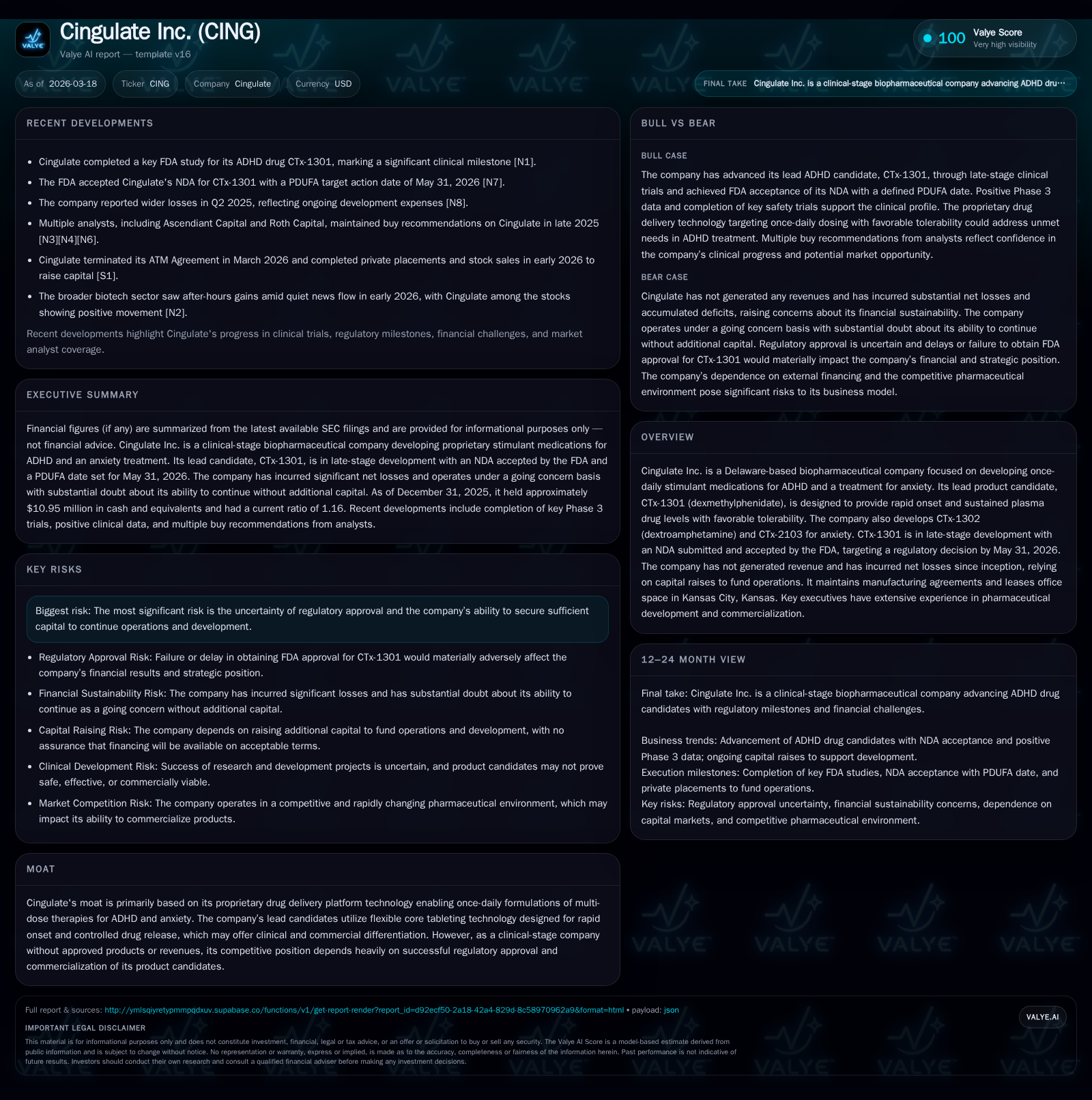
Cingulate Inc. is a clinical-stage biopharmaceutical company focused on innovative once-daily stimulant formulations for ADHD and anxiety treatment. Despite substantial losses totaling over $132 million since inception, the firm is advancing its lead candidate CTx-1301 with an NDA accepted by the FDA and a target regulatory decision date in May 2026. The company remains pre-revenue, heavily reliant on equity and debt issuances for funding, with approximately $11 million in cash at the end of 2025. Investors should monitor the upcoming FDA decision and the company's ability to secure continued capital to sustain operations.
Company Overview
Cingulate Inc., incorporated in Delaware, operates as a clinical-stage biopharmaceutical entity specializing in developing once-daily stimulant medications focused initially on ADHD (attention deficit hyperactivity disorder) treatment and also advancing an anxiolytic therapy candidate. Its core innovation rests in its proprietary drug delivery platform aimed at enabling controlled release profiles that achieve rapid onset alongside sustained plasma levels with enhanced tolerability [N1][S1].
Their lead product candidate is CTx-1301 (dexmethylphenidate), currently in late-stage development following full submission of an NDA which was accepted by the FDA as of early 2026 with target approval action by May 31, 2026 [N1][S3]. In addition to dexmethylphenidate, pipeline candidates include CTx-1302 (dextroamphetamine) aimed at ADHD and CTx-2103 targeting anxiety indications.
Historical Financial Performance
Since inception, Cingulate has not generated any commercial revenue and has operated at losses driven primarily by intensive research and development activities necessary to advance its drug candidates through clinical trials and regulatory review.
Financial data from recent fiscal years highlight persistent operating deficits compounded by substantial operating expenses related to clinical trial execution, manufacturing scale-up preparations, regulatory functions, personnel compensation, and corporate overhead.
Historical performance (annual)
| FY | Net ($mm) | CFO ($mm) | OpInc ($mm) | Capex ($) | Net YoY |
|---|---|---|---|---|---|
| 2025 | -22 | -17 | -20 | 162138 | -44.4% |
| 2024 | -16 | -18 | -16 | 211800 | +33.9% |
| 2023 | -24 | -15 | -23 | 224096 | -33.1% |
| 2022 | -18 | -16 | -18 | 153420 |
Source: SEC companyfacts cache [F1].
Capital returns and efficiency (annual)
| FY | FCF ($mm) | ROE% |
|---|---|---|
| 2025 | -17 | -894.8 |
| 2024 | -19 | -208.5 |
| 2023 | -15 | 342.6 |
| 2022 | -16 | -455.3 |
Source: SEC companyfacts cache [F1].
Operating income worsened year-over-year by around -27% from FY24 to FY25 while net losses widened approximately -44%, underscoring escalating expenditures related to late-stage development activities [F1]. The negative operating cash flow continues with slight improvement compared to prior periods.
Capital expenditures have decreased modestly by over twenty percent reflecting more stable investment in fixed assets such as manufacturing equipment relative to prior periods [F1].
Future Growth Prospects
Cingulate’s near-term growth narrative hinges entirely on successful regulatory clearance of CTx-1301 by the FDA expected mid-2026 [N1][S3]. Approval would mark their first commercial asset allowing transition from R&D phase into market entry. The proprietary controlled-release platform could differentiate it competitively within stimulant ADHD therapies given potential benefits around dosing convenience and side-effect profiles.
Other pipeline candidates like CTx-1302 (dextroamphetamine) and the anxiolytic program represent longer horizon opportunities but currently lack detailed timelines or milestones disclosed [S1].
However successful commercialization also depends heavily on availability of sufficient capital to scale manufacturing capabilities—currently under contract with Bend Bioscience for process validation batches costing approximately $7 million—and establish commercial infrastructure including marketing efforts within a competitive ADHD marketplace dominated by established brands [S8].
Key risks include the binary nature of regulatory approval outcomes as well as broader uncertainties regarding payer acceptance and physician adoption even if approved [S23]. Even post-approval market penetration could be constrained by competitive dynamics common in stimulant therapeutics sectors.
Financial Milestones & Catalysts To Watch
- May 31st ,2026 — PDUFA date for FDA decision on NDA submission for CTx-1301 [N1][S3]
- Potential regulatory milestones tied to launch readiness including manufacturing scale-up completion
- Capital raising initiatives or strategic collaborations announced ahead of commercialization push [S6]
Absent explicit guidance on projected revenues or timeframe post-launch forecasts from management filings or press releases [N#][S#], these milestones remain central inflection points potentially transforming financial profile.
Capital Structure and Liquidity Position
As of December 31st ,2025,Cingulate held approximately $11 million in cash equivalents against roughly $10.3 million in current liabilities yielding a current ratio estimate near 1.16 — signifying only moderate short-term liquidity cushion [F1][S10].
Total equity increased significantly compared to prior year attributed mainly to equity raises offsetting cumulative net losses exceeding $132 million since inception [F1][S13].
The company continues to deploy both debt and equity financing strategies:
- An unsecured promissory note issued in November 2025 with Avondale Capital totaling approximately $6.57 million (net $6 million received) bears a high interest rate of 9% over an 18-month maturity with covenant provisions involving monitoring fees and redemption options starting mid-2026 [S6][S7].
- Prior notes from entities such as WFIA have been converted into equity decreasing debt burden but illustrating reliance on related-party financings [S9][S17][S27].
- Equity proceeds from At-The-Market offerings plus private placements during early calendar year raised incremental capital into first quarter of FY26 [S18][S24].
These indebtedness structures entail material financial costs including amortization of debt discounts/issuance expenses recorded over note terms as well as periodic fair value adjustments on derivative liabilities embedded within financing arrangements [F1][S20]. Interest expenses rose sharply in FY25 relative to FY24 consistent with new debts assumed.
Given reported statements expressing "substantial doubt" about continued operations beyond one year without additional funding along with unmet milestones typical for clinical-stage biopharma peers lacking revenue streams [S1], securing sufficient capital remains critical.
Expense Composition & Operating Leverage
Research and development expenses for FY25 remained elevated at nearly $9.8 million comparable to previous year levels but showing increased allocation toward personnel costs ($2.78M in FY25 vs $1.76M prior), manufacturing scale-up ($3.25M in FY25 vs $2.69M), and regulatory activities which rose substantially coinciding with NDA preparation ($1.05M vs $0.28M) [S16]. General administrative costs also comprise sizable overhead though exact figures weren't broken down fully.
This mix underscores ongoing investment phase dynamics where operating leverage is limited given fixed commitment nature of clinical program costs plus overhead despite no product revenues achieved yet.
Risk Profile Summary
The prevailing risk arises from uncertainty involving:
- Receipt of timely FDA approval for the lead therapy candidate CTx-1301;
- Ability to raise meaningful additional capital under acceptable conditions crucial for sustaining operations into commercialization phases;
- Market acceptance challenges post-launch given entrenched competition;
- Reliance on third-party manufacturers including cost exposure associated with planned production runs;
- Legal contingencies inherent in pharma industry (although no material litigation disclosed currently) [S23][S6];
- Potential erosion of shareholders’ value if delays or adverse clinical/regulatory events occur.
Returns & Capital Allocation Policy
Due to its clinical-stage status without any revenue stream or profit generation history so far:
- No dividends have been declared or paid;
- No share repurchase activity has taken place recently nor is planned given capital preservation imperative;
- Return on equity is deeply negative (approximate calculation at roughly -895% based on latest net loss relative to book equity) reflecting accumulated deficits exceeding invested capital heavily influenced by ongoing losses from R&D intensity [F1];
- Free cash flow remains deeply negative reinforcing dependence on financing transactions for operational continuity.
The company utilizes stock-based compensation mechanisms to incentivize employees and consultants under an omnibus equity incentive plan whose capacity was expanded recently reflecting importance placed on equity incentives aligned with long-term value creation goals albeit speculative pending future commercial success [S25].
Conclusion & Monitoring Points (Analysis)
As Cingulate approaches the pivotal FDA decision expected before summer's end in calendar year '26 for its lead ADHD product candidate CTx-1301 using differentiated delivery technology enabling once-daily dosing regimens targeting important unmet patient convenience needs—they confront typical pre-commercialization challenges faced broadly among clinical stage biopharma companies:
Key factors requiring close observation that could materially influence trajectory include:
- Official FDA verdict granted or denied along with labeling particulars if approved,
- Speed and success delivering next rounds of financing required post-decision,
- Progress on scaling manufacturing capabilities tied directly to commercialization readiness,
- Market pricing strategies amid competitive products encompassing generic stimulants,
- Additional pipeline advancements offering optionality beyond core lead asset,
- Broader healthcare policy shifts impacting ADHD medication prescribing trends.
Without revenue generation or visible profit pathway until late-stage development culminates successfully into launch—this capital-dependent profile typifies substantial operational risk balanced against potentially transformational upside upon regulatory success.
This report synthesizes publicly available SEC filings dated March 18th ,2026,[F1] company news,[N1] and internal analyses.The information presented does not constitute investment advice or recommendations.
Disclaimer: This is research-only, informational analysis and not investment advice. It may include AI-generated interpretation and general industry context. Always verify important details using primary sources.

Comments