
Cellectis S.A. Boosts Revenue Through Collaborations While Sustaining Losses from CAR T-Cell Development
Cellectis increased 2025 revenue by over 75% via licensing and partnerships but recorded substantial net losses due to high research and administrative costs supporting its allogeneic CAR T-cell programs.
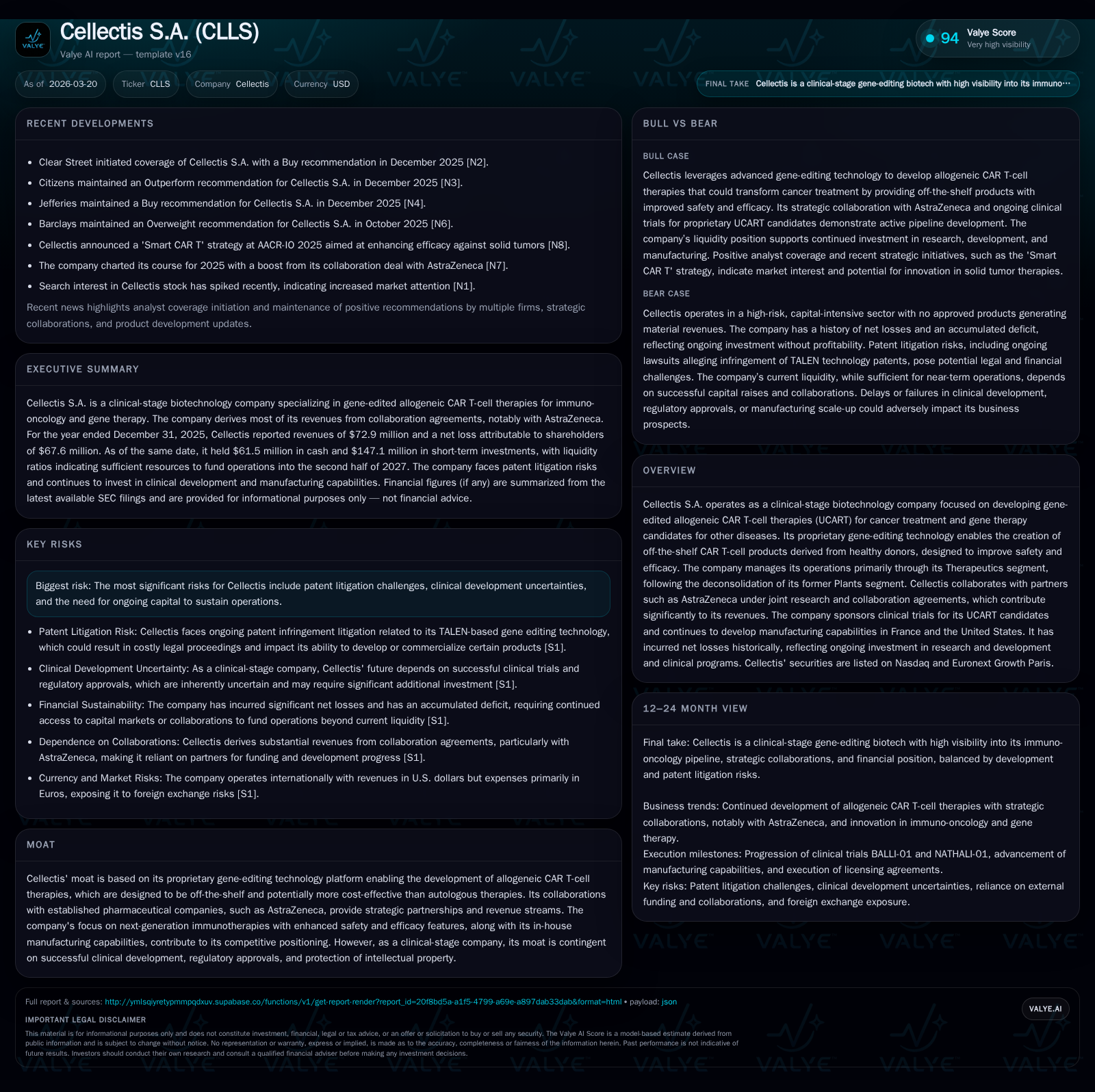
In 2025, Cellectis S.A. achieved a 75.8% year-over-year revenue growth to $72.95 million, primarily fueled by milestone payments, royalties, and cost reimbursements from strategic collaborations including AstraZeneca. Despite this revenue expansion, the company recorded a net loss of $67.6 million due to sustained high research and development expenses exceeding $93 million annually and selling, general and administrative costs near $19.8 million. The negative return on equity of approximately -89.1% reflects the company's focus on advancing its gene-edited allogeneic CAR T-cell therapy pipeline through clinical trials such as BALLI-01 and NATHALI-01. Supported by $61.5 million in cash and $144.8 million in fixed-term deposits at year-end 2025, Cellectis maintains adequate liquidity for operations into mid-2027 but remains dependent on continued funding and regulatory progress amid patent litigation risks.
Historical Financial Performance: Strong Revenue Growth Amid Continued Losses
Cellectis has demonstrated a pronounced increase in revenues over the past three years, rising from a nominal $0.76 million in 2023 to approximately $41.5 million in 2024 before surging to nearly $72.95 million in 2025—a year-over-year increase of 75.8% according to SEC filings [F1]. This revenue expansion is primarily attributed to milestone payments, royalties, and cost reimbursements under licensing agreements and collaborations, notably with AstraZeneca under their joint research collaboration agreement (JRCA) [S22].
Despite top-line gains, the company recorded a net loss of $67.6 million in 2025—an improvement relative to prior years but indicative of significant expenditures required to advance its pipeline [F1]. Operating expenses are dominated by research and development costs totaling approximately $93.5 million in 2025 alongside selling, general and administrative (SG&A) expenses near $19.8 million [F1][S23]. These figures highlight the capital intensity typical of clinical-stage biotechnology companies investing heavily in innovation.
The return on equity metric similarly reflects these operational realities: negative approximately -89.1% for the fiscal year ending December 31, 2025, underscoring ongoing unprofitability as Cellectis invests in clinical development programs [F1].
Historical performance (annual)
| FY | Rev ($mm) | Net ($mm) | Rev YoY | Net YoY |
|---|---|---|---|---|
| 2025 | 73 | -68 | +75.8% | -83.9% |
| 2024 | 42 | -37 | +5397.4% | +66.1% |
| 2023 | 1 | -108 | -96.1% | +4.9% |
| 2022 | 19 | -114 |
Source: SEC companyfacts cache [F1].
Capital returns and efficiency (annual)
| FY | ROE% |
|---|---|
| 2025 | -89.1 |
| 2024 | -28.1 |
| 2023 | -128.0 |
| 2022 | -90.5 |
Source: SEC companyfacts cache [F1].
Table notes: Operating expenses comprise R&D and SG&A components; total operating expense breakdown not fully specified for all years [F1].
Pipeline Focus: Allogeneic CAR T-Cell Therapies Under Clinical Evaluation
Central to Cellectis’ innovation strategy is its gene-editing platform enabling the development of allogeneic (off-the-shelf) chimeric antigen receptor T-cell (CAR T) therapies designed to treat hematologic malignancies more efficiently than autologous approaches [S22].
Leading candidates include lasme-cel (previously UCART22), evaluated in the BALLI-01 study targeting B-cell acute lymphoblastic leukemia; and eti-cel (formerly UCART20x22), studied under the NATHALI-01 trial focusing on non-Hodgkin lymphoma indications [S5][S22]. Both utilize TALEN gene editing technology aimed at minimizing graft-versus-host disease risks through specific genetic modifications embedded within the cell constructs.
In addition to these pivotal clinical programs, preclinical efforts continue toward expanding indications leveraging the platform’s genome engineering capabilities with potential applications beyond oncology [S22]. Clinical data readouts from these studies will be critical inflection points for regulatory engagement and commercialization strategies.
Collaborations Fuel Revenue Stability and Validation
AstraZeneca remains Cellectis’ primary strategic partner via their joint research collaboration agreement that generates milestone payments, royalties from licensed products or technologies, and reimbursement of research costs—forming the backbone of Cellectis’ therapeutic revenues [S22][F1].
These partnerships provide vital non-dilutive funding that supports ongoing research activities while validating Cellectis’ technological platform within the broader biopharmaceutical ecosystem.
Capital Allocation: Sustained Investment Without Shareholder Distributions
Research and development spending has steadily increased from roughly $87.6 million in fiscal year 2023 to about $93.5 million by the end of 2025—a reflection of growing internal capabilities including manufacturing scale-up efforts at facilities in France and North Carolina as well as expanded clinical trial activities [F1][S23][S18]. Personnel costs constitute a significant portion alongside third-party manufacturing contracts and intellectual property-related expenses.
Historically, Cellectis has not declared dividends nor initiated share repurchases—a stance consistent with clinical-stage biotech companies prioritizing reinvestment into pipeline advancement over shareholder distributions at this stage [S15][S21]. Capital allocation remains focused on sustaining innovation-led growth.
Risks: Patent Litigation and Regulatory Challenges Persist
Material risks facing Cellectis include patent infringement litigation concerning TALEN gene editing technology which could result in costly legal proceedings or settlements impacting operations if resolved unfavorably [S11][S13].
Clinical development uncertainties also pose significant risks given the inherent complexities of cell-based immunotherapies requiring extensive data generation for regulatory approvals [S4][S20]. Such factors may extend timelines or impact trial outcomes.
While liquidity is adequate through mid-2027 supported by cash reserves of approximately $61.5 million plus fixed-term deposits totaling about $144.8 million at year-end 2025 [F1][S8], additional financing will likely be necessary as clinical programs advance.
Financial Position: Liquidity Supports Near-Term Operations Amid Working Capital Constraints
As of December 31, 2025, Cellectis held cash & equivalents of about $61.53 million complemented by fixed-term deposits of roughly $144.8 million providing substantial liquidity for ongoing operations assuming stable burn rates [F1][S8]. The current ratio stood near 0.84 reflecting elevated current liabilities totaling approximately $145.75 million—typical for capital-intensive biopharma firms pre-commercial launch [F1].
Debt obligations include loans provided under European Investment Bank arrangements supporting R&D activities with associated warrants accounted for at fair value affecting earnings volatility [S6][S10][S11]. The equity base fluctuated over recent years influenced by strategic investments including those from AstraZeneca reinforcing collaborative alignment [S24].
Outlook: Clinical Data Readouts and Regulatory Milestones Are Key Near-Term Catalysts
Although no formal financial guidance has been issued [N1][S2][S3], market focus will center on forthcoming clinical trial results from BALLI-01 (lasme-cel) and NATHALI-01 (eti-cel), which represent critical validation points for efficacy and safety.
Subsequent regulatory filings such as investigational new drug amendments or biologics license applications may follow contingent upon positive data trajectories while manufacturing scale-up continues across U.S. and French sites.
Given absence of product sales-derived cash flow currently, continued access to capital markets through milestone payments or equity/debt financings remains essential.
Conclusion: Balancing Innovation with Financial Discipline Amid Developmental Risks
Cellectis exemplifies a pioneering biotech advancing next-generation gene-edited CAR T therapies offering potentially scalable off-the-shelf immuno-oncology solutions beyond patient-specific autologous models.
Revenue growth driven by strategic collaborations supports sustained investment; however, profitability remains elusive due to high R&D intensity typical of clinical-stage enterprises.
Intellectual property protection amidst ongoing patent disputes alongside successful navigation through complex regulatory pathways remain critical determinants of long-term value creation.
Investors should weigh transformative scientific potential against inherent developmental risks and capital requirements without near-term profits or dividend prospects.
This analysis synthesizes public disclosures through March 20, 2026, including SEC filings referenced herein; it does not constitute investment advice.
Disclaimer: This is research-only, informational analysis and not investment advice. It may include AI-generated interpretation and general industry context. Always verify important details using primary sources.

Comments