
Consumer Portfolio Services Boosts Subprime Auto Finance Amid Industry Challenges
CPSS leverages proprietary credit scoring and securitization expertise to sustain portfolio growth and enhance risk management in the competitive subprime auto finance market.
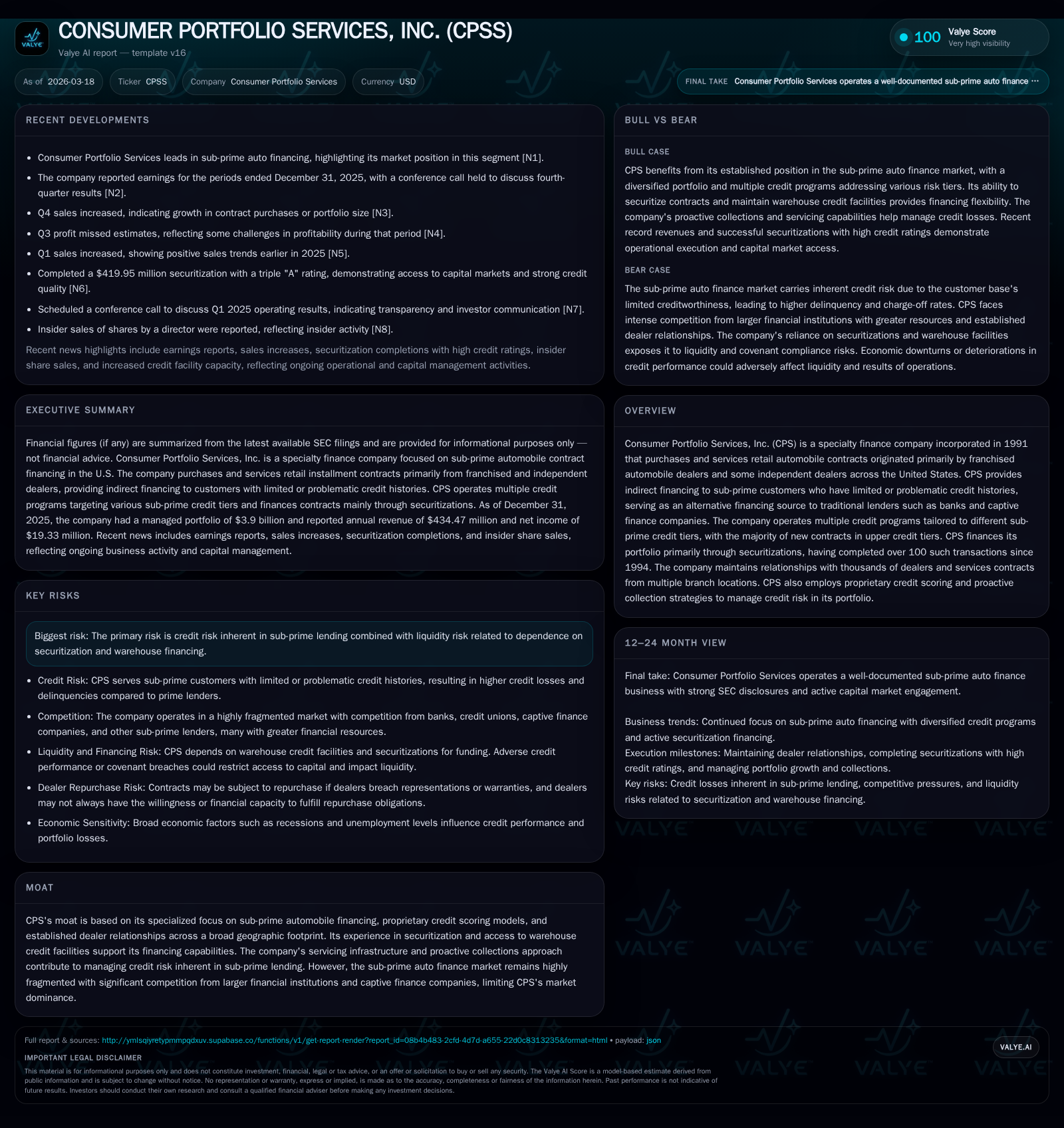
Consumer Portfolio Services, Inc. (CPSS) has reinforced its position in the subprime auto finance sector by expanding contract purchases and managed portfolio balances while maintaining credit risk controls through proprietary underwriting and collections approaches. The company's capital structure remains supported by robust securitization activity and diversified warehouse financing facilities, enabling growth despite market fragmentation and funding challenges. CPSS’s operating performance shows revenue growth with net income stability, underpinned by focused capital allocation including moderate share repurchases. Going forward, key metrics such as contract purchase pace, delinquency trends, and refinancing initiatives will be critical to monitor given increasing regulatory scrutiny and competitive pressures.
Trajectory of Growth: Contract Purchases and Revenue Trends
Consumer Portfolio Services, Inc. has demonstrated steady expansion in contract purchase volumes and managed portfolio size within its core subprime auto loan segment over the past five fiscal years. Contract purchases rose from approximately $1.15 billion in FY2021 to $1.64 billion in FY2025, with a notable surge in FY2022 followed by fluctuation indicative of market cyclicality and credit environment sensitivity [F1], [S1]. Concurrently, the managed portfolio—a comprehensive measure combining owned contracts plus third-party servicing obligations—increased from $2.25 billion to nearly $3.9 billion, a compound annual growth rate accentuated post-2023 reflecting disciplined portfolio acquisition strategies.
Financially, CPSS posted revenues of $434 million in FY2025 representing a robust 10.4% increase year-over-year, outpacing earlier years’ growth pace during competitive dynamics [F1]. Despite this top-line lift, net income barely edged higher by 0.6% to roughly $19.3 million highlighting margin pressure from higher credit losses endemic to subprime financing risk [F1]. Operating cash flow expanded materially by about 24%, driven by improved collections efficiency and structured securitizations that generate liquidity timing advantages.
Historical performance (annual)
| FY | Rev ($mm) | Net ($mm) | CFO ($mm) | Capex ($mm) | Rev YoY | Net YoY |
|---|---|---|---|---|---|---|
| 2025 | 434 | 19 | 289 | 1 | +10.4% | +0.6% |
| 2024 | 394 | 19 | 234 | 0 | +11.8% | -57.6% |
| 2023 | 352 | 45 | 238 | 1 | +6.8% | -47.3% |
| 2022 | 330 | 86 | 216 | 2 |
Source: SEC companyfacts cache [F1].
Capital returns and efficiency (annual)
| FY | Buybacks ($mm) | FCF ($mm) | ROE% |
|---|---|---|---|
| 2025 | 9 | 288 | 6.2 |
| 2024 | 13 | 233 | 6.6 |
| 2023 | 20 | 237 | 16.5 |
| 2022 | 46 | 214 | 37.6 |
Source: SEC companyfacts cache [F1].
*FY2024/25 data provisional per latest filings [F1]
Decoding CPSS’s Proprietary Credit Scoring and Risk Mitigation
CPSS differentiates itself through an advanced proprietary underwriting engine that fuses traditional credit bureau data with alternative indicators such as housing/rental payments alongside employment longevity metrics [S7], [S23]. Two internal credit scores are generated immediately upon application receipt allowing granular segmentation of subprime tiers ranging from 'Super Alpha' programs catering to applicants with recent performing credit histories contra 'Alpha' levels permitting discharged bankruptcies yet holding residual repayment capacity.
Furthermore, dealer-submitted applications undergo stringent verifications including direct customer confirmation "welcome calls" probing application authenticity reducing misrepresentations [S7]. The collections framework is deliberately proactive using early delinquency contact protocols backed by an outsourced nearshore call center complementing domestic teams supporting over five branch locations nationwide; collectors engage customers via telephonic outreach supplemented increasingly by digital text messaging channels to optimize recovery rates amid high-risk segments [S17], [S21]. This holistic risk management creates a moat against industry fragmentation as many competitors lack similarly integrated scoring coupled with dedicated collection infrastructure.
Capital Structure Levers: Securitization and Warehouse Facilities
Securitization remains the cornerstone of CPSS’s long-term funding model having executed more than one hundred such transactions since inception totaling over $22 billion in contracts securitized [S10], [S20]. The company maintains a quarterly issuance cadence averaging close to $1.7 billion annually over recent cycles aligned with managed portfolio expansion [S20]. Each securitization is structured as a secured financing where special purpose subsidiaries issue asset-backed notes purchased predominantly by institutional investors.
Notably, CPSS has periodically refined residual interest financings securing capital against ownership stakes in previously securitized receivables; the latest financing closed March 2025 raised $65 million via asset-backed notes carrying coupons near double digits (around eleven percent), underscoring the relatively elevated cost of capital reflective of subprime risk premiums [S4], [S20].
Interim portfolio acquisitions are predominantly funded through three distinct warehouse revolving credit facilities totaling approximately $703 million capacity as of end-2025 with staggered renewal dates extending into mid-2027 or beyond providing liquidity resilience [S4]. Incremental capacity increases were recently secured (e.g., December ‘24 facility raise from $200M to $335M), signaling lender confidence albeit within covenant constraints that mandate maintenance of net worth thresholds and leverage limits with cross-default provisions widely embedded across these agreements [S9].
Operating Performance and Return on Equity Dynamics
Despite rising revenues driven by contract purchase volume growth and pricing discipline, CPSS’s net income has remained relatively flat reflecting the delicate balance between yield capture from higher interest rates on subprime borrowers versus elevated credit charge-offs due primarily to inherent borrower risk profiles [F1]. Return on equity hovers around approximately six percent (6.2%) based on trailing twelve-month net income relative to shareholder equity positioning the company in modest profitability territory without excessive leverage dependence [F1].
Capital allocation has evidenced prudence with share repurchases scaling down notably from peak activity levels during earlier recovery years; buybacks fell from $46 million in FY2022 to under $9 million in FY2025 consistent with heightened uncertainty around credit performance stabilization [F1]. Dividend distribution is not material per disclosures suggesting reinvestment preference aligned with balance sheet strengthening objectives.
Liquidity Profile and Debt Covenant Compliance
With cash and equivalents totaling roughly $6.3 million at year-end FY2025 supplemented extensively by committed revolving credit facilities surpassing $700 million collectively across three lenders CPSS maintains strong liquidity headroom essential for operational flexibility amid volatile funding needs characteristic of vehicle contract acquisitions [F1], [S4], [S7].
All debt covenants remain fully compliant including minimum liquidity ratios and maximum permissible leverage levels mitigating refinancing risk amid tightening capital markets for non-investment grade securitized exposures rooted in residual interest financing structures [S9]. Cross-default clauses embedded within facility agreements pose typical inter-creditor coordination risks but have not been triggered given current operational stability.[S9]
Market Positioning Amid Competitive Pressures
The subprime auto finance niche serviced by CPSS remains highly fragmented dominated partly by larger financial institutions including banks and captive finance arms associated with OEMs benefiting from broader customer ecosystems and floorplan financing capabilities absent in CPSS’s model [S8], [N2]. Despite scale disadvantages versus these competitors CPSS commands meaningful dealer loyalty through consistently timely purchase decisions facilitated via dedicated sales personnel operating either remotely or from branch hubs nationwide.
Dealer relationships encompass a network exceeding several thousand entities spanning both franchised new car dealers (approximately seventy-three percent of active engagements) alongside independent used dealers diversifying originations footprint geographically across forty-seven states notably concentrated in Ohio, Texas, California, Illinois meaningfully reflecting regional vehicle market trends.[S16], [S25]
Primary competitive factors shaping dealer selection include purchase price adjustments tailored via acquisition fees linked directly to internal risk scoring bands along with rapid approval turnaround leveraging automated decision systems capable of near-instant authorization accommodating around ninety-nine percent of applications received monthly via industry-leading aggregators like DealerTrack.[S27]
Emerging Initiatives: Direct Consumer Refinancing Expansion
Following termination of its direct lending platform for new vehicle loans in September ‘23 CPSS implemented a strategic pivot towards originating direct-to-consumer automobile loan refinancings commencing December ‘25 targeting incumbents looking for restructuring options distinct from dealer-originated contracts.[S10], [N2]
Though currently accounting for less than one percent of managed portfolio balance this initiative serves as a tactical response aimed at diversifying contract sources while leveraging existing underwriting and servicing infrastructure adapted for direct customer interactions rather than intermediary-based approvals.[N2] Enhanced flexibility around loan terms retaining similar credit evaluation algorithms positions this segment as potential growth contributor contingent upon macroeconomic conditions affecting consumer refinancing behavior.
Assessing Regulatory Exposure and Risk Controls
CPSS operates under extensive federal and state regulatory frameworks mandating comprehensive consumer protection compliance including but not limited to Truth-In-Lending Act disclosures, Equal Credit Opportunity Act adherence, Fair Debt Collection Practices restrictions alongside supervision by Consumer Financial Protection Bureau (CFPB) empowered under Dodd-Frank Act provisions imposing ongoing examination regimes potentially impacting operational cost structures.[S6], [S14], [S29]
Licensing mandates vary state-by-state reflecting complex geographic operational footprint requiring ongoing dealer oversight ensuring contractual representations are thoroughly vetted reducing exposure stemming from warranty claims like Lemon Laws or finance charge limitations.[S14],[S25]
Governance surrounding cybersecurity risks is robust featuring dedicated senior IT officers reporting directly into EVP Risk Systems & IT who presents annual security status briefings to Board-level committees ensuring information security policies evolve commensurately addressing emerging digital threats inherent within cloud-based application processing environments supporting automated approval workflows.[S29],[S1]
Future Metrics to Monitor and Unfolding Catalysts
Absent explicit forward guidance CPSS stakeholders should closely track contract purchase volumes which serve as primary revenue drivers alongside shifts in managed portfolio composition particularly moves toward upper-tier subprime segments like ‘Preferred’ or ‘Meta’ programs that signal improving borrower quality.[N1],[N3]
Default rate oscillations remain key given their outsized impact on net income volatility within inherently higher-risk portfolios; thus early delinquency trends tied closely to macroeconomic labor market conditions must be analyzed carefully.[N3]
Renewal cadence and size of upcoming securitization transactions will inform capital availability trends especially relative to prevailing asset-backed note coupon spreads amidst evolving credit market sentiment.[N2],[N3]
Finally, progress within direct loan refinancing platform uptake could emerge as an incremental catalyst diversifying revenue streams if consumer adoption scales beyond nascent levels noted as of end-2025.
This analysis incorporates publicly available data primarily from SEC filings dated March ’26 alongside recent quarterly earnings reports without extending speculative investment advice or price forecasts consistent with analytical compliance standards.
Disclaimer: This is research-only, informational analysis and not investment advice. It may include AI-generated interpretation and general industry context. Always verify important details using primary sources.

Comments