
Sprinklr Accelerates Profitability with Strategic Customer Focus and AI-Native Platform Expansion
Sprinklr leverages its unified AI-native CXM platform and disciplined capital strategy to drive profitability despite a shrinking customer base.
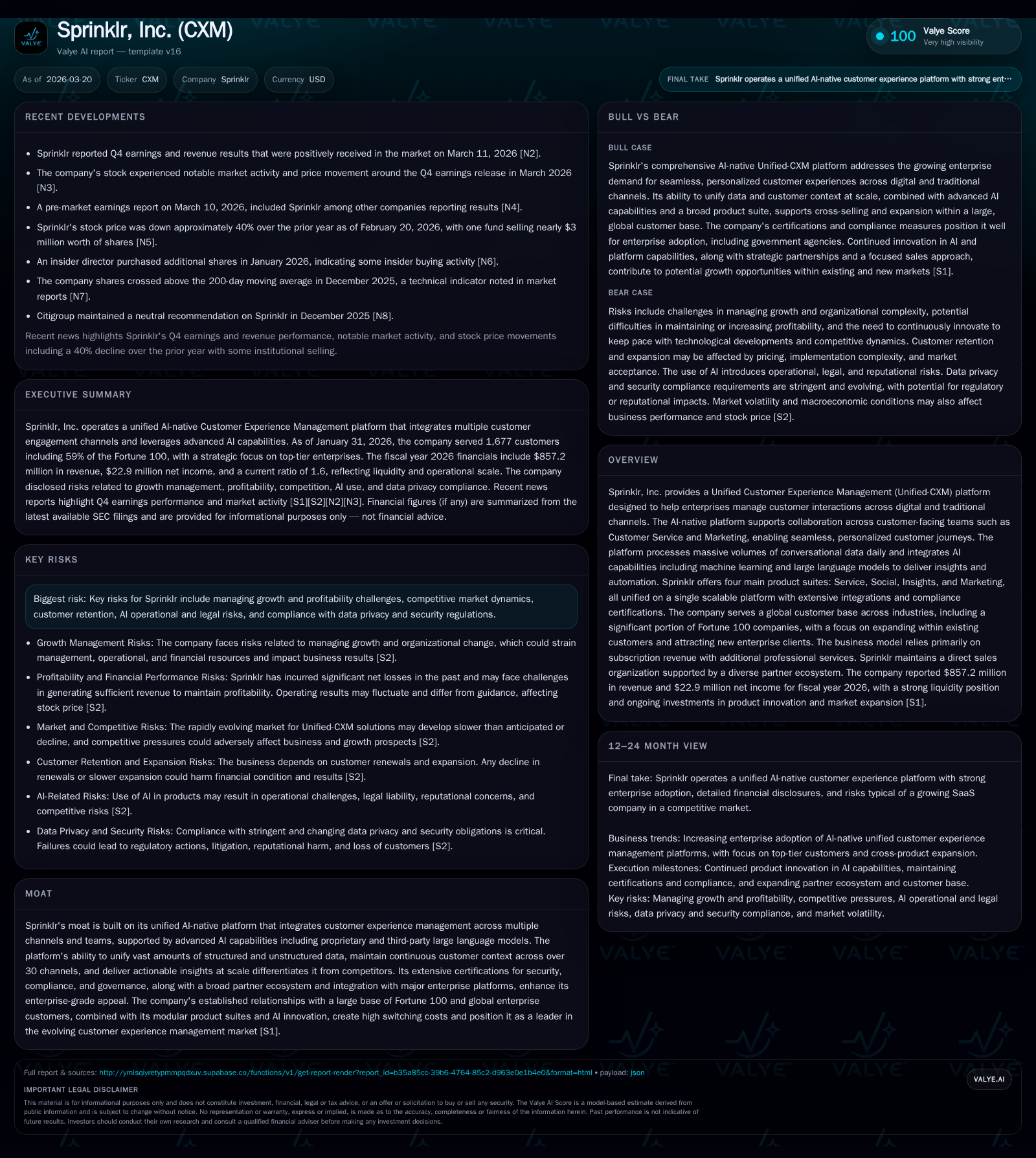
Sprinklr, Inc. has transitioned from years of net losses to a profitable fiscal year 2026, driven by growth in operating income and operating cash flows alongside a strategic refinement in its customer base emphasizing top-tier enterprise clients. The company’s unified customer experience management platform integrates AI and extensive channel connectivity, targeting expansion through deeper penetration within existing large customers and enhancements in international markets. Significant share repurchases underscore capital return discipline amid ongoing investments in R&D and professional services. Market risks include intensifying competition, customer retention challenges, and regulatory compliance pressures.
Historical Performance
Sprinklr has demonstrated significant financial improvement through fiscal year (FY) 2026 ending January 31, 2026 [F1]. Revenue reached $857.2 million for FY26, up approximately 7.6% from $796.4 million in FY25 [F1], reflecting continued adoption of its Unified-CXM platform despite a selective reduction in total customers.
Historical performance (annual)
| FY | Net ($mm) | CFO ($mm) | OpInc ($mm) | Capex ($mm) | Net YoY |
|---|---|---|---|---|---|
| 2026 | 23 | 159 | 40 | 1 | -81.2% |
| 2025 | 122 | 78 | 24 | 6 | +136.6% |
| 2024 | 51 | 71 | 34 | 9 | +192.2% |
| 2023 | -56 | 27 | -51 | 6 |
Source: SEC companyfacts cache [F1].
Capital returns and efficiency (annual)
| FY | Buybacks ($mm) | FCF ($mm) | ROE% |
|---|---|---|---|
| 2026 | 152 | 158 | 3.9 |
| 2025 | 274 | 72 | 19.9 |
| 2024 | 27 | 63 | 7.6 |
| 2023 | 0 | 21 | -10.1 |
Source: SEC companyfacts cache [F1].
Operating income grew substantially (+67.9%) in FY26 to $40.2 million due to cost efficiencies including reduced sales headcount and lower marketing expenses [S14]. Net income declined from an anomalous FY25 peak due in part to the absence of likely one-time items or tax benefits experienced earlier; nevertheless, Sprinklr delivered positive net income for the first time after prior losses [F1]. Operating cash flow more than doubled to $159 million aided by higher collections and efficient working capital management.
Total customers decreased from around 1,930 at FY25 to approximately 1,677 at FY26-end as Sprinklr refined its go-to-market focus towards larger enterprises—specifically those generating over $1 million in annual subscription revenue—which shrank slightly from 149 to 141 clients but increased average revenue beyond $3 million per client [S5]. This signals a deliberate pivot towards deeper account penetration and value realization from fewer but more strategically important clients.
Geographically, revenue outside the Americas grew to account for roughly 44% of total revenues from prior years around low-40%s [S4][S5]. This incremental international footprint was complemented by partnerships with global system integrators (GSIs), technology vendors like Microsoft and Salesforce, and an expanding channel ecosystem.
Future Growth Prospects
Sprinklr’s growth strategy centers on expanding within existing large accounts by selling additional product suites—Service, Social, Insights, Marketing—across multiple teams such as customer service operations and marketing departments [S17]. The integrated AI-native platform enables enterprises to unify siloed customer data across over thirty channels including social media messaging apps, web chat, voice interfaces, etc., enhancing personalized engagement at scale [S8][S20].
Further international expansion offers meaningful runway given increasing digital transformation investments globally; the platform supports over 150 languages easing localization barriers [S5]. Moreover, partnerships with hyperscalers and technology providers enhance Sprinklr’s market reach.
The company continues investing heavily in R&D (~11% of revenues), aiming to innovate AI features such as generative language models embedded across CX workflows [S14]. However, maintaining this innovation pace alongside operationalizing new AI tools safely presents both opportunity and risk.
Key challenges potentially capping growth include intense competition from point solutions across social listening, customer support software (CCaaS), marketing automation platforms, legacy CRM vendors adding CX modules, or consulting firms offering custom CX implementations [S11]. Additionally, evolving data privacy regulations (GDPR, CCPA), third-party platform policy changes (Apple/Google restrictions), and operational risks tied to AI use could constrain product adoption or increase compliance costs [S16][S28]. Retaining large enterprise customers amid shifting IT budgets remains critical given concentration dynamics.
Guidance & Milestones to Watch
While no explicit forward guidance was provided for FY27 in disclosed public filings or recent earnings releases [N1][S3], investors should monitor:
- The trajectory of large enterprise customer count versus average subscription revenue per account as a measure of effective upsell versus customer churn.
- International revenue growth sustaining above mid-40%s share.
- R&D investment trends relative to topline growth indicating innovation scale.
- Operating margin improvement metrics reflecting scaling efficiency post restructuring.
- Adaptation progress against tightening data privacy rules especially in EMEA markets.
- Market reception to new AI-driven product releases and depth of integration with major hyperscalers.
Returns & Capital Allocation
Sprinklr exhibits improving capital returns amid reinvestment commitments [F1][S9][S10]. The return on equity stands near 3.9% based on FY26 net income against shareholders’ equity around $592 million [F1]; while modest today, it marks progress toward profitability after prior substantial losses.
The company aggressively deployed cash for share repurchases: it consumed approximately $152 million repurchasing Class A stock under its authorized plans during FY26 alone [F1][S10]. This followed $274 million buybacks in FY25 mainly executed under expanded repurchase programs authorized through mid-2027 [S9][S10]. These activities indicate management prioritizing shareholder value return while maintaining liquidity; as of January 2026 it held roughly $163 million cash plus over $339 million liquid securities [F1][S7].
Capital expenditures have decreased significantly (-76% YoY), concentrated on cloud infrastructure rather than physical assets given the SaaS model's nature [F1][S14]. Operating cash flow generation has strengthened notably (+105% YoY), confirming robust business model scalability aided by subscription revenue stability and effective cost management [F1].
Competitive Position & Industry Dynamics
Sprinklr operates within the evolving experience management sector—a highly fragmented landscape featuring specialized vendors for social media monitoring, contact center software providers with AI-powered conversational tools (CCaaS), traditional CRM companies extending into CX capabilities, consulting firms deploying bespoke CX strategies—and generalist SaaS platforms aiming for broader engagement suites [S11].
Sprinklr differentiates itself through its unified architecture uniting Social Media Management (Social), Customer Service (Service), Customer Insights (Insights), and Marketing Automation on an AI-native cloud platform assembled over more than a decade [S8][S11]. This end-to-end scope combined with robust security/compliance certifications supports enterprise-grade requirements appealing to Fortune 100 clients covering diverse industries globally.
The platform’s continuous ingestion of structured/unstructured data signals from over thirty touchpoints enables richer contextual understanding enabling personalization beyond traditional CRM data fields that typically lack conversational depth or cross-channel continuity [S8][S20]. Partnerships with GSIs such as Accenture or Deloitte empower transformational deployments facilitating stronger stickiness given complex integrations required at scale [S13].
On the flip side, competitors innovate rapidly in niche segments—for example emergent startups focusing solely on AI-driven social listening analytics or homegrown digital care solutions optimized for specific verticals—posing ongoing threats if Sprinklr cannot maintain pace both technically and commercially [S11]. Furthermore regulatory complexity around third-party data sourcing combined with rising scrutiny related to AI fairness/privacy add layers of compliance risk impacting product development cycles.
Risk Landscape
Principal risks include: maintaining sustainable profitable growth amidst intense competition; potential difficulties retaining high-value enterprise accounts given buyers’ evolving priorities; operational/legal exposure stemming from proprietary AI tool deployment; stringent compliance demands under laws like GDPR/EU Digital Operational Resilience Act (DORA); reliance on third-party platforms which could alter policies limiting data access or integrations damaging service offerings; broader macroeconomic IT spend volatility influencing new contract signings or renewals; and potential litigation or activist shareholder interventions as occurred historically within tech sector peers affecting governance distractions or reputational harm [S6][S12][S16][S28].
Conclusion
Sprinklr stands at an inflection point having solidified profitability while executing a focused strategy honing in on top-tier enterprises suitable for expansive multi-product adoption enabled by its industry-leading unified CXM platform infused with advanced AI capabilities. Continued focus on operational efficiencies combined with disciplined capital allocation through share buybacks supports shareholder value creation.
Execution risks remain inherent due to competitive pressure coupled with complexity managing technological innovation alongside regulatory compliance in a rapidly changing digital engagement landscape.
Stakeholders should continue observing financial metrics tied closely to customer segmentation shift effectiveness, margin progression amid reinvestment cycles, regulatory adaptation initiatives especially overseas, advances in AI product suites rollout plus dynamics in strategic partnerships that expand Sprinklr's ecosystem reach worldwide.
This analysis is provided solely for informational purposes reflecting publicly available data without endorsement or investment recommendation about Sprinklr Inc.'s securities or business prospects.
Disclaimer: This is research-only, informational analysis and not investment advice. It may include AI-generated interpretation and general industry context. Always verify important details using primary sources.

Comments