
Digital Brands Group Reports Major Financial Turnaround and Forecasts Positive Cash Flow Starting September 2026
DBGI announces a near-term operating inflection driven by its collegiate program, while facing ongoing liquidity and leverage challenges as of mid-2026.
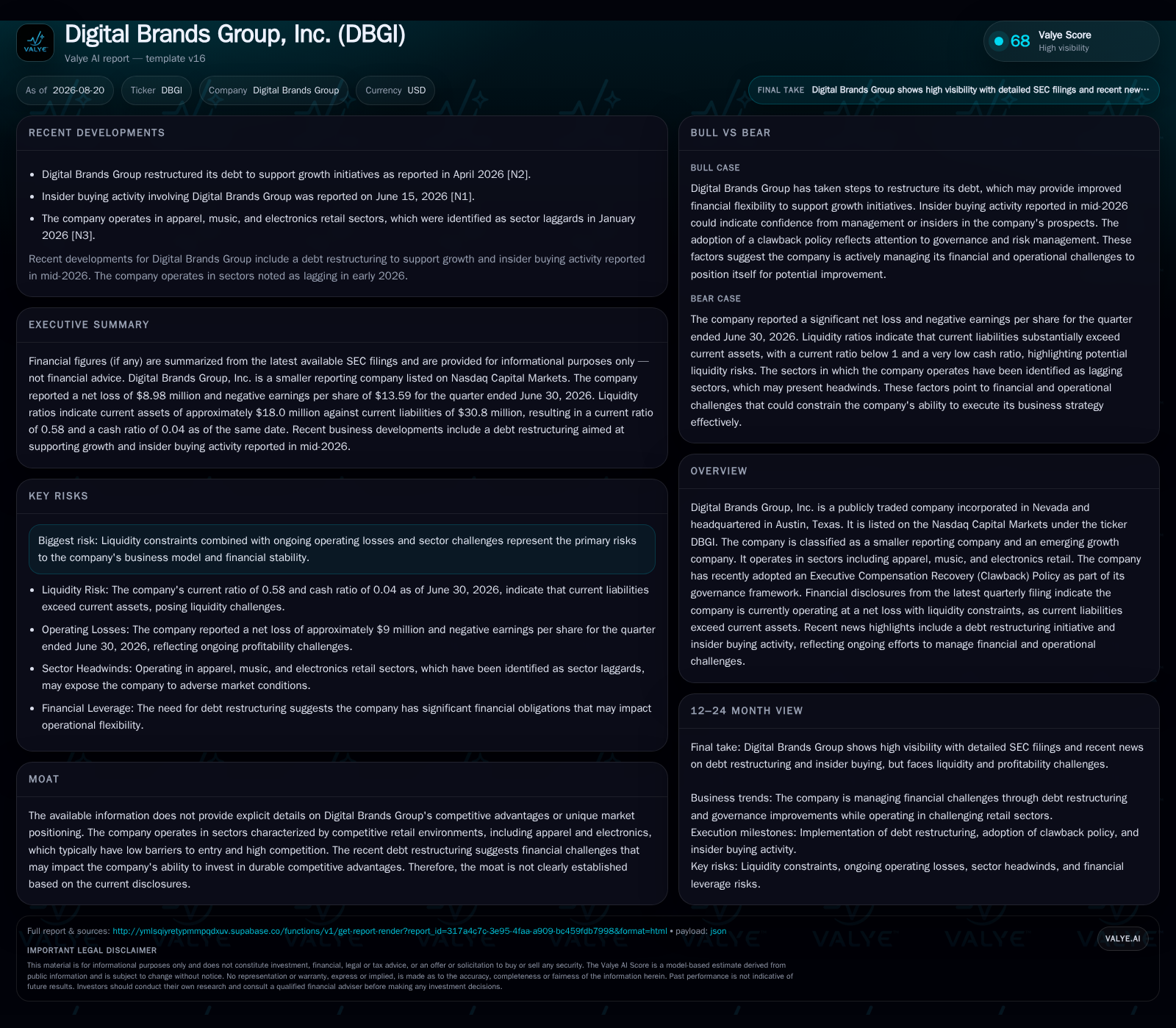
Digital Brands Group, Inc. (DBGI) disclosed a significant financial turnaround with expectations of positive cash flow beginning September 2026, primarily supported by growth in its collegiate program. Despite this operational improvement, the company's balance sheet as of June 30, 2026, reveals liquidity constraints with a current ratio of 0.58 and net debt near $16 million. DBGI continues to report net losses, underscoring persistent financial challenges. The near-term turnaround is a meaningful development but must be weighed against structural liquidity risks and leverage. Future quarters will be critical to validate sustained cash flow and improved financial stability.
Near-Term Operating Turnaround and Cash Flow Forecast
DBGI’s announcement of a major financial turnaround and the expectation of positive cash flow starting in September 2026 marks a significant near-term inflection point for the company’s operating performance [S3]. The collegiate program, which licenses apparel and branded products associated with universities and sports organizations, is identified as the primary driver of this improvement. This program’s growth appears to have enhanced revenue generation and operational efficiency relative to prior quarters, which were characterized by operating losses and negative cash flow [S2].
This turnaround announcement contrasts with the company’s recent financial challenges, suggesting that operational adjustments or market factors related to the collegiate program have improved cash flow dynamics. However, this forecast remains forward-looking and contingent on the sustained performance of the collegiate program and effective cost control.
Liquidity and Balance Sheet Constraints
Despite the optimistic cash flow forecast, DBGI’s balance sheet as of June 30, 2026, reveals significant liquidity constraints and leverage risks that temper the near-term outlook [F1]. This indicates that current liabilities exceed current assets by approximately $12.85 million, reflecting a structural working capital deficit that limits the company’s short-term financial flexibility [F1].
Further compounding liquidity pressures, DBGI’s total debt stood at $17.327 million with cash and equivalents of only $1.386 million, yielding net debt of roughly $15.94 million as of the same date [F1]. This level of leverage is substantial for a company still operating at a net loss, as reported in the latest quarterly filing [S2]. The combination of negative working capital and high net debt heightens refinancing risk and constrains the company’s ability to invest in growth or absorb operational shocks.
The persistence of net losses alongside these balance sheet challenges underscores the importance of the forecasted positive cash flow materializing as planned. Without a meaningful improvement in cash generation, DBGI may face increased difficulty meeting its short-term obligations and servicing debt, which could necessitate further restructuring or capital raising.
Business Model and Competitive Positioning
DBGI operates primarily in the retail apparel and branded products sector, generating revenue through sales of apparel and branded merchandise, including a collegiate licensing program [S1]. The collegiate program is a niche segment focused on retail consumers purchasing university- and sports-affiliated apparel, which has recently become the key driver of the company’s operating improvement and positive cash flow forecast [S3].
Revenue mechanics rely on consumer purchases of branded products, with margins and cash conversion influenced by product mix, sales volume, cost control, and inventory management [S2]. The collegiate program’s growth may enable DBGI to leverage operating efficiencies and improve margins, given its targeted market and potential for brand loyalty. However, the company’s recent operating losses and liquidity constraints indicate ongoing challenges in managing costs and scaling revenue effectively
DBGI operates in a competitive retail environment where price, assortment, and brand recognition are critical. The company does not disclose any explicit competitive moat, and its financial constraints may limit investment in differentiation or marketing. This would enable the company to invest in growth initiatives and reduce refinancing risk. Insider buying activity and the company’s own forecast lend medium confidence to this scenario [S3][S2][F1]. Ongoing debt management and capital raising would be necessary to maintain operations. This scenario is supported by the current balance sheet showing significant leverage and negative working capital, with high confidence [S3][F1]. Confirmation would include reduced but persistent net losses, stable yet suboptimal liquidity ratios, and disclosures of debt refinancing or capital raises.
- Bear Scenario: The anticipated turnaround fails to materialize, and DBGI continues to experience operating losses and worsening liquidity, potentially leading to insolvency risks or forced restructuring [S2][F1]. This scenario is plausible given the company’s weak financial position and reliance on the collegiate program’s success
In conclusion, Digital Brands Group’s announcement of a major financial turnaround and forecast of positive cash flow starting September 2026 highlights a potentially important inflection point driven by its collegiate program [S3]. However, the company’s balance sheet as of June 30, 2026, reveals significant liquidity constraints and leverage, underscoring ongoing financial risks [F1]. The sustainability of this turnaround depends on the collegiate program’s continued success and effective management of DBGI’s financial structure, with multiple scenarios possible based on these factors. Investors and stakeholders should closely monitor forthcoming financial disclosures and operational updates to assess the realization of this forecast and the company’s ability to navigate its structural challenges.
Disclaimer: This is research-only, informational analysis and not investment advice. It may include AI-generated interpretation and general industry context. Always verify important details using primary sources.

Comments