
Rivian Q2 2026: Revenue Growth and Narrowing Losses Amid Production Scaling
Rivian's Q2 2026 results demonstrate rising revenue from new vehicle deliveries and software expansion, alongside ongoing net losses driven by capital investments.
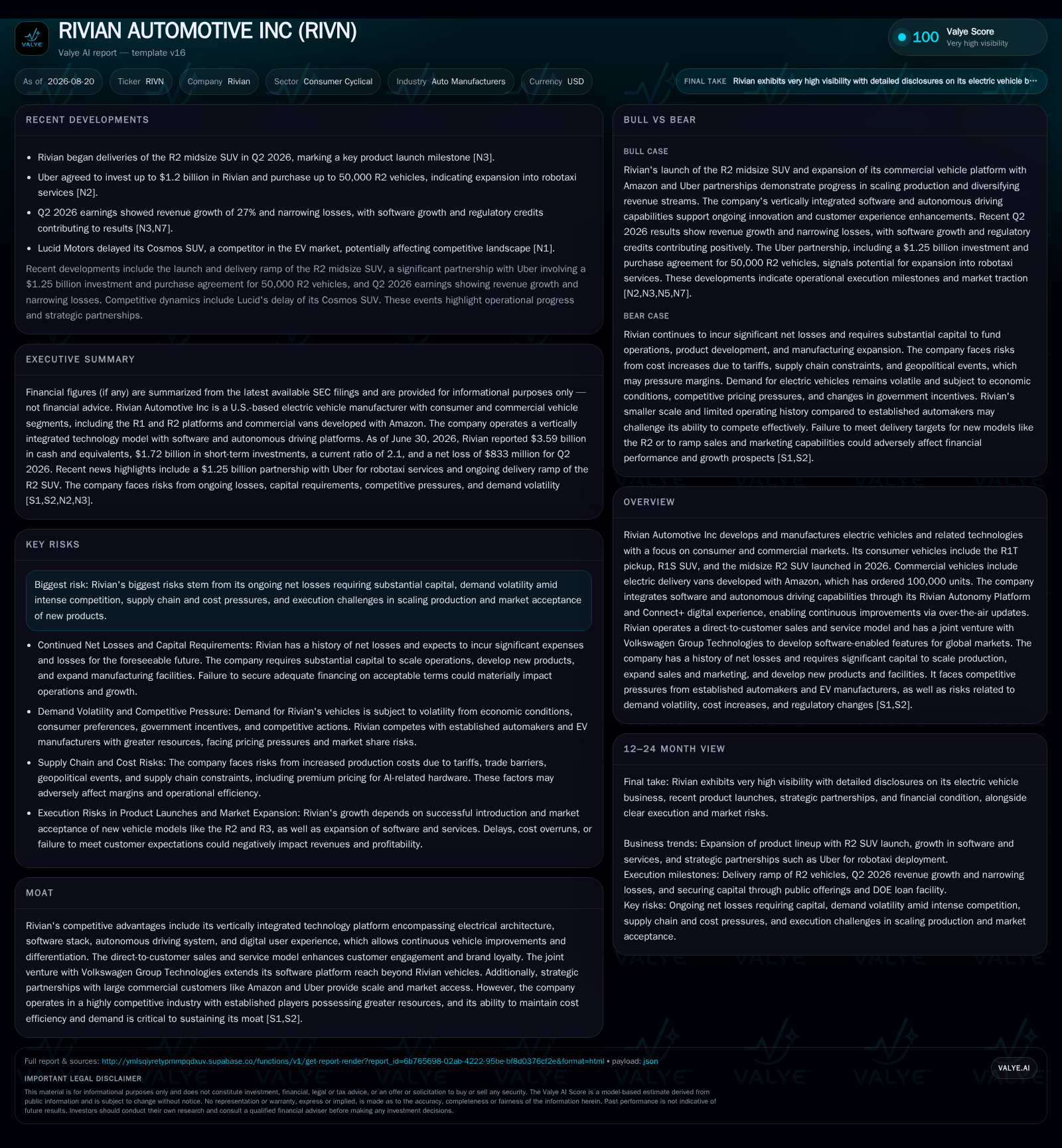
Rivian Automotive Inc reported a 27% increase in revenue for Q2 2026 compared to the same period in 2025, fueled by higher deliveries of its R2 SUV and commercial electric delivery vans. Despite this growth, the company continued to incur significant net losses, though these narrowed to $1,253 million in the first half of 2026 from $1,656 million in the prior year period, reflecting operational improvements amid ongoing investments. Rivian’s software and services segment is expanding, leveraging its vertically integrated technology platform, while a strong liquidity position supports continued capital expenditures and scaling efforts. The company’s ability to manage production scale, cost pressures, and software monetization will be critical to approaching profitability.
Q2 2026 Operating and Financial Performance
Rivian Automotive Inc reported a 27% increase in revenue for the second quarter of 2026 compared to Q2 2025, primarily driven by higher deliveries of its consumer R2 SUV and commercial electric delivery vans, including those produced for Amazon [S2]. This revenue growth signals expanding demand across both consumer and commercial segments, reflecting the company’s ongoing production ramp and market acceptance of new vehicle platforms. Despite this growth, Rivian continued to record net losses, though these narrowed to $1,253 million for the first half of 2026 from $1,656 million in the same period of 2025, indicating operational improvements during sustained investments in production and technology development [S2].
As of June 30, 2026, Rivian held $3.59 billion in cash and equivalents against total debt of $4.48 billion, resulting in a net debt position of approximately $883 million and a current ratio of 2.1, reflecting sufficient short-term liquidity to support ongoing capital-intensive operations [F1]. The company’s balance sheet position provides a financial buffer as it continues to scale manufacturing capacity and invest in new products.
Product and Market Development
Rivian’s product portfolio includes consumer electric vehicles such as the R1T pickup and R1S SUV, alongside the newer R2 SUV and commercial electric delivery vans developed in partnership with Amazon. The Q2 2026 results underscore the growing contribution of the R2 SUV and commercial vans to overall revenue, evidencing successful market penetration in both segments [S2]
Beyond hardware, Rivian is expanding its software and services segment, leveraging its vertically integrated technology platform. This includes the Rivian Autonomy Platform and Connect+ digital experience, which enable continuous vehicle improvements through cloud-based over-the-air (OTA) updates and support autonomous driving capabilities [S1][S2]. The growth of software revenue streams enhances product differentiation and offers potential recurring revenue beyond vehicle sales.
Strategic partnerships play a pivotal role in Rivian’s market development. The joint venture with Volkswagen Group Technologies aims to co-develop software-enabled features across multiple vehicle platforms, while commercial relationships with Amazon and Uber provide scale and validation for Rivian’s electric delivery vans and mobility solutions [S1][S2]. These alliances support technology development and broaden market access.
Business Model and Competitive Positioning
Rivian’s business model centers on direct-to-customer sales of electric vehicles to both consumers and commercial customers, supplemented by software and services revenue. The company’s vertically integrated technology platform enables control over vehicle software, digital user experience, and autonomous driving systems, allowing for continuous enhancements and product differentiation [S1]. This integration supports a seamless customer experience and potential cost advantages but also requires significant upfront investment.
Margins and cash flow in this capital-intensive industry depend heavily on production scale, manufacturing efficiency, and effective cost management. Rivian’s ongoing investments in production capacity, technology development, and go-to-market operations contribute to persistent net losses despite growing revenue [S2]. Competition from established automakers transitioning to electric vehicles and other pure-play EV manufacturers adds pressure on pricing and market share.
Financial Outlook and Capital Requirements
Capital expenditures remain significant to support production scale-up, new product development, and expansion of sales and service infrastructure. The company’s liquidity position, with a current ratio of 2.1 and net debt of $883 million as of June 30, 2026, provides a foundation to fund these investments in the near term [F1]. This liquidity buffer is critical given the company’s history of net losses and the capital intensity of scaling electric vehicle manufacturing.
Rivian’s net losses, while narrowing, still reflect the substantial operating expenses and capital expenditures required to build out production capacity and develop new technologies [S2]. The company’s ability to achieve profitability will depend on continued revenue growth, improved manufacturing efficiencies, and effective cost control. Additionally, external factors such as tariffs, supply chain disruptions, and changes in government incentives pose risks to cost structures and demand
Scenario Analysis and Investment Implications
Three plausible scenarios emerge based on Rivian’s current trajectory and market conditions:
Bull Scenario: Rivian successfully scales production and demand for its R2 SUV and commercial vans, achieves cost efficiencies, and expands software monetization. Confirmation would come from accelerating revenue growth, improving margins, and positive free cash flow. Conversely, demand slowdowns or rising costs could refute this outlook.
Base Scenario: Rivian maintains steady growth in vehicle deliveries and software revenue but continues to incur losses due to high capital expenditures and competitive pressures, delaying profitability beyond three years. Confirmation would include moderate revenue growth and stable margins, while rapid margin improvement or significant demand acceleration would refute it.
Bear Scenario: Rivian faces demand softness, cost inflation, and execution challenges leading to widening losses, liquidity strain, and potential need for additional capital raises. This is plausible given the competitive EV market and external cost pressures [S2][F1]. Confirmation would be revenue decline, widening losses, and deteriorating liquidity, while stable deliveries and strong cash position would refute it.
Conclusion and Watchpoints
Rivian’s Q2 2026 results demonstrate meaningful progress in scaling production and market acceptance of its new vehicle platforms, particularly the R2 SUV and commercial electric delivery vans, contributing to a 27% revenue increase year-over-year [S2]. The narrowing of net losses reflects operational improvements but also highlights the ongoing capital intensity and cost challenges inherent in the company’s growth phase [S2].
As of June 30, 2026, the company held $3.59 billion in cash and equivalents and reported a current ratio of 2.1, indicating available liquidity relative to short-term obligations [F1]. The net debt of approximately $883 million and ongoing capital expenditures highlight the need for careful management of cash flow and cost structures to support continued investments in production capacity and technology development [F1].
These metrics will provide critical insight into Rivian’s ability to move toward sustainable profitability amid a competitive and capital-intensive electric vehicle industry.
The balance sheet strength offers near-term support, but sustained operational improvements and market expansion are essential for long-term financial viability.
Disclaimer: This is research-only, informational analysis and not investment advice. It may include AI-generated interpretation and general industry context. Always verify important details using primary sources.

Comments