
DocGo Inc.'s Revenue Halves in 2025 Amid Strategic Shifts and Liquidity Challenges
DocGo’s vertically integrated mobile healthcare and transport platform faces substantial revenue declines and operational losses while pursuing a pivot toward value-based care.
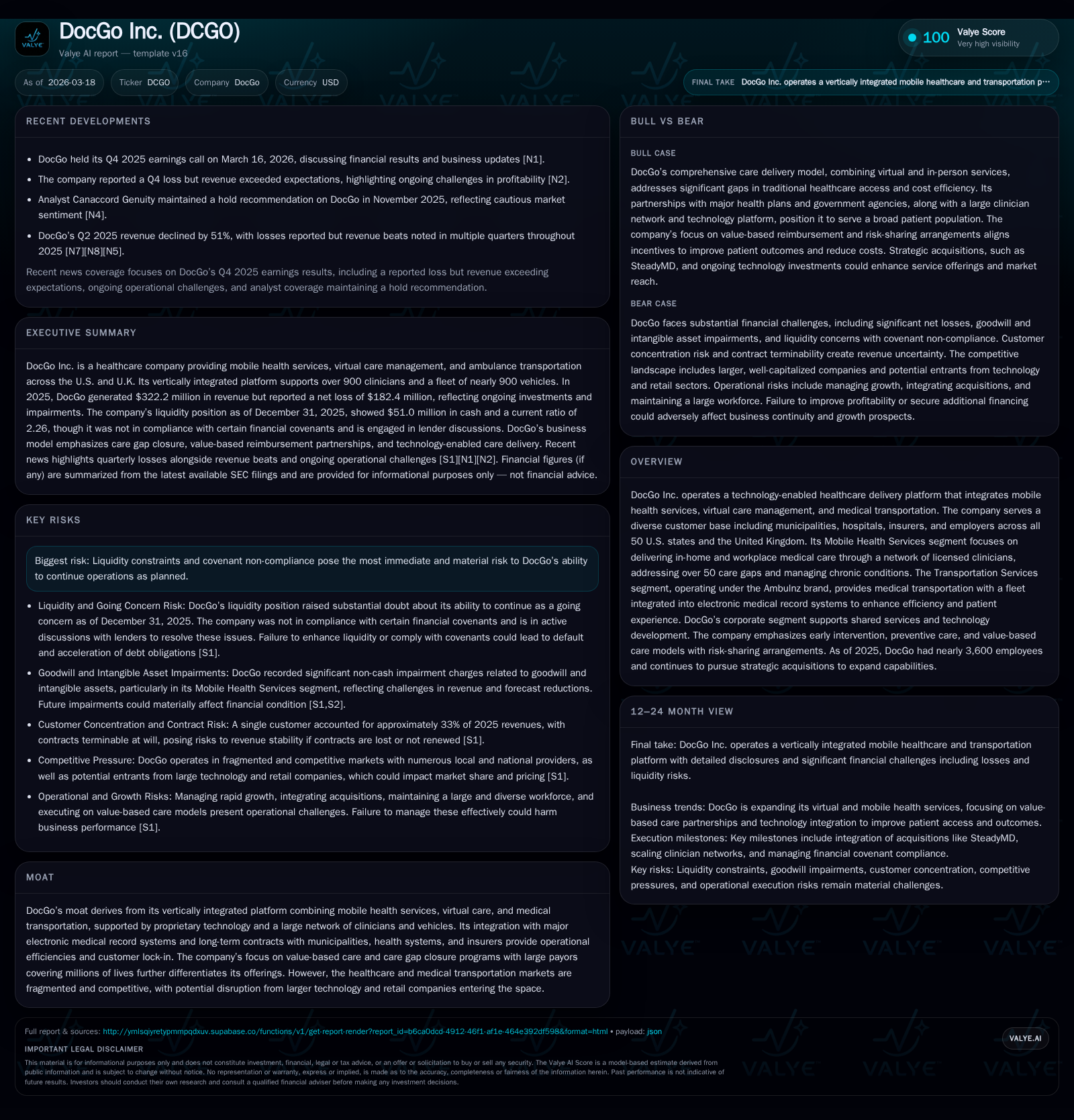
In 2025, DocGo Inc. reported a steep revenue decline of nearly 48% following prior years of growth, driven by loss of key municipal contracts and an evolving business strategy emphasizing virtual care and chronic disease management. Despite positive operating cash flow, heavy operating losses and goodwill impairments weighed on results. The company's capital structure shows covenant non-compliance risks and limited headroom. Going forward, revenue growth hinges on expanding value-based programs with payors covering over 60 million lives, geographic expansion, and leveraging acquired virtual care assets. Monitoring liquidity developments and contract renewals will be critical in the near term.
Historical Financial Performance
DocGo’s financial trajectory over recent years has been volatile with significant top-line fluctuation driven primarily by changes in its municipal contracts and strategic repositioning within mobile healthcare. Annual revenues reached $624 million in 2023, plateaued at approximately $617 million in 2024, before plunging almost 48% to $322 million in 2025 [F1]. This collapse corresponds largely to the loss of key customers such as municipal agencies that historically contributed disproportionately to revenue — notably one public benefit corporation representing roughly one-third of total sales in 2025 [S18].
Operating income mirrored this pattern but more dramatically; DocGo swung from profitability with an operating income of $29 million in 2024 to a steep operating loss of $178 million in the most recent year [F1]. This deterioration is attributable not only to reduced revenues but also to sizable non-cash goodwill impairment charges linked to underperformance within Mobile Health Services [S2]. Net income followed the same adverse trend, moving from positive territory ($35 million net income in 2022) into a significant net loss exceeding $182 million in 2025 [F1].
While operational profitability suffered, cash flow metrics depict a partial silver lining. Operating cash flow remained positive at $34.4 million despite revenue contraction — down roughly half from $70.3 million in 2024 — allowing for modest free cash flow of approximately $30 million after capital expenditures which rose moderately by nearly 19% year-over-year [F1]. This suggests tight management of working capital but also highlights constrained reinvestment capacity.
Historical performance (annual)
| FY | Rev ($mm) | Net ($mm) | CFO ($mm) | OpInc ($mm) | Rev YoY | Net YoY |
|---|---|---|---|---|---|---|
| 2025 | 322 | -182 | 34 | -178 | -47.7% | |
| 2024 | 617 | 70 | 29 | -1.2% | ||
| 2023 | 624 | -64 | 15 | +41.7% | ||
| 2022 | 441 | 35 | 29 | 22 | +80.3% |
Source: SEC companyfacts cache [F1].
Capital returns and efficiency (annual)
| FY | Buybacks ($mm) | FCF ($mm) | ROE% |
|---|---|---|---|
| 2025 | 11 | 30 | -126.7 |
| 2024 | 14 | 67 | |
| 2023 | 0 | -72 | |
| 2022 | 4 | 26 | 12.7 |
Source: SEC companyfacts cache [F1].
Note: Buybacks started occurring more meaningfully only since FY22.
Business Overview and Competitive Position
DocGo has positioned itself as an innovator in proactive healthcare delivery by integrating mobile health services, virtual care management, and medical transportation into a single technology-enabled platform [S11][S25]. Its Mobile Health Services segment delivers comprehensive at-home or workplace medical services addressing over fifty care gaps, including chronic condition management particularly among Medicare Advantage and Medicaid populations [S11]. The company operates under long-term contractual relationships with municipalities, hospital networks, insurers, and employers spread across all U.S. states plus operations in the UK.
The Transportation Services segment predominantly operates through the Ambulnz brand offering medical transportation supported by technology integration directly linking dispatch with electronic medical record systems — enhancing coordination efficiency compared to many fragmented competitors [S11][S24].
DocGo's moat lies primarily in its vertical integration combining these disparate yet complementary healthcare engagement points into one seamless delivery chain backed by proprietary software platforms helping manage clinical workflows and billing processes more efficiently than many individual legacy providers [S11][S24]. Nonetheless, competition is intense: local ambulance services remain fragmented but entrenched; large national EMS players such as Global Medical Response leverage scale; meanwhile cutting-edge telehealth companies including DispatchHealth, Teladoc, Amwell, Signify Health (CVS), MedArrive and Amazon’s One Medical compete vigorously within overlapping service segments [S20][S24]. The entry of tech giants and retailers like Apple or Walmart into adjacent telehealth markets could exert disruptive pressures.
Recent Developments and Future Growth Drivers
Key strategic shifts underpinning DocGo’s outlook revolve around enhancing virtual care capabilities — exemplified by its acquisition during 2025 of a comprehensive nationwide telehealth network serving Fortune 10 clients alongside a regional mobile phlebotomy provider [S11]. This expansion supports a transition towards value-based care frameworks designed to close clinical gaps for millions covered under payer programs including Elevance Health, Molina, LA Care among others totaling over sixty million lives [S11]. By focusing on these programs emphasizing preventive care and chronic disease management through hybrid modalities combining virtual visits with augmented onsite clinician presence, DocGo aims to capture growing reimbursement pools tied to quality outcomes rather than volume.
However, such transformations carry inherent execution risks including gaining sufficient market acceptance rapidly enough to offset lost traditional fee-for-service volumes; integrating acquisitions successfully; scaling cost structures without exacerbating losses; and navigating complex multi-jurisdictional regulatory environments subject to frequent change or interpretation especially around billing compliance [S1].
Municipal contract instability manifested sharply as noted revenue dropoffs also highlight dependency concerns despite diversification efforts [S18]. Furthermore, DocGo continues actively seeking new payor relationships while aiming for deeper penetration within existing partners — effectively testing its platform’s scalability across additional states leveraging both technology investments and workforce deployment efficiencies [N1][N2][S11].
From a timing perspective, upcoming milestones include monitoring quarterly updates on contract renewals/expansions particularly relating to Mobile Health Services gap closure programs alongside further progress reports on virtual care population health initiatives targeting chronic conditions impacting tens of thousands currently managed remotely via proprietary monitoring platforms secured during recent expansions [N1][S11].
Capital Structure and Liquidity Considerations
As of December-end 2025, DocGo held approximately $51 million in cash equivalents against current liabilities totaling about $67 million yielding a current ratio near healthy at ~2.26x [F1]. Yet lurking beneath is substantial leverage constrained by covenants related to its revolving credit facility valued initially at $55 million with possible incremental commitments up to $20 million subject to lender discretion .
Crucially though, DocGo was not compliant with minimum liquidity covenants as per latest filings but remains engaged in ongoing lender negotiations aimed at covenant waivers or amendments preserving access to working capital lines critical for near-term operations [N2]. Failure to achieve resolution would risk acceleration clauses triggering potential foreclosure events that could materially disrupt business continuity.
Total equity contracted swiftly due primarily to net losses dropping below $144 million as compared with over $320 million one year earlier highlighting capital erosion pressures [F1]. Share repurchases persisted albeit scaled down relative to previous periods spending roughly $10.8 million during FY25 possibly reflecting confidence in stock valuation despite operational challenges though no dividends were declared consistent with typical growth/restructuring playbooks [F1][S17].
Given operating profitability remains elusive coupled with contractual revenue volatility plus intensified competition requiring ongoing investment, financial flexibility represents a critical watchpoint going forward.
Risks Overview
DocGo confronts numerous risks including:
- Contract dependency: Concentration among few large government-related clients with contracts terminable on short notice risking sudden revenue loss.
- Regulatory environment: Complex overlapping federal/state healthcare laws such as HIPAA compliance gaps risk costly investigations/fines impacting reputation and finances.
- Litigation exposure: Ongoing legal proceedings typical for healthcare providers could impose material settlements or operational constraints.
- Market competition: Both established ambulance operators and emerging telehealth giants impose pricing pressures plus innovation imperatives.
- Liquidity constraints: Covenant violations raise immediate concerns regarding access to credit lines essential for working capital.
- Execution risks: Scaling value-based offerings amidst industry shifts entails substantial uncertainty regarding reimbursement models adoption rates.
These are well documented extensively within their recent SEC filings highlighting dependence on continued regulatory compliance effectiveness alongside successful strategic adjustments [S1][S4].
What To Watch Next: Analysis Perspective
Absent explicit formal guidance beyond earnings commentary available post Q4/25 results release [N1][N2], stakeholders should closely monitor:
- Quarterly revenue trends especially stabilization or recovery signals within Mobile Health Services post sizable prior contractions.
- Updates on key contractual renewals or customer additions indicative of enhanced market footprint expansion.
- Progress on debt covenant resolutions providing clarity on financial runway.
- Operating margin trajectory improvements linked to integration of virtual care assets into core offerings.
- Management commentary regarding acquisitions pipeline or further capital allocation plans including buybacks or potential dividends.
- Competitive responses arising from major industry consolidations or retail-tech entrants reshaping market dynamics.
Collectively these will frame whether DocGo can successfully pivot its business model toward sustainable profitability while managing liquidity headwinds inherent during transitional phases.
This analysis is based solely on documents provided through March 18, 2026 without any form of investment advice.
Disclaimer: This is research-only, informational analysis and not investment advice. It may include AI-generated interpretation and general industry context. Always verify important details using primary sources.

Comments