
Deere & Company’s Shifting Growth Trajectory and Capital Strategy
Analyzing Deere's recent revenue contraction, strategic technology initiatives, and evolving approaches to capital deployment amid a cyclical market environment.
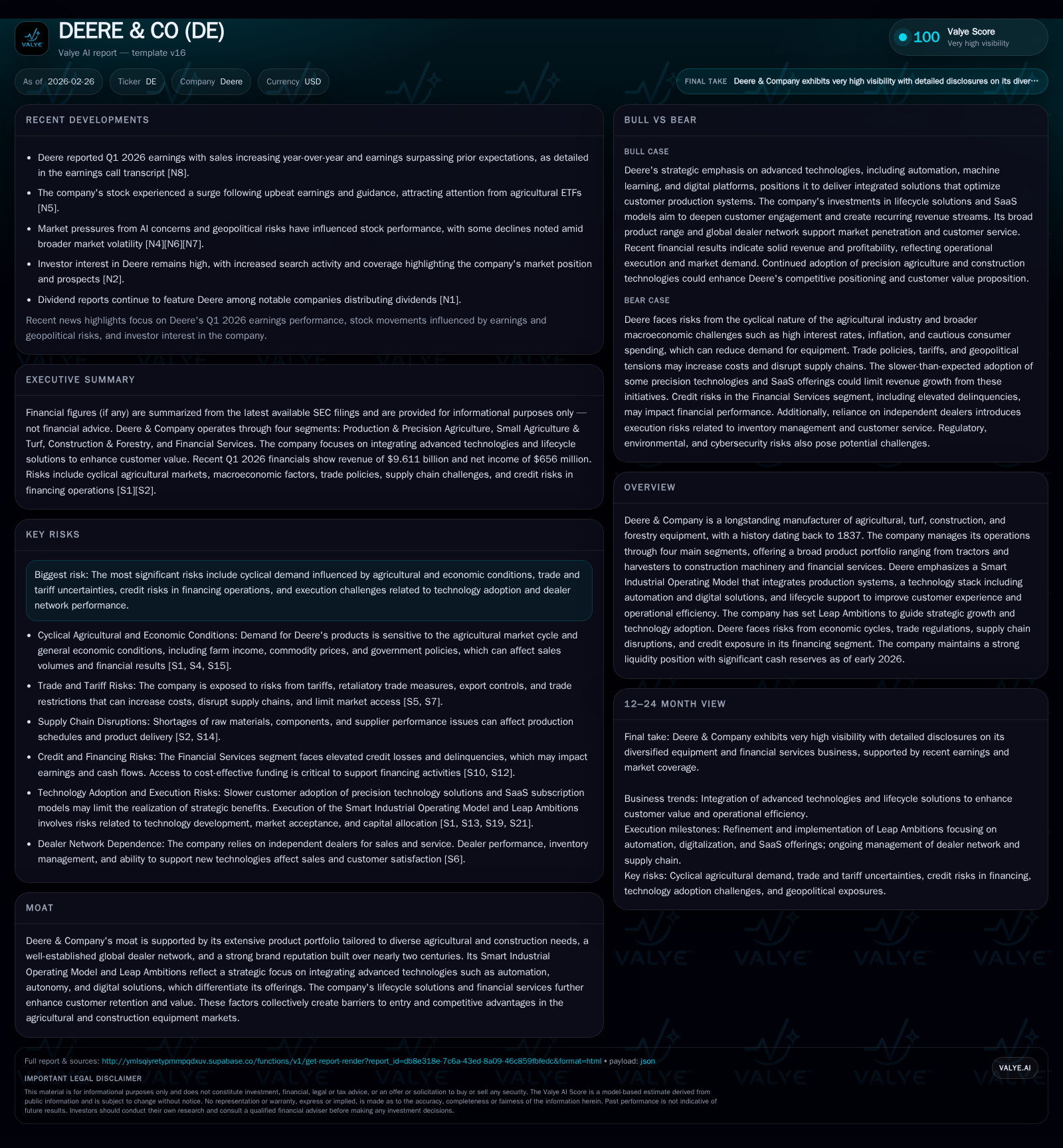
Deere & Company has experienced a marked decline in revenues and profits from FY2023 to FY2025, reflecting agricultural market cyclicality and economic headwinds that have dampened equipment demand. Despite this top-line pressure, the company delivered an earnings beat in Q1 FY2026 supported by operational controls and improved sales mix, underscoring resilience. Deere’s Smart Industrial Operating Model and Leap Ambitions signpost a pivot toward embedding technology such as automation and digital lifecycle solutions as growth levers. Capital allocation balances moderating buybacks with steady dividend growth while maintaining strong free cash flow generation. Regulatory scrutiny over repair restrictions remains a material risk, imposing potential constraints on after-sales flexibility. Strategic execution across dealer networks and technology adoption will be key watchpoints heading into 2026.
Historic Revenue and Profit Trends Reveal Market Cyclicality
Deere & Company’s financial performance from FY2023 through FY2025 highlights the impact of agricultural market cycles combined with broader macroeconomic headwinds. Revenue contracted from approximately $61.3 billion in FY2023 to $45.7 billion in FY2025—a nearly 12% decline year-over-year between the latter two years—primarily driven by lower equipment sales volumes amidst challenging farm income dynamics and cautious customer spending [F1][S1].
Operating income saw an over 30% decline from about $9.0 billion in FY2024 to a lower level in FY2025 [F1], reflecting mix shifts towards lower-margin products compounded by elevated financing costs and greater reliance on sales incentives during this period [S1]. Net income followed similar declines signaling margin pressure across the enterprise. This contraction reflects Deere’s sensitivity to commodity price swings, farmland values, trade dynamics, and inflation effects characteristic of the agricultural cycle [S1].
Core Business Segments Fueling Growth and Presenting Challenges
Deere’s operations are segmented into Production & Precision Agriculture (PPA), Small Agriculture & Turf (SAT), Construction & Forestry (CF), and Financial Services (FS), each exhibiting distinct risk-reward profiles [S7][S19]. The PPA segment includes heavy-duty tractors and row crop equipment essential for large-scale farming; this segment remains central but volume demand has softened due to subdued crop prices and economic uncertainty affecting farmer investment decisions [S19].
Precision agriculture technologies integrated within PPA serve as a key growth lever by enabling data-driven farming practices through automation and connectivity features—the "technology stack" layered onto traditional equipment—with ongoing efforts to increase adoption despite some customer hesitance linked to understanding SaaS value propositions [S7][S26]. Small Agriculture & Turf addresses specialty tractors, commercial mowing equipment, and golf course machinery catering to smaller-scale or recreational uses; market conditions here remain stable but less volatile than core ag equipment.
The CF segment comprising backhoe loaders, skid steers, excavators, roadbuilding machinery, and timber harvesters aligns more closely with infrastructure spending cycles subject to regional construction levels [S19]. Though offering diversification beyond agriculture, CF growth is constrained by housing market softness and governmental infrastructure budgets [S1]. The Financial Services arm supports a substantial portion of global equipment sales through customer financing but faces elevated credit risks stemming from delinquencies exacerbated by farm income softness—a key operational challenge flagged in disclosures that could influence earnings volatility going forward [S11][S1].
Emerging Opportunities from Smart Industrial Model and Technology Push
An integral part of Deere’s strategy is its Smart Industrial Operating Model consolidating three pillars: Production Systems alignment focused on customers’ workflows; an advanced Technology Stack embedding connectivity, automation, machine learning, autonomy; and Lifecycle Solutions enhancing aftermarket services such as proactive maintenance subscriptions [S19]. Leap Ambitions further refine these initiatives targeting sustainable long-term growth by embedding SaaS models alongside hardware offerings.
These digital transformation efforts aim not only to differentiate Deere technologically but also extend revenue streams through higher lifecycle value extraction via connected services—reflecting a shift toward recurring revenue amid cyclical product sales pressures. Execution risk persists given slower-than-expected adoption among farmers unfamiliar with subscription-based models as well as complexities inherent in dealer training on digital tools [S26]. Success here is crucial for offsetting margin compression in traditional manufacturing segments.
Analysis of Recent Earnings Beat Against Macroeconomic Hurdles
In Q1 FY2026 results announced February 19th (latest available report), Deere delivered an earnings beat with improved year-over-year sales despite persistent inflationary pressures and elevated interest rates hampering investment appetite including agriculture [N3][N1][S2]. Sales growth partially reflected favorable product mix shifts toward higher-tech equipment integrated with smart solutions.
The firm highlighted ongoing challenges related to credit exposure within John Deere Financial amid elevated delinquencies reflecting agricultural customers’ payment difficulties under current economic conditions—likely constraining free cash flow flexibility near term [N3][S1]. Inflation pressures on raw material costs are exacerbated by tariffs especially on imports from Mexico after production shifts there added incremental duties; management notes ongoing mitigation efforts including supply chain optimizations [N1][S21]. This juxtaposition of positive near-term momentum against structural macroeconomic headwinds highlights Deere's balancing act moving forward.
Capital Allocation: Balancing Shareholder Returns with Strategic Investment
Financial data shows Deere maintained robust operating cash flows through FY2025 at approximately $7.46 billion but reduced capital expenditures by about 17% relative to prior year signaling some tightening amid revenue contraction [F1]. Free cash flow remained healthy at roughly $6.10 billion after capex absorption providing capacity for returns alongside strategic spends.
Return on equity hovered near 19.4%, reflecting solid profitability relative to shareholder equity even amid cyclicality-induced earnings moderation [F1]. Dividend payments steadily increased year-over-year with about $1.72 billion paid in FY2025 versus $1.60 billion in FY2024 signaling commitment despite tougher conditions.
Conversely share buybacks decelerated markedly from $4.01 billion in FY2024 down to about $1.14 billion in FY2025 reflecting probable prioritization of liquidity preservation or reinvestment into R&D under the Smart Industrial model ambitions cited earlier [F1]. At February 2026 quarter-end Deere held nearly $6.8 billion in cash equivalents underscoring strong liquidity supporting capital deployment flexibility.[F1]
Monitoring Legal Risks Impacting Operational Freedoms
Deere faces significant legal scrutiny over alleged monopolistic practices focused on repair service restrictions involving limited access to diagnostic tools for independent repair shops—a point raised notably by the FTC along with several state attorneys general filing lawsuits seeking injunctions compelling Deere to open repair channels previously limited only to authorized dealers or technicians [S4][S5].
Despite motions filed by Deere attempting dismissal (denied by courts) negotiations remain ongoing but unresolved as of late 2025. This legal cloud poses business model risks because forced remedies may curtail aftermarket service exclusivity forming part of Deere’s customer retention strategy under lifecycle services pillars.[S5] Beyond financial penalties potential operational impacts include changes required to service logistics possibly diluting dealer channel strength or necessitating increased compliance investments.
Key Metrics Table: Operational and Financial Evolution Over Four Years
Historical performance (annual)
| FY | Rev ($bn) | Net ($bn) | CFO ($bn) | OpInc ($bn) | Rev YoY | Net YoY |
|---|---|---|---|---|---|---|
| 2025 | 45.7 | 5.0 | 7.5 | -11.7% | -29.2% | |
| 2024 | 51.7 | 7.1 | 9.2 | 9.0 | -15.6% | -30.2% |
| 2023 | 61.3 | 10.2 | 8.6 | 13.0 | +16.5% | +42.6% |
| 2022 | 52.6 | 7.1 | 4.7 | 9.5 |
Source: SEC companyfacts cache [F1].
Capital returns and efficiency (annual)
| FY | Div ($mm) | Buybacks ($bn) | FCF ($bn) |
|---|---|---|---|
| 2025 | 1720 | 1.1 | 6.1 |
| 2024 | 1605 | 4.0 | 7.6 |
| 2023 | 1427 | 7.2 | 7.1 |
| 2022 | 1313 | 3.6 | 3.6 |
Source: SEC companyfacts cache [F1].
Note: Operating income for FY2025 is not separately reported but indicated falling per disclosures.
Outlook Considerations for Investors
Looking ahead into 2026 several pivotal factors will influence Deere’s trajectory:
- Technology Adoption: The pace at which customers embrace precision ag technologies, autonomy features, and SaaS subscription models will affect realization of Leap Ambitions goals (,[S26]).
- Trade Policy Dynamics: Shifts mitigating tariff burdens or escalating trade barriers will materially impact cost structures given production footprints spanning U.S., Mexico, Europe ([S21],[S16]).
- Dealer Network Execution: Dealer effectiveness at inventory management and servicing high-tech products stands as a critical enabler or bottleneck for demand ([S15]).
- Macroeconomic Environment: Inflation persistence combined with interest rate variability shapes equipment purchase affordability influencing order books ([N3],[S1]).
- Credit Exposure Management: Elevated delinquency risk within John Deere Financial requires monitoring due to potential earnings drag ([S11]).
- Regulatory Outcomes: Resolution of antitrust litigation could alter aftermarket service economics challenging established customer lock-in strategies ([S4],[S5]).
Amid these watchpoints Deere's ability to innovate operationally while judiciously deploying capital balancing shareholder returns against investment needs will define sustainable recovery from cyclical troughs since FY2023.
This analysis is based solely on publicly available filings including annual reports and recent SEC documents as well as official company disclosures without speculative projections or investment recommendations.
Disclaimer: This is research-only, informational analysis and not investment advice. It may include AI-generated interpretation and general industry context. Always verify important details using primary sources.

Comments