
DHT Holdings’ Fleet Modernization and Capital Returns Reflect Industry Challenges
DHT’s recent earnings growth contrasts with revenue declines as it invests in new vessels and maintains shareholder payouts.
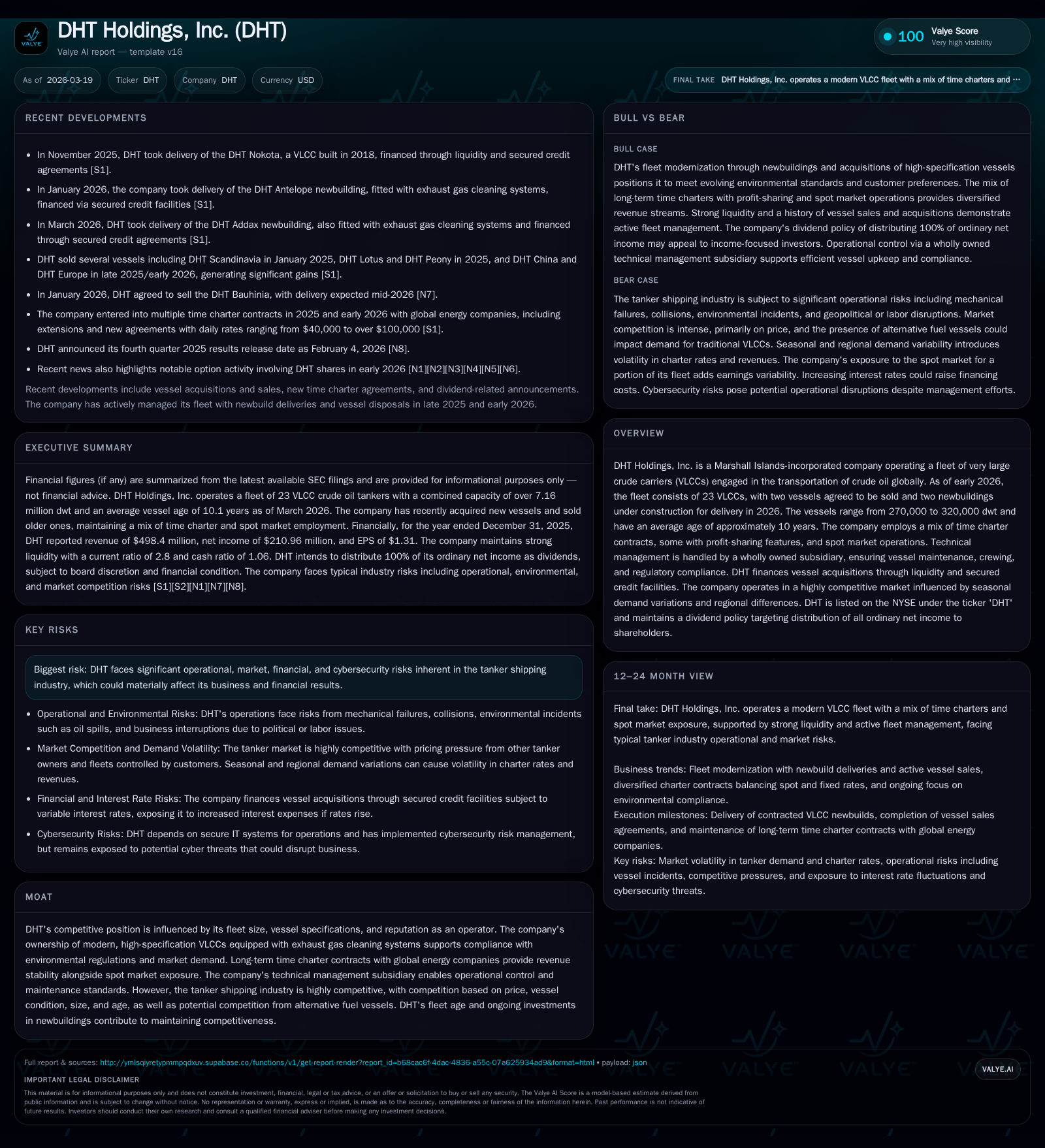
DHT Holdings, a Marshall Islands-based owner of very large crude carriers (VLCCs), reported a 12.8% revenue decline in 2025 despite a 16.3% increase in net income. This divergence highlights operational leverage driven by its mix of time charter and spot market exposure amid volatile tanker rates. The company is actively modernizing its fleet, commissioning two new high-spec VLCCs for delivery in 2026, equipped with exhaust gas cleaning systems to meet environmental standards. While revenues have softened due to market cyclicality and competition, DHT continues to prioritize returning capital to shareholders through dividends and limited share repurchases, supported by a healthy liquidity profile and manageable debt. Market watchers should monitor freight rate trends and newbuilding deliveries to assess DHT’s capacity to sustain earnings momentum.
A Track Record of Robust Profit Growth Amid Flatter Revenues
DHT Holdings exhibited a notable financial contrast in fiscal year 2025. Total revenues contracted by approximately 12.8% year-over-year to $498 million, down from $572 million in 2024 [F1]. This top-line softness was influenced by cyclical downturns typical of the highly competitive VLCC shipping sector, where freight rates notably fluctuated due to seasonality and global crude oil trade patterns.
Despite this revenue dip, net income increased markedly by 16.3%, reaching $211 million compared to $181 million the prior year [F1]. This jump evidences significant operating leverage inherent in DHT's business model: fixed vessel operating costs combined with a fleet mix that includes long-term time charters insulating some earnings even as spot rates ebb. Additionally, gains may reflect improved fleet utilization or judicious cost management across technical operations.
Historical performance (annual)
| FY | Rev ($mm) | Net ($mm) | Rev YoY | Net YoY |
|---|---|---|---|---|
| 2025 | 498 | 211 | -12.8% | +16.3% |
| 2024 | 572 | 181 | +2.0% | +12.4% |
| 2023 | 561 | 161 | +23.4% | +160.4% |
| 2022 | 454 | 62 |
Source: SEC companyfacts cache [F1].
Capital returns and efficiency (annual)
| FY | Div ($mm) | ROE% |
|---|---|---|
| 2025 | 119 | 18.6 |
| 2024 | 161 | 17.4 |
| 2023 | 187 | 15.6 |
| 2022 | 20 | 5.8 |
Source: SEC companyfacts cache [F1].
Table: Historical Performance Overview (FY2023–FY2025) showing revenue contraction alongside growing profitability and dividends [F1]
Fleet Composition and Operational Modalities Anchor Competitive Position
As of early 2026, DHT's operating fleet encompasses 23 Very Large Crude Carriers (VLCCs), each between approximately 270,000 and 320,000 deadweight tons (dwt), maintaining a combined capacity above seven million dwt [S1]. The average fleet age is about ten years — an influential factor when competing on crew credentials, fuel efficiency, and regulatory compliance.
Ownership extends over all vessels either directly or through wholly owned subsidiaries domiciled in the Marshall Islands [S1]. The company employs a dual operational approach: roughly half the fleet operates under time charter contracts providing revenue certainty; the remainder sails under spot market exposure that can yield higher but more volatile returns [S2].
A critical competitive differentiator is DHT’s internal technical management subsidiary responsible for crewing logistics, maintenance scheduling, regulatory compliance including vetting approvals, and drydockings [S1]. This operational control promotes superior vessel condition—a key tariff driver among charterers who balance price against reliability and environmental compliance.
Most vessels are equipped with exhaust gas cleaning systems (“scrubbers”), enabling adherence to evolving IMO sulfur emissions limits without incurring high-cost fuel switches [S1]. This environmental compliance capability is increasingly necessary for accessing certain trade routes where port state controls penalize excessive emissions.
Investment in Newbuildings and Environmental Compliance Driving Future Readiness
Further emphasizing modernization priorities, DHT has contracted two new VLCCs scheduled for delivery during the first half of 2026 at Hyundai Samho Heavy Industries [S23]. These vessels feature advanced environmental technologies including exhaust gas cleaning systems.
Investment figures over recent years include approximately $386 million on four newbuilding contracts alongside $23 million spent retrofitting eight older vessels with scrubbers [S1][F1]. Additional acquisitions include two secondhand vessels purchased for $201 million providing strategic fleet renewal without full newbuild lead times.
These capital expenditures reflect management’s response to tightening environmental regulations and the need to maintain a competitive average fleet age which could otherwise pressure charter rates for older ships or limit employment options.
However, such expenditures weigh on free cash flows given the capital intensity of tanker ownership—highlighting the ongoing tradeoff between maintaining competitiveness via modern assets versus liquidity preservation.
Navigating Market Cyclicality, Competition, and Risk Factors
The VLCC market's cyclical nature subjects DHT’s revenues to external factors including seasonal demand swings dependent on macroeconomic conditions [S29]. Spot charter rates vary widely depending on regional refinery demand differentials and geopolitical events affecting shipping lanes or cargo supply chains.
Competition includes other VLCC owners and integrated energy companies controlling proprietary tanker fleets offering charter alternatives at discounted terms [S21]. Vessel attributes such as speed capabilities, size optimization for specific ports or cargo types, age-related maintenance profiles, as well as enhanced fuel-efficiency features provide competing advantages.
Emerging challenges relate to industry shifts toward alternative fuel technologies—including LNG-powered or ammonia-capable tankers—that may reshape future competitive dynamics as carbon emission regulations intensify. These transitions impose additional capital spending burdens while also risking asset obsolescence.
Cybersecurity risks are acknowledged as potential sources of operational disruption or data breaches monitored actively by senior management and overseen at audit committee levels with third-party consulting support engaged [S29].
Capital Allocation Focus: Sustained Dividends Versus Limited Buybacks
DHT targets returning essentially all ordinary net income as quarterly dividends [S1][S9]. In FY2025 dividends paid totaled approximately $119 million despite lower revenues but higher profits [F1]. Dividend per share shows some quarterly variation reflecting earnings fluctuations [S1].
Board-authorized share repurchase programs allow up to $100 million; however no shares were repurchased during fiscal year 2025 reflecting conservative capital retention amid ongoing fleet investments [S4][S8].
Prioritizing dividends aligns with investor expectations for steady income streams within cyclical shipping markets given the capital-intensive nature of tanker ownership.
Liquidity and Debt Profile Underscore Financial Flexibility
At December 31, 2025 DHT reported cash and equivalents of approximately $79 million with current assets totaling nearly $209 million versus current liabilities near $75 million yielding a healthy current ratio around 2.8x [F1]. Such liquidity cushions operational contingencies while supporting debt service.
Longer-term financing primarily consists of secured credit facilities from banks including Nordea Bank Abp and ING Bank N.V., structured around vessel collateralization due to high asset specificity of tankers [S6][S13]. Interest rates are variable tied principally to SOFR plus margins — exposure partially mitigated by interest rate derivatives where applicable.
This financing structure enables deployment of substantial capital into acquisitions or newbuild projects whilst preserving balance sheet stability essential under volatile shipping sector conditions.
What Investors Should Monitor Next
There is no explicit earnings guidance disclosed; however attention naturally centers on several fundamental indicators:
- Trends in VLCC spot freight rates that dictate daily charter hire potential particularly for vessels not secured under long-term contracts [N4][N5]
- Timing and successful delivery of scheduled newbuildings planned for mid-2026 which will influence capacity expansion and operating leverage effects [S23]
- Consistency of dividend payments reflective of sustainable cash flow generation amid variable market cycles allied with prudent capex pacing remain key monitors for stakeholders seeking predictability amidst shipping oscillations.
Other considerations include how DHT navigates ESG mandates impacting emissions compliance costs relative to competitors' fleet renewal strategies or alternative fuel adoption which could reshape tanker market fundamentals over medium term horizons.
This analysis relies solely on reported company disclosures from SEC filings dated up to March 19, 2026 ([F1],[S1]-[S29]) along with contemporaneous news reports ([N1]-[N6]). No investment recommendations or price forecasts are provided herein; readers should consider multiple information sources when forming their own views regarding DHT Holdings’ prospects.
Disclaimer: This is research-only, informational analysis and not investment advice. It may include AI-generated interpretation and general industry context. Always verify important details using primary sources.

Comments