
Galecto’s Transitional Phase: Clinical Innovation and Capital Infusion
Galecto advances its clinical pipeline through strategic asset acquisitions and a substantial capital raise while managing intensified losses.
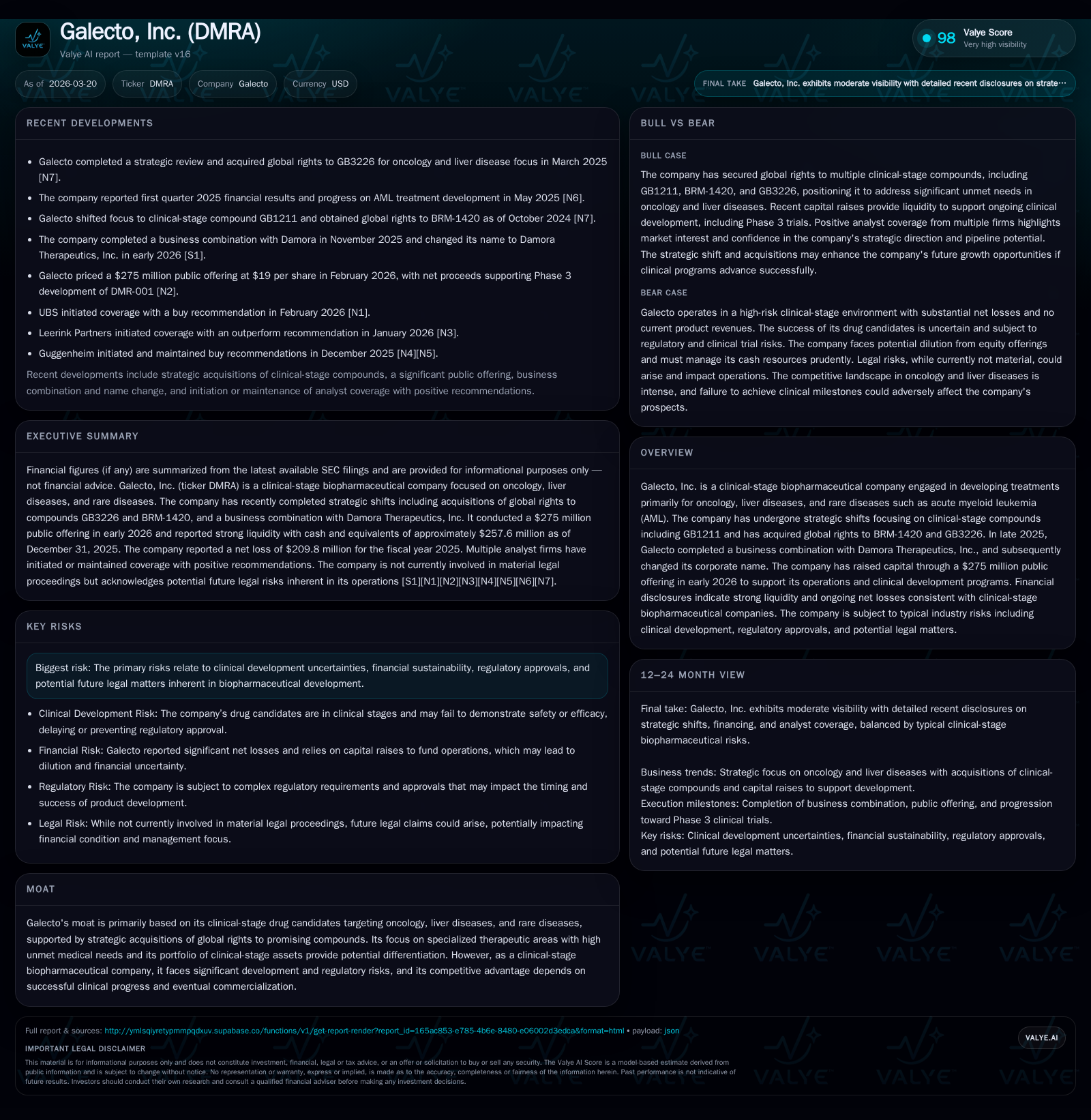
Galecto, Inc. has entered a transitional phase marked by a transformative merger, strategic focus on oncology and rare diseases, and an ample capital infusion via a $275 million public offering. The company’s recent financials reveal sharply increased operating losses driven by expanded clinical activity, balanced by a robust liquidity position that supports ongoing development. Milestones in clinical trials and regulatory approvals remain pivotal for Galecto’s trajectory as it navigates inherent biotech risks amidst market skepticism.
Historical Financial Performance: Growth Challenges and Cost Trajectory
Galecto’s recent financial history illustrates the steep cost ramp characteristic of clinical-stage biopharmaceutical companies aggressively advancing their pipelines. Fiscal year 2025 posted an operating loss of approximately $210.9 million ([F1]), an almost 8.5-fold increase over the prior year’s $22.3 million loss. This surge reflects intensified expenditures as Galecto expands clinical trials and integrates acquired assets from the Damora merger.
Net income follows this trend closely, with losses widening to nearly $209.8 million in FY2025 from $21.4 million in FY2024 ([F1]). Meanwhile, operating cash flow improved modestly from negative $18.6 million in FY2024 to negative $6.7 million in FY2025, illustrating some operational cash burn moderation although still deeply negative.
Financial stability remains supported by strong liquidity; at year-end 2025, Galecto held cash and equivalents totaling about $257.6 million ([F1]) alongside current assets nearing $260.4 million against current liabilities of only $20.1 million, yielding a robust current ratio close to 13 ([F1]).
Historical performance (annual)
| FY | Net ($mm) | CFO ($mm) | OpInc ($mm) | Capex ($) | Net YoY |
|---|---|---|---|---|---|
| 2025 | -210 | -7 | -211 | -878.8% | |
| 2024 | -21 | -19 | -22 | +44.1% | |
| 2023 | -38 | -37 | -40 | 196000 | +37.8% |
| 2022 | -62 | -43 | -61 | 196000 |
Source: SEC companyfacts cache [F1].
Capital returns and efficiency (annual)
| FY | FCF ($mm) | ROE% |
|---|---|---|
| 2025 | -87.3 | |
| 2024 | -135.4 | |
| 2023 | -37 | -118.6 |
| 2022 | -43 | -99.8 |
Source: SEC companyfacts cache [F1].
FY2025 financials capture the post-merger escalation in developmental expenses with a stark operational loss spike.
Strategic Shifts in Pipeline Focus and Asset Acquisitions
Following its business combination with Damora Therapeutics completed in November 2025 ([S9], [S26]), Galecto undertook a significant strategic overhaul to concentrate on promising late preclinical or clinical-stage candidates targeting oncology, liver diseases, and rare diseases such as acute myeloid leukemia (AML) ([S1], [N1]). The core pipeline now highlights GB1211—positioned for fibrotic-driven pathologies—and newly acquired global rights to BRM-1420 and GB3226 as key assets leveraging unmet needs within highly specialized indications.
This targeted portfolio consolidation represents a classic pathway for clinical-stage biopharma firms seeking to bolster their competitive moat through focused R&D investment rather than broad exploratory efforts. However, such concentration heightens portfolio risk exposure since success hinges on these few assets advancing through regulatory hurdles ([S6]). The acquisition of global rights denotes a deliberate move to streamline commercialization potential while retaining control over geographic markets.
Capital Market Activities: Fundraising and Liquidity Position
In February 2026, Galecto executed a notable equity raise by pricing approximately 16.7 million shares at $19 each in a public offering generating gross proceeds near $317 million before underwriting fees ([N2], [S24]). After expenses and full exercise of the underwriters’ option to purchase additional shares—the net proceeds stand around $296 million ([S24]).
Before this offering close date in February, management estimated preliminary cash and cash equivalents of roughly $535 million as of February 28, 2026 ([S8]), effectively bolstering the balance sheet beyond the $257.6 million recorded at December 31 year-end ([F1]). This liquidity buffer provides essential runway into advanced clinical development phases without immediate dilution concerns.
Additionally, prior private investment in public equity (PIPE) transactions executed concurrently with the Damora merger contributed roughly $285 million through convertible preferred stocks ([S12], [S15]), subject to conversion mechanics limiting concentrated ownership stakes.
Despite dilutionary effects implicit with Series B/C Preferred Stock conversions into common shares (notably one preferred share converting into one thousand common shares), the capital structure adjustments align with sustaining an aggressive R&D spend profile necessary for pipeline maturation.
Pipeline Development Prospects and Regulatory Risks
Galecto’s active pipeline remains at various developmental stages with conspicuous emphasis on fibrotic-related disorders and hematologic malignancies such as AML ([S1], [N1]). Critical catalysts anticipated include Phase 2/3 trial readouts which will inform regulatory pathways toward approval or additional studies.
However, the company articulates classical attrition risks endemic to clinical-stage biotech ventures—outcomes are contingent on trial success probability and obtaining requisite regulatory clearances across multiple jurisdictions ([S4], [S7]). Such uncertainties require investors to weigh potential binary event outcomes heavily when evaluating valuation or capital allocation decisions.
Analyst Sentiment and Market Reception Post-Offering
UBS initiated coverage recently with a buy rating on Galecto’s renamed ticker DMRA but encountered market headwinds reflected in share price declines following the February offering announcement ([N1], [N2]). This divergence underscores cautious investor attitudes toward biotech firms heavily reliant on future clinical milestones amid macroeconomic uncertainties impacting speculative sectors.
While analyst reports highlight upside tied to scientific progress, broad market sentiment currently integrates concerns around sustained net losses and elongated timelines before revenue generation.
Capital Allocation Strategies and Shareholder Returns Outlook
Reflecting its developmental status structure as elucidated in SEC filings ([S10], [S11], [S14]), Galecto maintains zero dividends or share repurchases consistent with capital conservation mandates amidst negative operating cash flows.
Return metrics validate these dynamics; net income losses measured against year-end equity denote an approximate return on equity near negative 87% ([F1]), emphasizing ongoing value generation challenges absent commercialization successes.
Capital deployment centers almost exclusively on research efforts aligned with drug development programs adapted post-merger—spending patterns unlikely to shift toward shareholder returns until pipeline validation confers commercial viability or strategic partnerships emerge.
Legal Landscape: Absence of Material Litigation Amid Inherent Risks
SEC disclosures confirm Galecto is not presently engaged in any material legal proceedings or claims; however potential latent legal exposures remain viable given industry norms ([S5]). Regulatory compliance complexities combined with intellectual property disputes typical of biopharma are highlighted risk factors impacting cost structures or management focus if realized.
What Investors Should Watch Next: Milestones and Cash Burn Analysis
Forward monitoring should prioritize timing around pivotal clinical data releases primarily concerning GB1211 and newly acquired compounds BRM-1420/GB3226 amid evolving regulatory submission plans ([N1], [N2], [S3]). Close tracking of cash burn trends relative to fortified liquidity will offer insight into runway duration and necessity for subsequent financing rounds.
Corporate governance signals including stockholder vote results for preferred stock conversions and equity plan approvals hint at readiness for scaling shareholder base alongside possible restructurings ([S17]). The next fiscal periods will be highly formative in transitioning Galecto from an expense-intensive development entity toward eventual evidence-based value creation.
This analysis synthesizes publicly available information from SEC filings and credible market reports at the time of writing without conjecture beyond demonstrated facts. Readers should consider the volatile nature of clinical-stage biotechnology companies featuring high operational risk combined with extended timelines before potential profitability.
Disclaimer: This is research-only, informational analysis and not investment advice. It may include AI-generated interpretation and general industry context. Always verify important details using primary sources.

Comments