
DarkPulse Q2 2026: Severe Liquidity Constraints Amid Ongoing Net Losses
DarkPulse, Inc.'s Q2 2026 financial report reveals critical liquidity shortages and persistent net losses, raising significant financial risks.
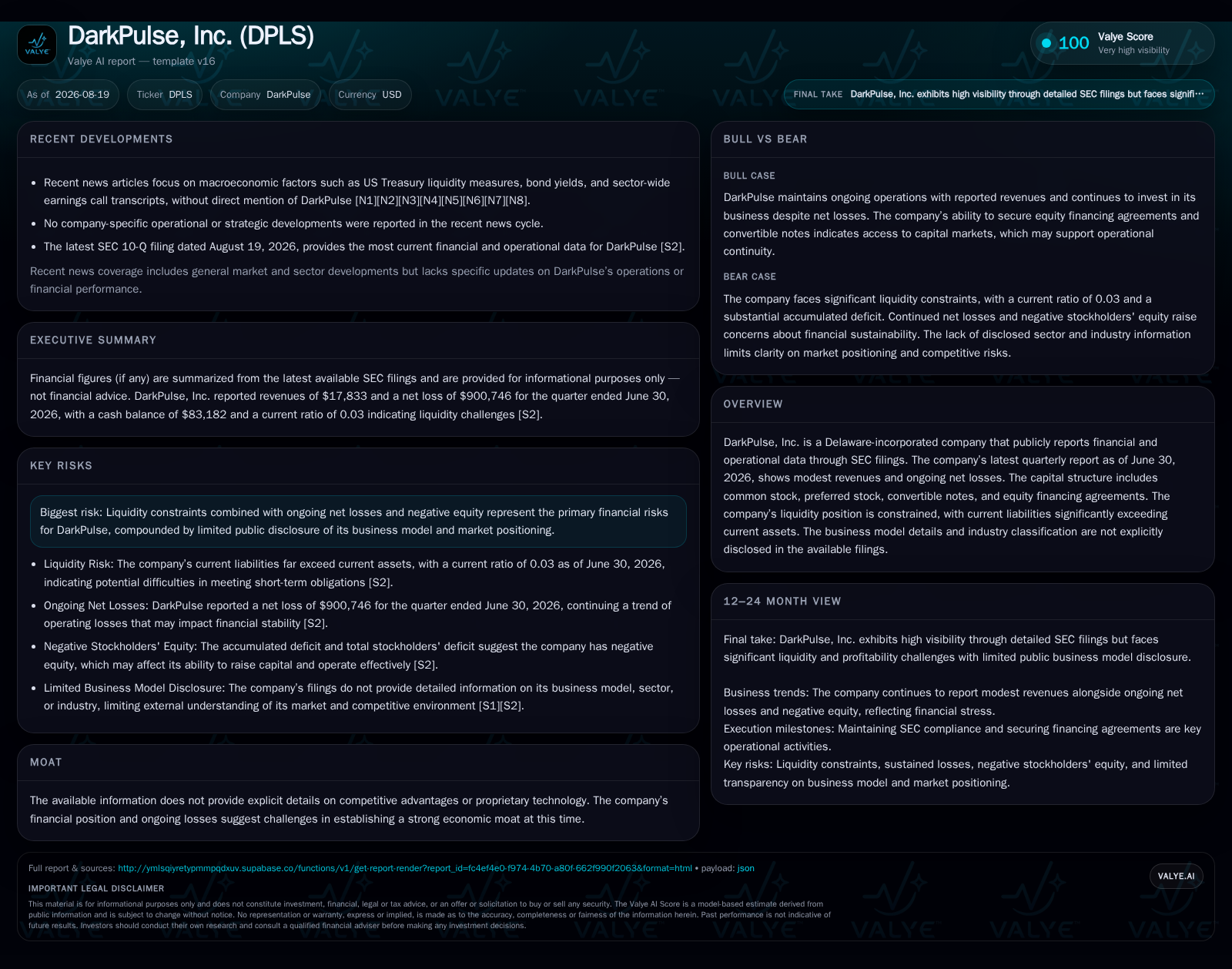
In its Q2 2026 filing, DarkPulse, Inc. reported a current ratio of 0.03 with current liabilities exceeding current assets by over $20 million, underscoring a severe liquidity shortfall. The company continues to incur net losses, contributing to negative equity and financial instability. Limited cash reserves and complex capital structure further constrain its ability to meet short-term obligations. These factors indicate structural financial challenges that threaten near-term operational viability without additional financing or restructuring.
DarkPulse, Inc. reported a critical liquidity position in its Q2 2026 financial results ending June 30, 2026, with current assets of $567,587 sharply contrasted by current liabilities of $20,615,462, yielding a current ratio of just 0.03 [F1]. This severe imbalance highlights the company's inability to meet short-term obligations, underscoring significant financial instability and operational risks that threaten its ongoing viability and pose substantial concerns for investors and creditors [S2].
Cash and cash equivalents were reported at $83,182 at quarter-end, a minimal buffer relative to the scale of current liabilities [F1]. While accounts receivable and contract assets are classified as current assets, the company notes that retainage related to long-term contracts may extend beyond one year, which could overstate the availability of near-term liquidity [S2].
The company continues to report net losses in Q2 2026, consistent with prior periods, as indicated in the latest 10-Q filing [S2]. These ongoing losses contribute to a negative equity position, reflecting accumulated deficits that erode shareholder value and limit the company’s financial flexibility. The persistence of net losses without signs of margin improvement or revenue growth sufficient to reverse negative equity suggests that DarkPulse faces structural financial challenges rather than temporary setbacks. This structural nature of the financial distress implies that the company’s difficulties are embedded in its business model or market conditions, rather than being the result of cyclical or transient factors.
DarkPulse’s capital structure includes common stock, preferred stock, convertible notes, and equity financing agreements, which collectively complicate its financial leverage and refinancing options [S2][S1]. The total debt stood at $481,081 as of June 30, 2026, with net debt (debt minus cash) approximately $397,899 [F1]. The presence of convertible notes and preferred stock introduces potential dilution risks and may impose restrictive covenants or conditions that further constrain the company’s ability to raise new capital or restructure existing obligations.
Revenue recognition at DarkPulse is based on contractual billings, including retainage provisions common in long-term contracts [S2]. Customers pay for sensing and monitoring technology products and related services under contracts that may include retention clauses, delaying full cash collection beyond the standard operating cycle. This revenue mechanic, while standard in the industry, impacts cash flow timing and working capital management.
The company’s limited cash reserves relative to its liabilities suggest that operational cash burn is not being offset by sufficient inflows, placing pressure on management to secure external financing or restructure liabilities to maintain operations.
The industry context for DarkPulse is difficult to ascertain due to limited disclosure on its business model and market positioning [S1]. Important key performance indicators such as liquidity ratios, net losses, debt levels, and contract asset collection periods are critical for assessing financial health, but peer comparisons are not feasible given the absence of explicit industry classification or detailed operational metrics.
Analytically, DarkPulse’s extremely low current ratio of 0.03 as of Q2 2026 indicates a critical liquidity crisis that threatens near-term operational viability [F1]
Furthermore, the persistence of net losses and negative equity suggests that DarkPulse faces structural financial challenges rather than temporary setbacks [S2][F1]. The latest quarterly filing shows ongoing net losses with no evidence of margin improvement or revenue growth sufficient to reverse negative equity, indicating fundamental business or market issues. This structural weakness raises concerns about the company’s long-term sustainability absent significant operational or financial restructuring.
Two plausible scenarios emerge from this analysis.
This scenario assumes access to short-term credit or bridge financing, stable or flat revenue and expense trends, and no material adverse events impacting operations. Refutation would involve sudden liquidity improvement or profitability gains, material increases in debt or equity financing, or operational disruptions.
Changes in accounts receivable collection periods, particularly relating to contract retainage, could materially affect cash flow timing and liquidity. Announcements of capital raises or debt restructuring efforts will be critical indicators of the company’s ability to address its liquidity crisis. Additionally, monitoring operating margin trends and revenue growth in subsequent quarters will be essential to evaluate any potential turnaround in financial health.
Without meaningful capital infusion or restructuring, these challenges are likely to persist, underscoring the importance of vigilant monitoring of the company’s financial disclosures and operating performance. The combination of severe liquidity constraints, ongoing net losses, negative equity, and complex capital structure presents significant financial risks that may limit DarkPulse’s ability to sustain operations and meet its obligations in the near term.
Disclaimer: This is research-only, informational analysis and not investment advice. It may include AI-generated interpretation and general industry context. Always verify important details using primary sources.

Comments