
Destination XL Group’s Revenue Gains Offset by Sharply Rising Losses and Cash Outflows
Although Destination XL has grown top-line sales year-over-year, significant margin compression and cash burn pose near-term operational challenges.
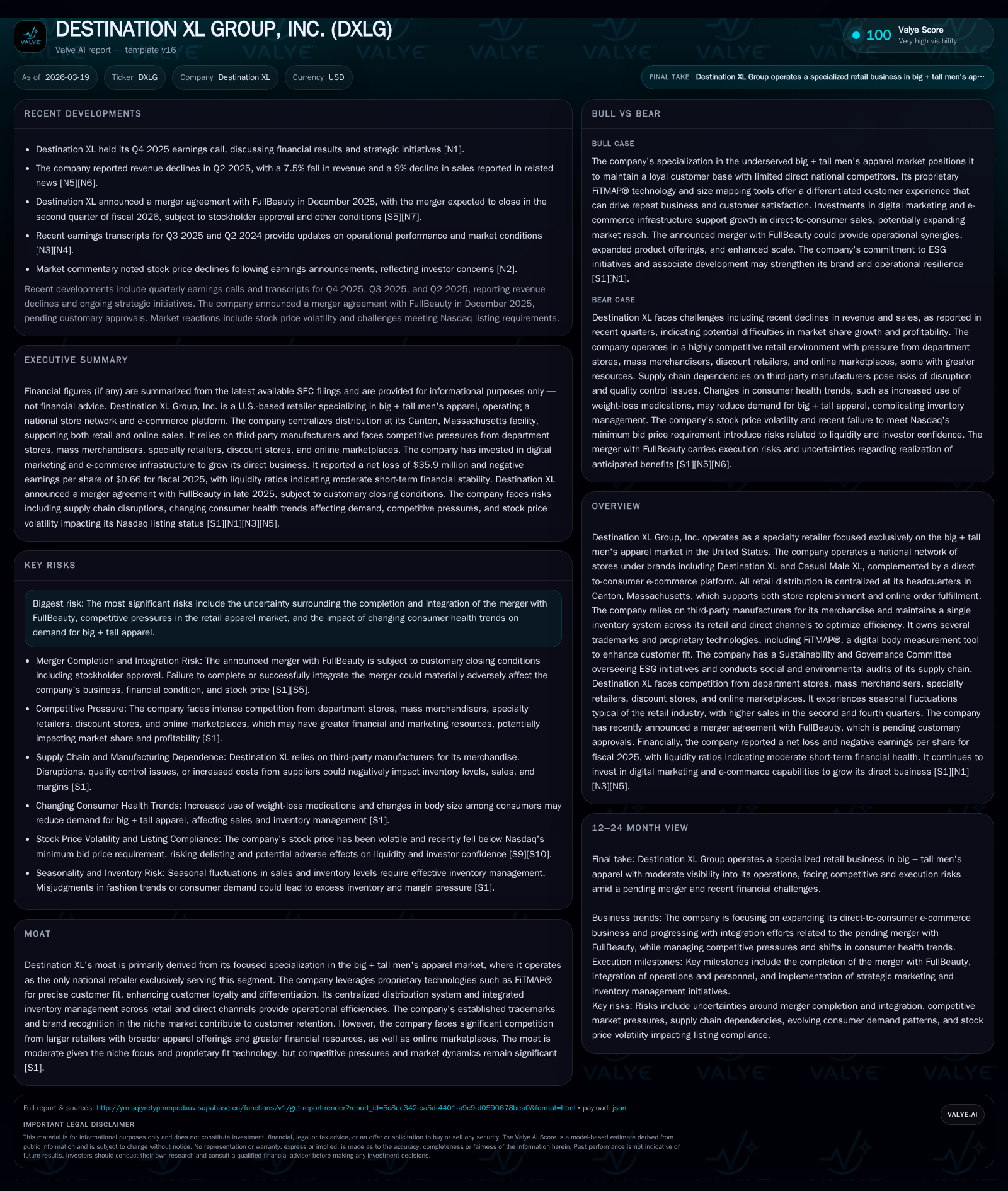
Destination XL Group, Inc., specializing exclusively in the big + tall men’s apparel niche through its DXL and Casual Male XL brands, reported a 10.5% revenue increase in its latest fiscal year. However, this top-line growth was overshadowed by a steep decline in operating income, turning to a $18.2 million loss due largely to increased operating expenses and strategic investments. The company’s centralized distribution and proprietary fit technology provide meaningful competitive advantages, yet it faces intensified competition from larger retailers and online marketplaces. The planned merger with FullBeauty introduces integration uncertainties and elevated execution risk, further complicating its path to margin recovery. Capital allocation has shifted away from shareholder returns toward sustaining operations amid negative free cash flow of $18 million.
Historical Financial Trajectory: Revenue Growth Amid Profit Erosion
Destination XL Group reported a notable rebound in revenue during fiscal year 2025, achieving $135.5 million representing a 10.5% increase over the prior fiscal year’s $122.6 million figure [F1]. This growth reflects successful penetration strategies in the big + tall men’s apparel segment across both physical retail stores (DXL and Casual Male XL) and its direct-to-consumer digital channels. Despite top-line traction, profitability deteriorated markedly; operating income plunged from a positive $3.7 million in FY2024 to a $18.2 million operating loss—a staggering 586.6% decline Year-over-Year (YoY) [F1]. This swing signals severe margin compression amid rising costs.
Net income reflected an even starker deterioration, spiraling into a $35.9 million loss from a modest profit of roughly $3 million the previous year [F1]. The operating cash flow also contracted sharply by approximately 93%, down to just over $2 million, hampering liquidity despite ongoing capital expenditures of $20.1 million that reflect continued investments in infrastructure or technology upgrades [F1]. The reconciliation between CFO and Capex yields a free cash flow shortfall of roughly $18 million highlighting a heightened cash burn rate that could stress near-term financial flexibility unless operational efficiencies or revenue enhancements accelerate.
Historical performance (annual)
| FY | Net ($mm) | CFO ($mm) | OpInc ($mm) | Capex ($mm) | Net YoY |
|---|---|---|---|---|---|
| 2025 | -36 | 2 | -18 | 20 | -1275.4% |
| 2024 | 3 | 30 | 4 | 28 | -89.0% |
| 2023 | 28 | 50 | 42 | 17 | -68.7% |
| 2022 | 89 | 60 | 59 | 10 |
Source: SEC companyfacts cache [F1].
Capital returns and efficiency (annual)
| FY | Buybacks ($mm) | FCF ($mm) | ROE% |
|---|---|---|---|
| 2025 | 0 | -18 | -33.2 |
| 2024 | 14 | 2 | 2.2 |
| 2023 | 25 | 32 | 18.7 |
| 2022 | 13 | 50 | 64.9 |
Source: SEC companyfacts cache [F1].
The historical figures underscore an acute tension: while Destination XL preserves growth momentum within its niche, persistent operating losses and weakening cash flows raise concerns about scalability constraints and margin levers under current cost structures.
Operational Backbone: Centralized Distribution and Inventory Integration
DXLG's hallmark operational strength is its centralized distribution center located in Canton, Massachusetts—a hub that supports all U.S.-based retail stores alongside direct e-commerce order fulfillment processes [S1],[S9]. This integration yields several competitive benefits including optimized selling space at stores by minimizing backroom inventory stocks and real-time visibility into supply chain status.
Advanced supply chain technologies provide import tracking and domestic delivery updates allowing precise freight staffing forecasts thereby reducing costs related to receiving inefficiencies or downtime at the warehouse level [S1]. The labor management system embedded in warehousing improves productivity while continuous software upgrades elevate order processing throughput.
The dual-channel shared inventory platform for DXL and Casual Male XL stores enhances SKU rationalization by accurately balancing demands across physical locations and online orders; this synergy helps minimize markdown risks common in seasonal apparel retailing where misaligned inventory turns can erode margin significantly.
Moreover, Destination XL partners with large national carriers for store shipments enabling end-to-end shipment tracking—a critical factor for maintaining customer experience via reliable delivery windows—and supplies authorized web return services offering convenience that complements increasingly omnichannel consumer expectations [S1],[S9]. International customer servicing leverages third-party logistics firms to mitigate fraud and currency exchange risks for non-U.S buyers without inventory entanglements.
This infrastructure investment prioritizes supply chain agility but also amplifies fixed costs contributing partially to recent margin compressions observed amid rising labor costs in tight labor market conditions impacting distribution staffing rates [S16].
Proprietary Technologies Driving Customer Fit and Loyalty
A fundamental pillar of DXLG's moat lies in its proprietary FiTMAP® technology—an innovative digital scanning tool capable of capturing over two hundred unique body measurements contactlessly—which underpins fit differentiation critical within the big + tall apparel segment where traditional sizing often fails customers seeking comfort plus precision sizing options [S1],[S6],[S29].
Licensed until at least January 2030 via Formcut, FiTMAP links directly into DXLG's custom Size Mapping system aligning scanned dimensions with best-selling brands guaranteeing apparel fit accuracy unmatched among many larger mass merchandisers that carry extended sizes only as ancillary offerings.
Fit technology operates as a robust customer retention driver—repeat purchases often hinge on reducing return rates caused by poor fit experiences—thereby enhancing lifetime customer value in a segment historically marked by high dissatisfaction rates around size availability and style limitations.
However, scalability of this advantage depends on widespread consumer adoption of the scanning technology either instore or online—a challenge given demographic imperfections with technology usage rates among older big + tall consumers—as well as ongoing vendor collaboration ensuring proprietary data translates seamlessly into manufacturing specs maintaining consistent quality control across product lines.
Future initiatives may involve deeper integration of AI-driven predictive analytics facilitating personalized recommendations expanding beyond fit into cross-selling opportunities leveraging dataset insights derived from aggregated measurement profiles.
Competitive Positioning within the Big + Tall Men’s Apparel Market
While DXLG enjoys an exclusive national footprint solely dedicated to big + tall men’s apparel—a distinctive specialization ostensibly creating entry barriers—the competitive landscape remains intense with encroachment from several fronts simultaneously pressuring pricing power and market share retention[S1].[S8].
Mass merchandisers such as Walmart, Kohl’s, and J.C. Penney wield substantial buying power enabling aggressive discounting strategies while economically leveraging scale economies outside specialized niches.[S1] These players indirectly erode exclusivity despite Destination XL's brand positioning centered on fit precision.
Online marketplaces like Amazon present substitution threats benefiting from vast inventory breadth coupled with logistical efficiencies attractive to convenience-seeking consumers.[S1] KingSize—a competitor owned by FullBeauty—is notable as both rival brand presence especially relevant considering DXLG's announced merger with the same entity creating potential conflict but also synergy risks.[N1], [S15]
Exclusivity agreements on certain national brands help mitigate direct price-based competition; however,[S4] losing or diluting such agreements jeopardizes foot traffic and compromises ability to command premium pricing observed historically under Destination XL's merchandise assortments.[S5]
Consequently,the company is repositioning to increase private-label penetration aiming at reducing dependence on licensed brands vulnerable to external contract termination; yet failure of private brands to meet price-value acceptance thresholds poses revenue headwinds.[S5]
Ultimately,the moderate moat offered by DXLG’s focus corrects for scale disadvantages but does not obviate risks stemming from evolving fashion trends,[S14] consumer preferences shifts,[S29] or broader economic cyclicality impacting discretionary spend patterns common in the apparel sector.
Strategic Outlook and Integration Challenges Post-Merger Announcement
In December 2025 DXLG announced an intended merger with FullBeauty Brands Holdings Corporation targeting closure during Q2 Fiscal Year 2026 contingent upon stockholder approvals[N1],[S15]. Management projects the transaction will support long-term strategic growth ambitions including:
- Market share expansion through brand portfolio broadening,
- Enhanced digital business scaling,
- Operational synergies realized via infrastructure consolidation,
- Increased marketing efficiency leveraging combined resources[S8].
However key strategic risks are inherent including synergy realization uncertainty exacerbated by historically protracted apparel sector integrations which frequently suffer cultural misalignment issues,[N1] employee attrition during transitions,[S16] operational disruption potential,[S15] litigation risks tied to governance[S15], and supply chain realignment complexities particularly given existing vendor relationships.[S7]
Operational milestones tied closely to merger success include:
- Ability to retain loyal customer base while integrating overlapping channels,
- Technology platform harmonization,
- Real estate portfolio rationalization balancing store conversions versus closures,
- Brand identity preservation amid consolidation initiatives.[N1]
Any delay or failure to execute integration roadmap timely could translate into incremental costs offsetting anticipated scale economies while creating investor sentiment volatility negatively affecting valuation trajectories pre-completion.[N2]
Impact of Consumer Trends and External Risks on Demand Dynamics
Emerging consumer health trends present dynamic demand implications for DXLG's core product segments.[S29] Specifically, prevalent adoption of GLP-1 receptor agonists used for weight management has introduced uncertainty around future demand elasticity given potential sustained weight loss among historically big + tall consumers potentially compressing size requirements.[S29] This shift might reduce unit volumes aligned with extended sizes while increasing consumer requirements for intermediate transitional sizes complicating inventory forecasting accuracy thus raising markdown risk profiles.[S29] Nonetheless new opportunities arise as customers navigating weight changes require wardrobe refreshes across adjacent size categories enhancing purchase frequency albeit moderated by individual shopping behaviors focused on consolidation or delayed replenishment.[S29] DXL's proprietary FiTMAP technology offers adaptive positioning to capitalize on these shifting preferences through tailored fit solutions mitigating some risk exposure provided accurate real-time body measurement data guides assortment decisions.[S29]
Underlying macroeconomic risks encompass geopolitical tariff uncertainties influencing input costs particularly cotton-based raw materials essential for manufacturing garments derived from emerging nationalist trade policies affecting sourcing geographies such as Vietnam India Bangladesh evidenced during recent fiscal year.[S4],[S22],[S26] Ongoing monitoring of tariff regime alterations is indispensable given their material impact on cost structures requiring dynamic resourcing strategies inclusive of First Sale Initiative utilization aiming at cost pass-through efficiency.[S22] Cybersecurity vulnerabilities remain salient within e-commerce framework since payment processing involves sensitive customer data; provisional mitigations including tokenization protocols reduce exposure though rising ransomware threats enhance risk premiums necessitating continual vigilance headed by dedicated Cybersecurity Committee oversight.[S5] Together these factors contribute layered external headwinds warranting careful operational management adjustments aiming at preserving margins while supporting growth plans.
Capital Deployment, Cash Flow Constraints, and Shareholder Returns
Capital allocation at Destination XL Group reveals a cautious shift reflective of strained free cash flow conditions.[F1] During FY2025 no share repurchases were executed compared with $13.7 million spent during FY2024 illustrating retrenchment on shareholder yield initiatives amid liquidity prioritization.[F1] Dividend payments are neither documented nor conspicuous suggesting either suspension or minimal pay-out aligned with preservation stance given challenging earnings trajectory.[F1] The company recorded approximately negative $18 million free cash flow resulting predominantly from depressed operating cash flow coupled with elevated capex outlays signaling high capital intensity linked possibly to IT upgrades or distribution facility enhancements aiming at long-run efficiency gains though pressuring near-term balance sheet metrics.[F1] Equity base declined moderately reflecting accumulated losses calling attention toward deteriorated ROE approximating -33%, indicative of significant shareholder capital impairment within fiscal period measured against contemporaneous equity levels. Given these metrics stakeholders must monitor closely the company's ability to stabilize margins swiftly alongside effective cost containment measures vital for restoring sustainable cash generation requisite for future discretionary capital returns or debt servicing capacity enhancements.
Monitoring Key Milestones: What to Watch in Upcoming Earnings
Forward-looking scrutiny should concentrate on several critical performance indicators elucidated during latest earnings commentary:[N1],[N2]
- Post-merger integration progress quantified via realized cost synergies versus forecast benchmarks affected by upfront restructuring charges;
- Margin stabilization indices encompassing gross margin improvement trajectories offsetting inflationary wage pressures;
- E-commerce growth benchmarks tracking digital channel sales percentage relative to total revenues signaling success in omnichannel strategy execution;
- Marketing spend efficiency gauged through return metrics tied directly to traffic increases;
- Private brand penetration rates revealing effectiveness of merchandising diversification efforts lowering dependency on licensed merchandise;
- Inventory turnover ratios illustrating merchandize planning agility responsive to evolving body size distributions influenced by health trend dynamics;
- Cash flow trajectory improvements aiming toward positive free cash flow generation reversing recent burn observed FY2025 figures. Robust reporting against these variables will materially influence investor confidence levels impacting valuation considerations amid ongoing competitive pressures combined with uncertainties arising from evolving macroeconomic conditions.
This memorandum synthesizes publicly available SEC filings dated March 19, 2026 ([S#]), recent earnings disclosures ([N#]), noted industry-specific considerations based strictly on disclosed corporate data without speculation beyond cited sources ([F1]). It is prepared solely for informational purposes without conveying any investment recommendation regarding Destination XL Group, Inc.
Disclaimer: This is research-only, informational analysis and not investment advice. It may include AI-generated interpretation and general industry context. Always verify important details using primary sources.

Comments