
Emergent BioSolutions Expands Government Medical Countermeasures with Regulatory Advances
Latest quarterly results highlight contract durability and new regulatory approvals while underscoring manufacturing risks in a government-dependent model.
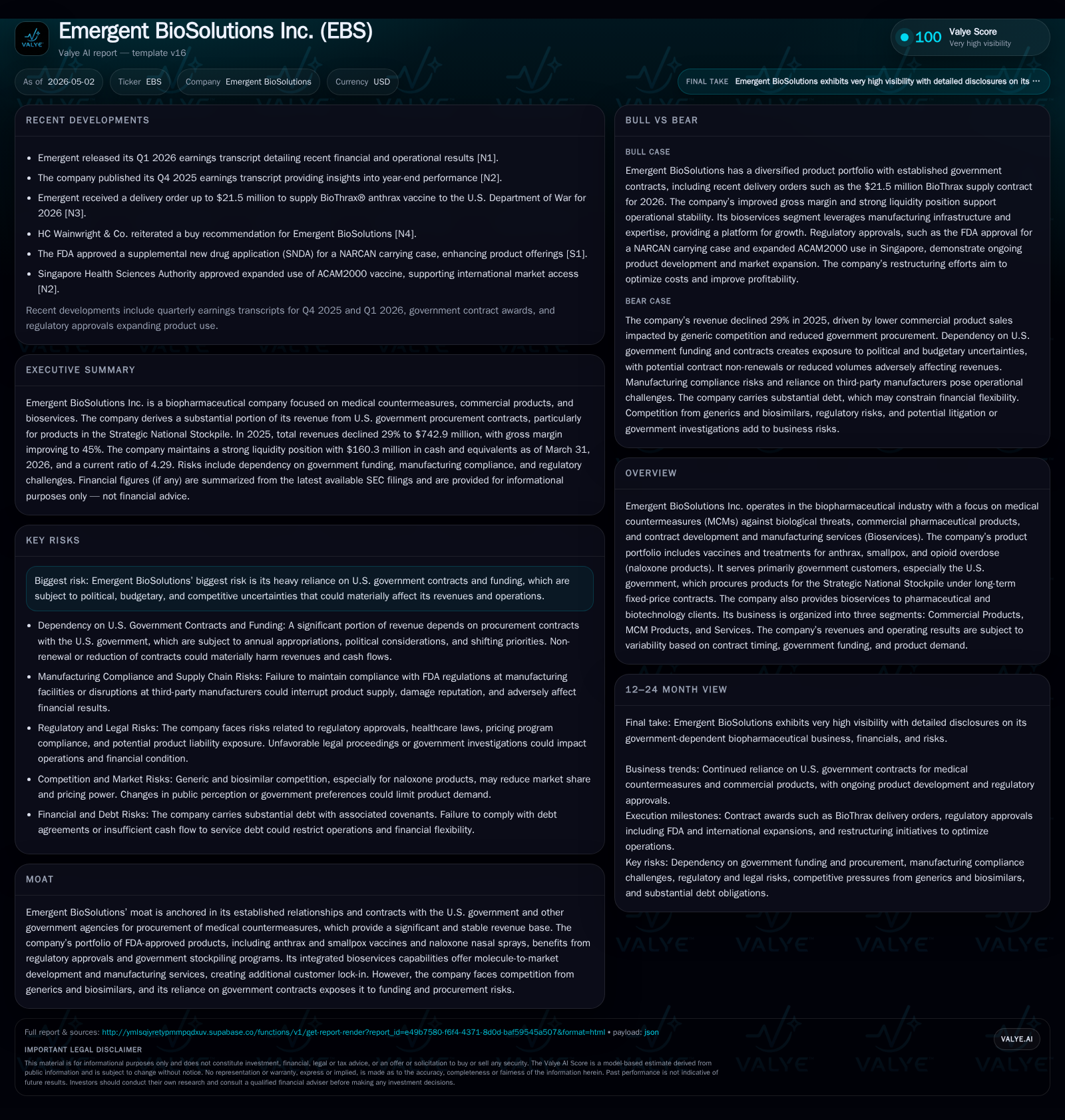
Emergent BioSolutions’ Q1 2026 filing affirms continued reliance on U.S. government contracts for medical countermeasures and commercial naloxone products. The company secured regulatory approval in Singapore for expanded use of ACAM2000, reinforcing geographic growth prospects. While its integrated bioservices and FDA-approved vaccines sustain competitive defenses, heightened third-party manufacturing dependencies pose execution risks. Future growth hinges on contract renewals, product launches, and managing funding variability inherent to government procurement.
Latest Quarterly Highlights and Operational Update
Emergent BioSolutions’ first quarter 2026 report filed May 1 reiterates stable operational footing anchored by ongoing U.S. government medical countermeasure (MCM) procurements [S2]. Demand for core products like BioThrax® (anthrax vaccine) and ACAM2000® (smallpox vaccine) remains steady under existing long-term contracts. Notably, the company disclosed the Singapore Health Sciences Authority’s approval of expanded labeling for ACAM2000, authorizing broader use of this single-dose smallpox vaccine in a new key geography [S3][N3]. This regulatory milestone serves both as a growth lever beyond traditional U.S. markets and validation of product lifecycle management efforts.
The quarter also spotlighted a heightened risk discussion around third-party manufacturing partnerships that supply most Emergent products [S2]. The firm depends heavily on sole-source Contract Manufacturing Organizations (CMOs), which introduces vulnerabilities including quality compliance challenges controlled externally. Failure by CMOs to maintain FDA standards could lead to costly supply interruptions potentially impacting government deliveries.
These updates reinforce Emergent’s embedded position in government biodefense mandates while simultaneously underscoring supply chain fragility inherent in the third-party manufacturer model.
Integrated Business Model Anchored in Government Contracts
Emergent operates across three primary segments: Commercial Products, Medical Countermeasures (MCM) Products, and Bioservices—contract development and manufacturing services (CDMO) [S1].
Commercial Products revolve around opioid overdose treatments such as NARCAN® Nasal Spray (naloxone HCl), approved OTC by the FDA, alongside KLOXXADO®, an 8 mg naloxone nasal spray recently acquired under an exclusive U.S./Canada commercialization agreement with Hikma Pharmaceuticals [S1][N1]. These products generate revenues from retail pharmacies as well as institutional buyers like health departments and law enforcement.
MCM Products include anthrax therapeutics such as BioThrax®, CYFENDUS® (a recently FDA-approved adjuvanted anthrax vaccine variant), ANTHRASIL®, Raxibacumab injection, and smallpox vaccines including ACAM2000® [S1]. These products are primarily sold to the U.S. Strategic National Stockpile through fixed-price government contracts often spanning several years.
Bioservices provide end-to-end molecule-to-market CDMO capabilities covering drug substance production to finished product packaging for pharma/biotech clients [S1]. This segment leverages manufacturing infrastructure but experienced revenue contraction driven by prior facility divestitures.
Across all three segments, revenue mechanics pivot on volume driven largely by government stockpiling demand cycles, set pricing via contracts or regulated commercial parameters, and product mix influenced by new approvals or declining programs.
The FDA’s endorsement of Emergent’s vaccines creates strong barriers through exclusivity in stockpile programs and complex regulatory hurdles competitors face to entry [S1]. Naloxone naloxone-based treatments face more competitive pressure but benefit from clinical necessity amid opioid crisis awareness.
Competitive Dynamics and Industry Structure
Emergent operates within a niche market centered on public health preparedness against biological threats—a segment dominated by a handful of specialized providers serving mostly governmental customers [S1]. Regulatory approvals act as significant moats due to prolonged development timelines, multi-layered safety/efficacy standards, and stringent manufacturing requirements impacting competitor entry.
For medical countermeasures like anthrax or smallpox vaccines, pricing power flows from contractual frameworks negotiated with government agencies often backed by legislative appropriations [S9][S12]. However, policy shifts or budget cuts can alter procurement cadence profoundly.
Conversely, commercial naloxone products face intensifying competition from generic formulations eroding margins despite high demand driven by overdose emergencies [S1][S9]. Ongoing portfolio expansion with KLOXXADO aims to capture premium market share leveraging higher dosage format.
Bioservices contend with industry-wide challenges including capacity constraints at CMOs, regulatory compliance oversight burdens, and cost pressures that may affect competitiveness versus larger CDMO players with broader asset footprints [S2]. Emergent’s reported dependency on sole-source manufacturers exposes it to supply disruption risks that competitors may circumvent through diversified supplier networks.
Growth Catalysts: Regulatory Milestones and Contract Renewals
Emergent’s recent Singapore approval for ACAM2000 signals important international expansion potential into Asia-Pacific government stockpiling programs increasingly concerned about biothreat preparedness [N3]. Geographic diversification addresses concentration risks from U.S.-centric procurement.
The integration of KLOXXADO into its commercial portfolio is expanding presence in opioid emergency treatments with potential for incremental market penetration bolstered by increasing awareness campaigns [S1][N1].
Pipeline candidates advancing through pre-clinical/clinical stages may unlock future growth avenues pending regulatory success supported partially by external development funding arrangements [S1].
Upcoming contract renewals or new awards from the U.S. government constitute critical milestones given their outsized impact on revenue visibility [S2][N1]. Timing of RFP issuance and award announcements dictate production scale plans driving capital allocation decisions within Bioservices operations.
Successful fulfillment of these contracts alongside diversifying revenue sources via international approvals underpin main vectors forecasted to drive medium-term growth.
Operational and Strategic Risks Including Manufacturing Dependencies
The company’s near-total dependence on U.S. government funding exposes it to political budget variability that can abruptly influence buying schedules or scale [S9][S2]. Delays or cancellations owing to legislative appropriations uncertainties remain persistent hazards.
Manufacturing concentration among third-party CMOs represents a tangible operational vulnerability highlighted explicitly in the latest quarterly discussion—any adverse regulatory action against these facilities could trigger prolonged supply interruptions affecting revenue recognition [S2]. Replacement sourcing requires expensive rezoning approvals entailing lengthy lead times creating execution risk pockets.
Pricing erosion risk is notable on naloxone commercial products due to intensifying generic competition constraining margin expansion despite volume growth ambitions [S9][S15].
Reputational risk linked to involvement in biodefense products remains pronounced given public sensitivity around biosecurity programs; negative media or activist focus could exacerbate political scrutiny complicating contract negotiations or pipeline commercialization [S2][S9].
Compliance burdens related to federal healthcare laws coupled with exposure to legal proceedings add an overlay of financial uncertainty requiring sustained management resources [S9][S22].
Key Upcoming Catalysts and Monitoring Points
Watchpoints center on near-term outcomes from expected U.S. government request-for-proposals concerning MCM procurements which will clarify production throughput plans and backlog quality metrics [N1][S2].
Expansion opportunities await progress in international regulatory jurisdictions following Singapore's ACAM2000 decision; other markets pursuing similar security postures may emerge as incremental targets [N3].
Further rollouts or market uptake data for KLOXXADO within North America will inform commercial product segment trajectory given competitive pressures noted previously.
Clinical trial readouts or milestone achievements within pipeline projects backed by external grants provide medium- to long-term growth indicators subject to successful completion without delay [S1].
Overall management commentary during earnings presentations offers directional guidance cues embedding cautious optimism tempered by external funding cycle uncertainties.
Current Financial Position and Liquidity Snapshot
As of March 31, 2026, Emergent held approximately $160 million in cash and equivalents against $590 million total debt resulting in net debt close to $429 million [F1]. Current assets stood at $638 million compared to current liabilities of $149 million yielding a strong current ratio of about 4.29x indicative of ample short-term liquidity buffers supporting operational commitments [F1].
Stable revenues underpinned by predominantly fixed-price government agreements offer predictable near-term cash flows helping facilitate routine interest obligations despite gross debt levels approaching $600 million. Capital expenditure requirements remain moderate aligned with scaled manufacturing investments.
Disclaimer: This analysis is based solely on information publicly available as of May 2026 including SEC filings and news reports cited herein. It does not constitute investment advice or recommendations. Readers should perform independent due diligence considering their own financial situations before making decisions related to the company discussed.
Disclaimer: This is research-only, informational analysis and not investment advice. It may include AI-generated interpretation and general industry context. Always verify important details using primary sources.

Comments