
Lattice Semiconductor Expands with $1.65 Billion AMI Acquisition and Accelerates Low-Power FPGA Innovation
Record Q1 revenue growth and margin expansion position Lattice to leverage acquisition and strengthen its leadership in low-power programmable semiconductors.
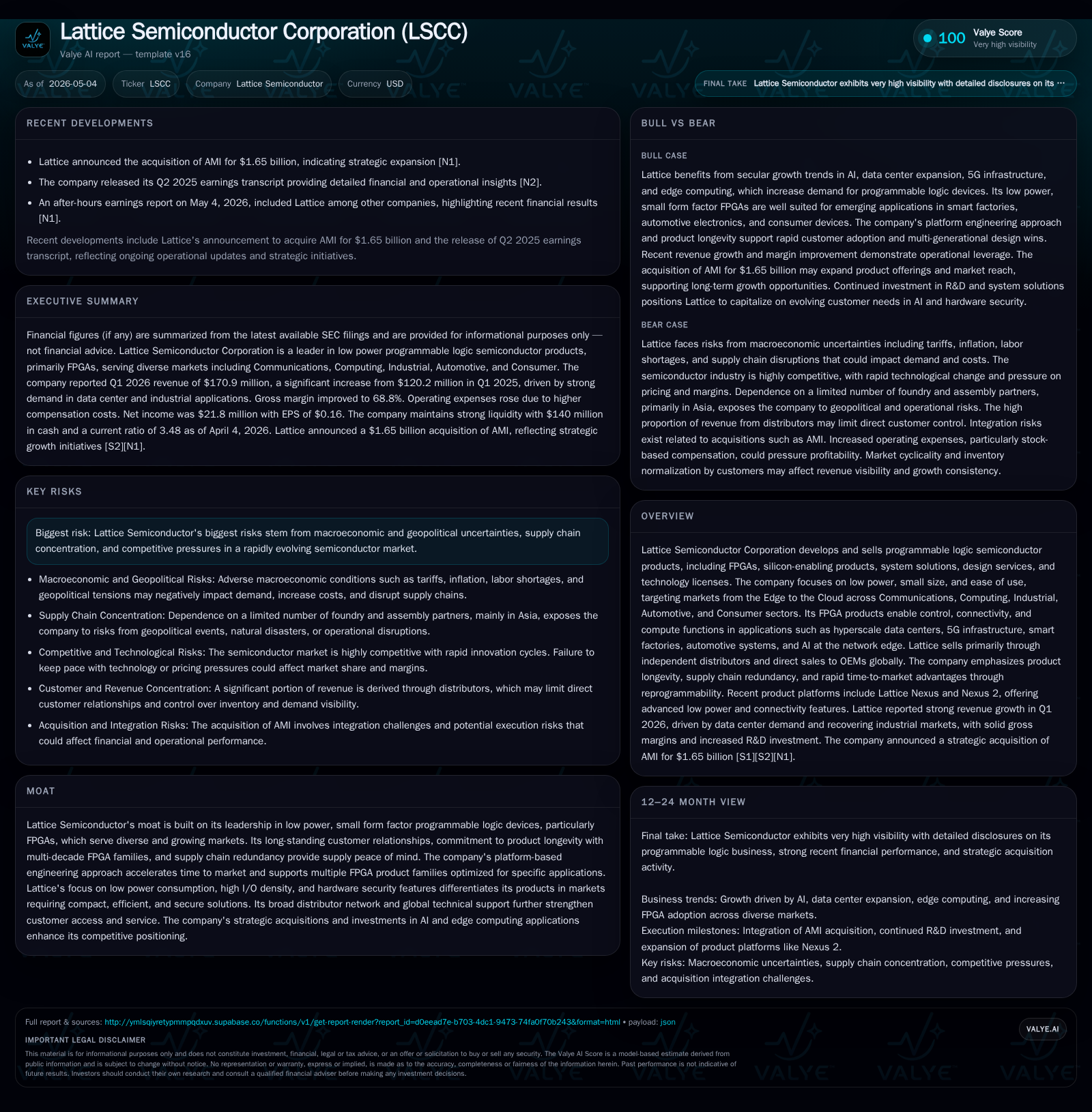
In Q1 fiscal 2026, Lattice Semiconductor reported robust revenue growth exceeding $170 million, up 42% year-over-year, alongside improved gross margins led by favorable product mix shifts. The company announced a transformative agreement to acquire AMI Semiconductor for $1.65 billion, signaling an aggressive expansion into broader programmable logic markets. Lattice's business model centers on low power, small size FPGAs and system solutions across burgeoning sectors such as Edge AI, industrial automation, and communications infrastructure. With no current debt and strong liquidity of approximately $140 million in cash, Lattice is well-positioned to integrate AMI while continuing investment in R&D to capitalize on structural industry trends including AI-driven design cycles and platform security demands. Risks include macroeconomic uncertainties, supply chain concentration, and competitive pressures from larger semiconductor players.
Recent Operating Update
Lattice Semiconductor demonstrated material operating progress in the first quarter of fiscal 2026 ending April 4, 2026. Revenue surged 42% year-over-year to about $170.9 million [S2], bolstered by strong demand across the company’s programmable logic device portfolio. This top-line strength was accompanied by an expanded gross margin of 68.8%, up roughly 80 basis points compared to Q1 last year, attributed primarily to favorable product mix effects and increased volume [S2]. Inventory was optimized slightly downward by $1 million or about 1%, reducing days of inventory on hand during the quarter though management signaled plans to build inventory levels again to support ongoing demand growth [S2].
Operating expenses notably grew; research and development expenditures rose by approximately 23%, reaching nearly $50.8 million but declined as a percentage of revenue from 34.4% to 29.7%, illustrating scalable R&D investments aligned with growth [S2]. Selling, general, and administrative costs increased by just over 21%, propelled by elevated stock-based compensation expense [S2]. Adjusted EBITDA more than doubled compared to the prior year’s equivalent period reaching near $67.8 million with an improved margin of almost 40% [S14].
The most consequential near-term event was Lattice's announcement on May 4, 2026 that it entered into a definitive Merger Agreement to acquire AMI Semiconductor for $1.65 billion on a cash-free/debt-free basis [S3][N5]. The transaction reflects a strategic move to broaden Lattice’s technology portfolio and complement its core FPGA offerings with expanded IP assets and silicon-enabling capabilities. Funding plans consist of using around $140 million in cash on hand combined with new debt facilities including a senior secured term loan facility up to $950 million plus a revolving credit facility of up to $200 million secured from Wells Fargo and Morgan Stanley [S16][S25]. Completion is targeted for Q3 2026 pending customary regulatory clearances.
Business Model
Lattice’s revenue model revolves around selling differentiated programmable logic semiconductor products—primarily FPGAs—with an emphasis on low power consumption, compact form factors, and ease of integration supported by comprehensive software tools and IP licensing [S1][S2]. Its end-customers span multiple high-growth verticals including Communications (e.g., 5G infrastructure), Computing (hyperscale data centers), Industrial automation (smart factories), Automotive systems (electrification & ADAS), Consumer electronics (smart devices), and Embedded applications demanding efficient edge AI capabilities.
The company generates revenues through multiple channels: direct OEM sales complemented substantially by intermediary independent distributors who accounted for approximately 94% of revenues in the latest quarter compared to 79% previously [S6]. Product longevity forms a crucial strategic asset; Lattice supports multi-decade existence for its FPGA families catering especially to industrial customers requiring long-term availability plus rapid reprogrammability advantages that reduce time-to-market risk [S1].
Additional monetization sources include system solutions leveraging integrated silicon-enabling products alongside design services that accelerate customer adoption cycles as well as licensing fees associated with proprietary IP cores facilitating customized chip designs [S1][S2]. Recent proprietary platforms like Lattice Nexus and Nexus 2 highlight advanced low-power attributes conforming with market demand trends favoring energy efficiency without compromising input/output density or security features.
Industry Structure and Competitive Position
The programmable logic device space resides at the intersection of semiconductor manufacturing complexity and software ecosystem agility. Key broad competitors include major FPGA vendors such as Xilinx (part of AMD) and Intel’s Altera unit—firms with significantly greater scale but predominantly focused on high-end performance rather than low-power niche segments where Lattice leads. This market bifurcation offers Lattice moat protection grounded in its excellence at ultra-low power consumption hardware optimized for compact physical footprints.
Emerging themes shape industry dynamics: AI demands shorten design cycles necessitating adaptable hardware accelerating FPGA adoption; escalating ASIC development costs render embedded FPGAs economical alternatives; post-quantum cryptography gains importance amplifying programmable platform security requirements; expanding sensor proliferation in automotive & industrial IoT elevates need for small-form-factor programmable controls [S1].
Furthermore, Lattice benefits from entrenched global distribution networks enhancing customer reach along with engineering support ensuring swift customization—factors improving switching costs relative to commoditized logic devices [S1]. Supply chain redundancy strategies address broader industry concerns over wafer sourcing geopolitical exposure reinforcing reliability criticality for customers deploying mission-critical infrastructure.
Growth Drivers
- AI Edge Acceleration: Proliferation of Edge AI applications requiring localized inferencing capability plays directly into Lattice’s strengths in low power FPGAs supporting functions like face detection and video analytics [S1].
- Communications Infrastructure Expansion: Continued rollout of advanced wireless networks including post-5G technologies necessitates agile control/connectivity components provided via FPGAs enabling flexible dataplanes in base stations/data centers.
- Industrial Automation & Electrification: Rising smart factory initiatives adopt programmable logic for sensor fusion and motor control applications benefiting from compactness & long system lifecycles inherent in Lattice products.
- Platform Security Demand: Enhanced platform security needs across sectors utilizing programmable hardware that can accommodate evolving cryptographic algorithms such as PQC favor Lattice’s FPGA programmability advantage.
- Acquisition Synergies: The pending AMI purchase will extend addressable markets through addition of complementary silicon-enabling technologies bolstering product solution offerings potentially unlocking new customer segments [N5].
Risks / Watchpoints / Growth Constraints
- Macroeconomic & Geopolitical Exposure: Tariffs, export restrictions, inflationary pressures alongside the fragile global wafer fabrication landscape introduce supply chain vulnerabilities; disruptions could impact capacity or input cost structures adversely impacting margins or delivery timelines [S2].
- Competitive Pressure: Larger players with deeper pockets may accelerate development cycles or pricing competitiveness eroding segment shares particularly if market consolidation intensifies.
- Integration Risk: Successful assimilation of AMI entails execution complexity encompassing cultural alignment, systems integration, retention of key personnel, realization of projected cost synergies — failure here might strain operational focus or capital deployment efficiency [S3][S16].
- Cyclicality in End Markets: Despite secular trends benefiting FPGAs structurally, semiconductor demand remains sensitive to economic cycles affecting end-customer capex spending patterns resulting in revenue volatility.
- Stock-Based Compensation Impact: Rising equity compensation expense dilutes non-cash earnings metrics influencing operating leverage dynamics though this is balanced against talent retention objectives aligned with growth ambitions [S14][S23].
What to Watch Next
- Progress updates on closing the AMI acquisition expected in Q3 fiscal 2026 including financing arrangements execution clarity.
- Post-merger integration milestones: product portfolio rationalization plans leveraging combined IP assets.
- Demand indicators from hyperscale data center clients plus communications infrastructure OEMs relating to new product ramp velocity.
- Monitoring inventory buildup trajectory versus order intake signals subtle shifts between cautious supply positioning/sales optimism.
- R&D expenditure trends especially investments targeting AI edge enhancements or hardware security platform expansions.
- Adjustments in distributor sales concentration metrics which may reveal channel dynamics underpinning scalability assumptions.
- Analysts’ reception concerning incremental gross margin expansion or operating leverage improvements driven by scale effects post-acquisition.
Financial Profile Snapshot (Q1 Fiscal 2026)
Latest financial snapshot
| Metric | Value | Period |
|---|---|---|
| Cash & equivalents | $140mm | |
| 2026-04-04 | ||
| Current assets | $386mm | |
| 2026-04-04 | ||
| Current liabilities | $111mm | |
| 2026-04-04 | ||
| Current ratio | 3.48x | |
| 2026-04-04 |
Source: SEC companyfacts cache [F1].
Latest available total debt figure; disclosure notes no borrowings outstanding under current credit facility as of early calendar year but intends new financing related to acquisition [F1][S7][S16]
Operating cash flow improved markedly over prior year period generating approximately $50 million during Q1 reflecting earnings growth tempered slightly by working capital changes while investing cash outflows increased marginally consistent with elevated R&D spends [S2]. The company believes that its financial resources, including current cash and cash equivalents, cash flow from operating activities, and credit facilities, will be sufficient to meet liquidity and working capital needs through at least the next 12 months [S2].
This analysis leverages reported SEC filings dated May 4, 2026 (10-Q & Form 8-K) as primary sources supplemented with company-disclosed financial data snapshots for latest quarter-end metrics. No forward-looking investment recommendations are expressed herein.
Disclaimer: This is research-only, informational analysis and not investment advice. It may include AI-generated interpretation and general industry context. Always verify important details using primary sources.

Comments