
V2X, Inc. Solidifies Its Position Through Contract Extensions and Streamlined Operations
V2X’s latest quarterly report highlights contract extension progress and backlog dynamics that underpin improved revenue visibility and operational discipline.
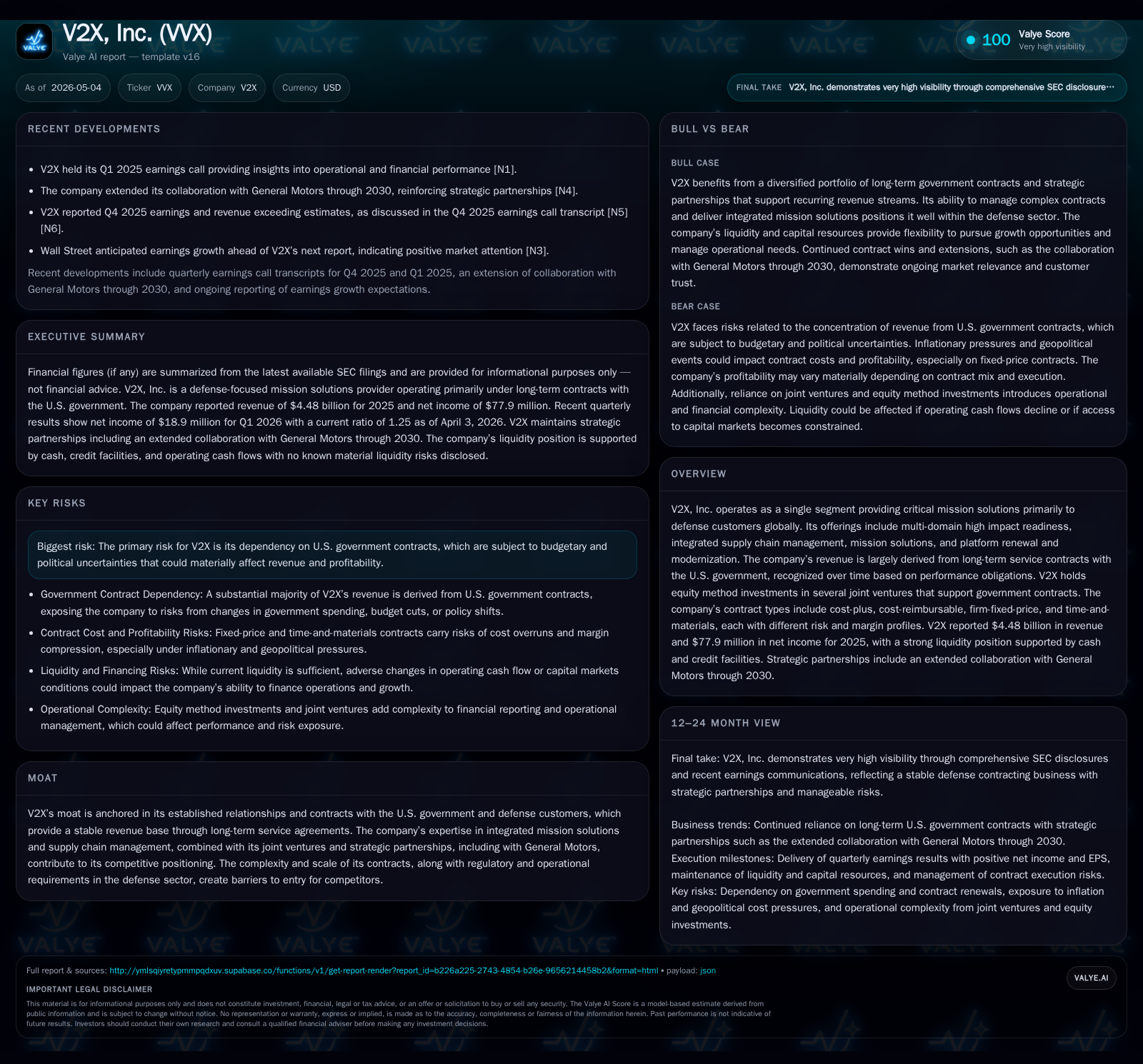
In its most recent quarter ending April 3, 2026, V2X disclosed significant progress in extending long-term government contracts, notably the LOGCAP V Kuwait Task Order potentially extendable to mid-2030, which bolsters near- and medium-term revenue visibility. Funded backlog modestly declined reflecting contract revenue recognition rather than a softening of demand, while unfunded backlog remains substantial but carries inherent execution risk. The company’s business model revolves around multi-year cost-plus and firm-fixed-price contracts serving U.S. defense customers, with growth supported by strategic partnerships and integrated mission solutions capabilities. Risks remain tied predominantly to U.S. government budget fluctuations and the timing of contract awards or option exercises. Financially, liquidity is strong with a current ratio of 1.25 and net income of $77.9 million for fiscal 2025 supporting a stable operational foundation.
Latest Quarterly Operating Update: Contract Extensions and Backlog Developments
In the quarter ended April 3, 2026, V2X reported meaningful developments reinforcing its stable revenue base tied to government contracts [S2]. The Logistics Civil Augmentation Program (LOGCAP) V Kuwait Task Order—one of the largest contracts representing roughly 10% of annual revenues—has a current performance period through June 30, 2026, but notably includes option periods exercisable by the U.S. Army extending potentially through June 2030 [S1]. The company confirmed ongoing discussions and expectations around exercising these long-dated options [S2], effectively lowering revenue visibility risk over the next several years.
Funded backlog saw a modest decline aligning with revenue recognized in the quarter—reflecting performance under existing contracts rather than reduced demand [S1]. As of end-2025, funded backlog stood at $2.3 billion versus an unfunded backlog of $8.8 billion, indicating robust pipeline coverage albeit with execution risk due to the discretionary nature of unfunded portions.
Recent events filings [S3] affirmed no equity sales or use-of-proceed activity that might impact capital structure or liquidity in this period. This suggests management is prioritizing operational stability while pursuing contract renewals.
These operating disclosures underscore that V2X’s near-term revenue picture benefits from successfully extended multi-year government contracts accompanied by disciplined contract fulfillment translating into steady backlog conversion.
Business Model and Quality of Mission Solutions Offerings
V2X operates exclusively in mission-critical defense services delivered under long-term contracts primarily to the U.S. government [S1]. Contracts are structured across multiple pricing arrangements — cost-plus (cost reimbursement plus fee), firm-fixed-price, time-and-materials — each imparting particular margin profiles and performance risk allocation.
Revenue is recognized over time as performance obligations are met under these contracts. The company’s offerings encompass multi-domain readiness solutions supporting ground operations, integrated supply chain management to ensure availability of critical parts or services, platform modernization programs updating legacy systems, and other mission support activities [S1].
Significantly, V2X engages in multiple joint ventures where it holds equity stakes with partners also providing complementary capabilities enhancing competitive bids for government contracts [S21]. These investments add incremental revenue streams recorded proportionally under equity method accounting.
The complexity embedded within these offerings alongside stringent regulatory compliance requirements creates high switching costs for U.S. government customers who value proven operational reliability and program continuity.
Competitive Positioning within the U.S. Defense Services Sector
Within the large yet politically sensitive defense contracting ecosystem, V2X maintains a differentiated competitive stance driven by:
- Regulatory barriers protecting incumbents,
- Established track record exemplified by LOGCAP engagements,
- Strategic partnerships including an extended collaboration with General Motors enhancing platform renewal efforts,
- Capability breadth allowing integrated mission solutions across multiple domains.
Pricing power is necessarily constrained by federal acquisition rules limiting markups; however, scale advantages in bid preparation, execution efficiencies, and compliance functions afford economic leverage.
Sector-native points such as indefinite delivery/indefinite quantity (IDIQ) contract mechanisms mean that new awards usually stem from competitive re-bids or task order competitions where past performance on complex logistics operations plays an outsized role relative to low-cost positioning [S1]. This incumbency advantage has been tested amid rising industry competition but remains core to V2X’s moat.
Pathways for Growth: Funded Orders, Contract Options, and Strategic Partnerships
Growth at V2X derives largely from inflows of funded orders—contracts awarded or renewed with committed funding—and the successful exercise of option periods built into multiyear agreements [S1]. In 2025, funded orders totaled approximately $4.5 billion, an increase of $700 million year-over-year driven mostly by award timing rather than an expansion in total addressable market.
The flexible structure of many government contracts—with initial base periods typically one year or less plus successive options—means renewal rates on these options critically influence future revenue streams [S1]. Moreover, bridge contracts extending term beyond formal expiration provide incremental runway for sustained cash flow.
Joint ventures boost capacity without commensurate fixed capital investment risks while diversifying service offerings into areas such as advanced readiness technologies or supply chain digitization initiatives supported by major partners like General Motors. Such collaborations help broaden V2X’s proposal value proposition for multi-domain mission support bids.
Risks and Constraints: Government Budget Uncertainties and Dependency Issues
V2X’s concentrated dependence on U.S. government defense spending exposes it to fiscal policy shifts tied to political cycles beyond company control [S1]. Although defense budgets remain large historically—with FY2026 DoD base budget around $848 billion plus supplementary appropriations—the timing and amount allocated to service contracts can vary materially based on macroeconomic conditions or legislative dynamics.
Contract protests filed with entities such as GAO or COFC can delay award finalization or execution start dates further complicating revenue predictability [S1]. Termination for convenience clauses allow government cancellation but generally preserve recovery on costs incurred so margin exposure is somewhat mitigated.
Cybersecurity risks detailed in risk disclosures imply heightened operational vigilance is necessary given adversarial targeting potential within sensitive defense programs. Operational disruptions here could adversely impact service delivery reputations crucial for renewals.
Key Monitoring Points Ahead: Guidance, Backlog Changes, and Execution Markers
Investors should monitor incoming quarterly updates for explicit management guidance revisions addressing backlog conversion expectations or changes in funded order inflows [N1][S3]. Off-cycle announcements regarding contract extensions—especially relating to major task orders like LOGCAP—or emerging joint venture awards would materially affect near-term visibility.
Utilization rates on staffed portions of contracts will signal operational efficiency gains translating into margin expansion potential observed in prior year improvements [F1,S1]. Tracking protest resolutions impacting new awards timelines will clarify competitive positioning trends.
The ability to maintain or grow funded backlog beyond prevailing levels will be a bellwether for sustaining top-line momentum given unfunded backlog faces inherent exercise risk from discretionary funding decisions on government side.
Financial Snapshot Reflecting Liquidity and Profitability Trends
Latest financial snapshot
| Metric | Value | Period |
|---|---|---|
| Current assets | $1169mm | |
| 2026-04-03 | ||
| Current liabilities | $933mm | |
| 2026-04-03 | ||
| Current ratio | 1.25x | |
| 2026-04-03 |
Source: SEC companyfacts cache [F1].
| Metric | Value (USD) | Period Ending |
|---|---|---|
| Current Assets | 1,169,406,000 | |
| 2026-04-03 | ||
| Current Liabilities | 933,304,000 | |
| 2026-04-03 | ||
| Current Ratio | 1.25 | |
| 2026-04-03 | ||
| Net Income | 77,882,000 | |
| 2025-12-31 |
As supported by the latest filings [F1,S2], V2X maintains a solid balance sheet foundation with a current ratio exceeding one indicating sufficient near-term liquidity coverage for working capital needs. Reported net income of $77.9 million for full-year 2025 reflects stable profitability achieved despite inflationary cost pressures prevalent across supply chains servicing government programs.
Total debt figures from previous periods indicate manageable leverage relative to EBITDA implied in operating income growth trends; no significant changes reported this quarter suggest capital structure stability supporting ongoing operations without refinancing concerns.
Disclaimer
This analysis is based solely on publicly available information including recent SEC filings through May 4, 2026. It does not constitute investment advice or recommendations regarding V2X stock or securities. Readers should conduct independent due diligence before making financial decisions.
Disclaimer: This is research-only, informational analysis and not investment advice. It may include AI-generated interpretation and general industry context. Always verify important details using primary sources.

Comments