
First Hawaiian, Inc. Balances Local Market Strength with Rising Regulatory and Climate Risks
Recent quarterly disclosure underscores First Hawaiian’s geographic moat and regulatory challenges amid evolving fintech competition.
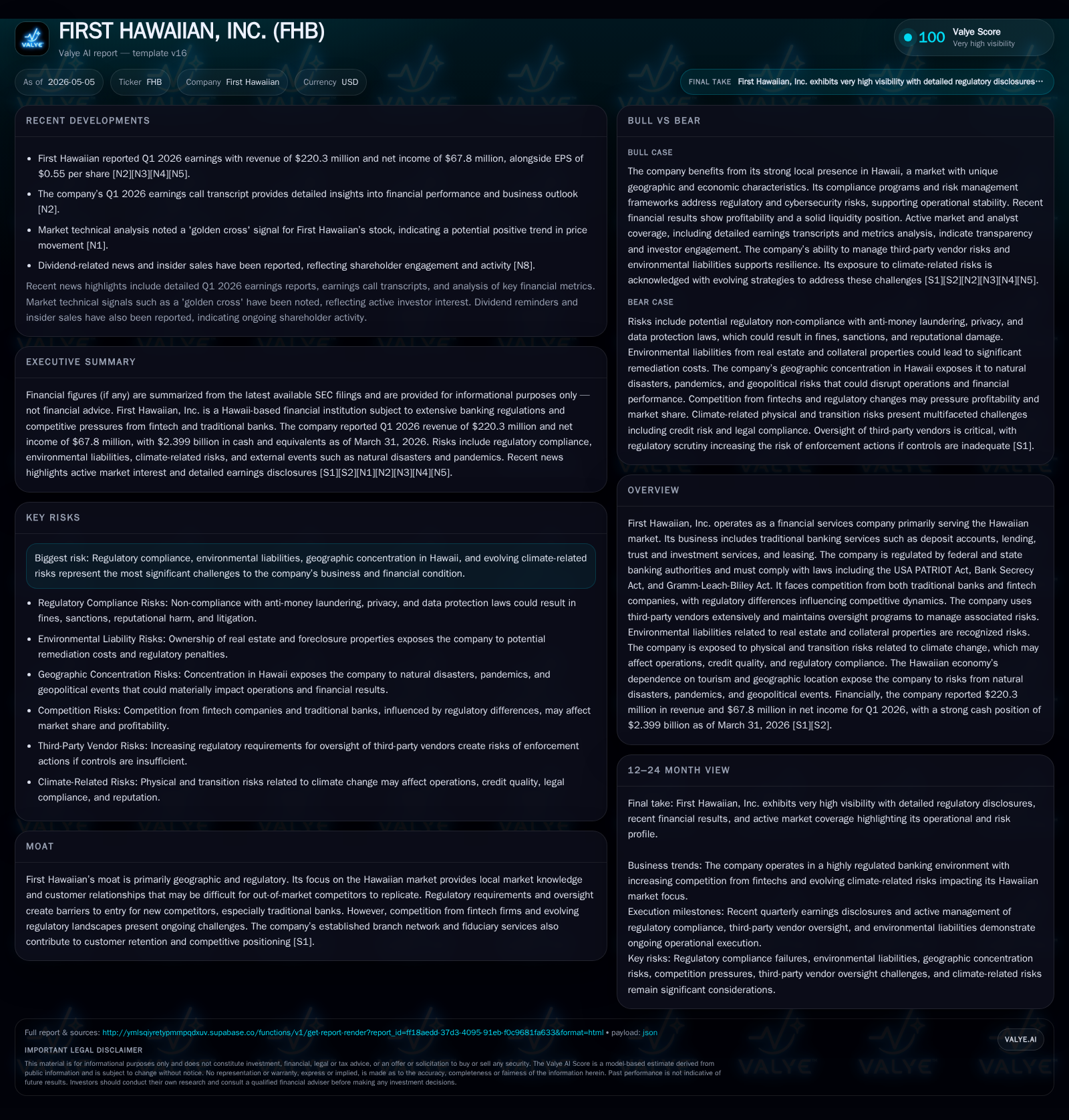
First Hawaiian, Inc. reported its latest quarter highlighting steady operation within its core Hawaiian market while contending with regulatory complexities and emerging climate risks. The company’s business model leverages local market knowledge and a widespread branch network but faces growing fintech competition and regulatory scrutiny, including compliance with anti-money laundering laws and climate-related operational risks. Growth is driven by the regional economic environment, deposit dynamics, and fiduciary services, while watchpoints include geographic concentration and regulatory costs. Upcoming regulatory developments around payment stablecoins and evolving cybersecurity threats remain key milestones to track.
Recent Operating Update
First Hawaiian issued its latest quarterly report for Q1 2026 on May 4, 2026, confirming continuing stability in operations without introducing material changes to risk factors disclosed as of its fiscal year-end 2025 filing [S2]. The company reaffirmed that existing risk factors remain relevant but unchanged materially for the recent period. The preceding event filing on April 24, 2026 clarified governance updates regarding board authority over stockholder meetings alongside ratification of Deloitte & Touche LLP as independent auditors for fiscal 2026 [S3]. These filings frame a stable operating backdrop heading into mid-2026.
Business Model
First Hawaiian operates as a full-service financial institution primarily serving the Hawaiian Islands. Its revenue stems from traditional banking activities: accepting deposits; providing commercial, consumer, residential mortgage loans; fiduciary trust and investment management services; and leasing operations related to its branch infrastructure [S1]. Customers predominantly consist of local residents and businesses within Hawaii’s geographically concentrated economy.
The company’s offering strength derives from entrenched local market knowledge coupled with widespread physical branches across the islands that foster customer loyalty through personal relationships. Additionally, its fiduciary services expose it to premium fee income derived from managing client assets where it assumes fiduciary responsibilities—a potentially sticky source of revenue owing to high switching costs.
However, the banking industry is experiencing rapid shifts due to fintech entrants disrupting traditional intermediation roles through digital channels. First Hawaiian competes with these entities that may offer bank-like services such as deposit accounts or payments without the same regulatory overhead or branch footprint [S1], [S5], [S18]. This dynamic pressures pricing models and customer acquisition strategies.
Industry Structure and Competitive Position
The Hawaiian banking market exhibits characteristics of a regional oligopoly shaped heavily by geographic isolation and regulatory barriers. First Hawaiian's moat is predominantly local: extensive branch networks cement scale advantages absent elsewhere on the islands alongside nuanced understanding of local borrower credit profiles and business conditions [S1]. State and federal regulations also limit new entrants effectively through licensing hurdles.
Yet competition evolves as fintechs increasingly partner with chartered banks or obtain industrial loan charters themselves to bypass some traditional banking restrictions. Regulatory reforms such as the GENIUS Act enacted in July 2025 create new categories for payment stablecoins that could substitute traditional deposits, threatening core deposit bases if consumer interest grows significantly [S1], [S18]. This nuance introduces shifting competitive contours beyond pure geographic advantages.
Moreover, First Hawaiian relies heavily on third-party vendors for operational support. Increasing supervisory expectations mandate enhanced diligence and ongoing monitoring which imposes cost and operational risks not born directly by smaller competitors or fintechs [S18].
Growth Drivers
Regional Economic Dependency
Hawaii's economy — heavily tourism-driven — influences demand for both deposits and lending products. Visitors indirectly support local businesses that borrow working capital or expand operations financed via loans from First Hawaiian. A stable or growing tourism environment tends toward increased banking activity.
Deposit Base Stability & Pricing
The company benefits from locally loyal retail customers augmented by commercial deposits from regional enterprises. Deposit growth correlates with regional income trends plus migration patterns within Hawaii affecting scope and volume.
Fiduciary & Investment Services
Trust operations present opportunities for fee-based revenue growth tied to wealth accumulation among local clients, which may provide some insulation from cyclical lending markets.
Regulatory Environment Shaping Product Demand
Compliance costs can constrain offerings but periodically also raise entry barriers protecting incumbents’ deposit franchises against unregulated competitors.
Risks / Watchpoints / Growth Constraints
Regulatory Compliance Burden
First Hawaiian must comply vigorously with AML regimes under USA PATRIOT Act and Bank Secrecy Act frameworks; violations attract severe penalties including fines or restrictions that could damage reputation or stall expansion plans [S4], [S10].
Environmental Liabilities Exposure
Owning physical branch properties combined with foreclosure-owned real estate collateral exposes the bank to potential remediation costs arising from hazardous substance discoveries, possibly reducing asset values or usage options severely impacting capital deployment flexibility [S4].
Climate Change Impacts
Transition risk includes regulatory shifts toward sustainable finance demands while physical risks encompass property damage from Hawaii’s susceptibility to extreme weather events like hurricanes or tsunamis affecting both operational continuity and credit quality among borrowers exposed to climate stressors [S15], [S12].
Technology Displacement Risk
Accelerating fintech adoption threatens traditional deposit models; particularly relevant are stablecoin implementations under recent legislation requiring close monitoring for impacts on deposit flow stability over time [S1], [N6].
Third-party Vendor Oversight Complexity
Increased scrutiny raises operational control demands which may increase costs or expose vulnerabilities if not managed rigorously under enhanced supervisory regimes [S18].
What to Watch Next
- Regulatory guidance implementations under the GENIUS Act mandating oversight of payment stablecoins representing deposit substitutes will be critical milestones.
- Monitoring deposit retention trends as fintech competition accelerates product innovation.
- Developments in state/federal environmental regulations influencing real estate management costs.
- Updates from Board Risk Committee concerning cybersecurity postures given expanding threat vectors.
- Quarterly performance updates reflecting tourism activity impact on loan demand and deposit influx.
- Any amendments in third-party vendor compliance frameworks or enforcement actions impacting vendor relationships.
Financial Profile Briefly Supported by Latest Data
Disclaimer: This analysis is based solely on publicly available information from SEC filings and reputable news sources as cited; it does not constitute investment advice or recommendations regarding First Hawaiian Inc.’s securities.
Disclaimer: This is research-only, informational analysis and not investment advice. It may include AI-generated interpretation and general industry context. Always verify important details using primary sources.

Comments