
National Health Investors Advances Strategic Portfolio Shift Through $560 Million Sale
NHI's announcement of a major portfolio divestiture signals a pivotal shift in its healthcare real estate strategy and financial profile.
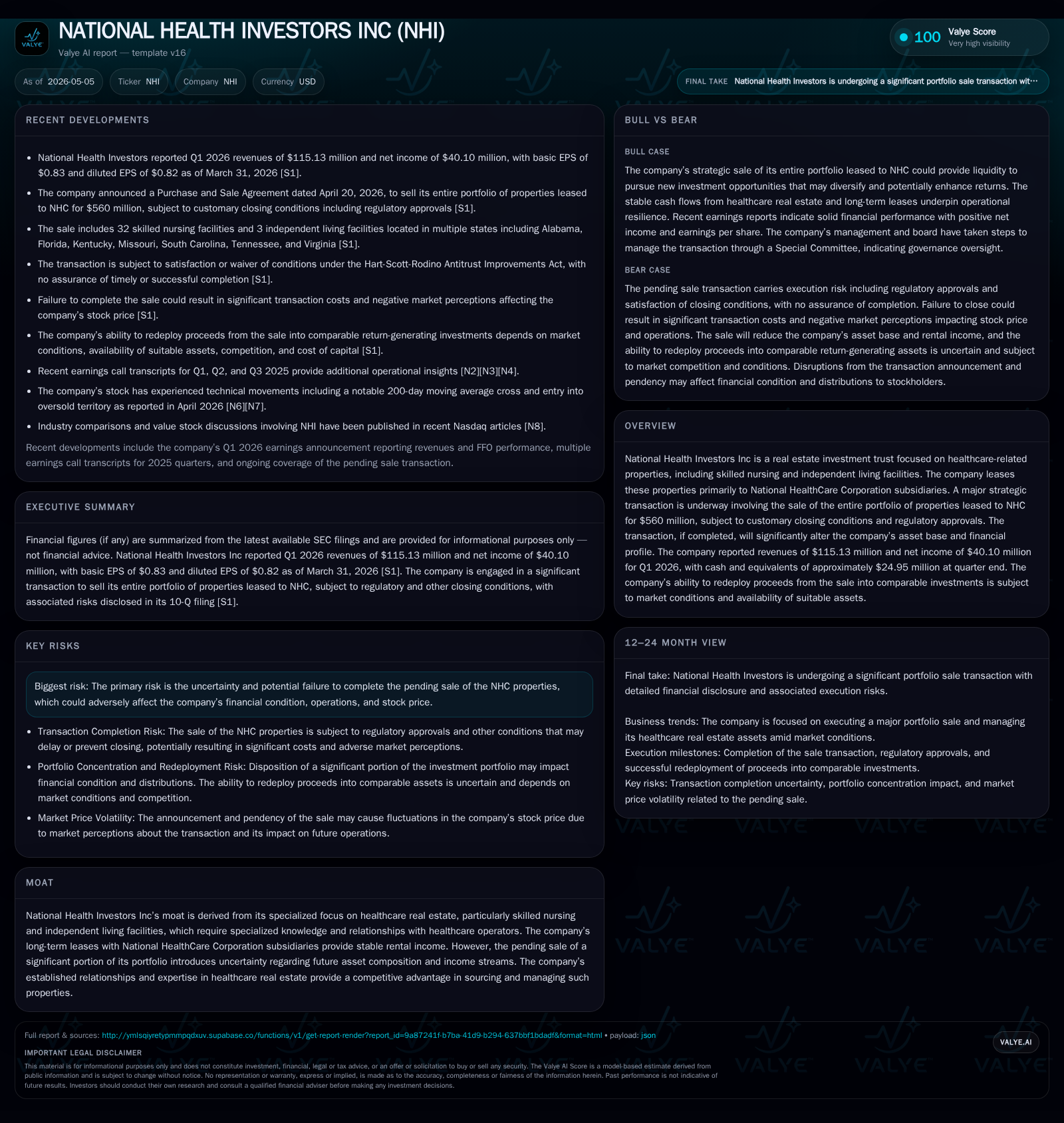
National Health Investors Inc (NHI) reported strong first-quarter 2026 results but faces a transformational juncture due to its pending $560 million sale of properties leased to National HealthCare Corporation subsidiaries. This transaction, contingent on regulatory approvals including Hart-Scott-Rodino clearance, will divest a significant portion of NHI’s specialized healthcare asset base. While the deal offers capital for redeployment, execution risks and reinvestment challenges introduce uncertainty over future income stability and growth trajectory. NHI operates a niche healthcare REIT model characterized by long-term master leases with stable operators, positioning it well within the competitive healthcare real estate sector despite this near-term disruption.
Latest Operating Update: Portfolio Sale and Immediate Impacts
National Health Investors Inc disclosed in its Q1 2026 10-Q filing dated May 4, 2026, an agreement to sell its entire portfolio leased to National HealthCare Corporation (NHC) subsidiaries for approximately $560 million [S2]. This portfolio includes 32 skilled nursing facilities and three independent living facilities located across several states including Alabama, Florida, Kentucky, Missouri, South Carolina, Tennessee, and Virginia [S22]. The transaction is conditioned on customary closing requirements such as Hart-Scott-Rodino antitrust approvals along with regulatory consents. A non-refundable deposit totaling $5 million was made shortly after the April 21 agreement date with a review period extending through May 29, 2026, during which either party may terminate [S22], [S29].
This sale represents a substantial divestiture that will significantly alter NHI's asset base composition as these properties have been core income generators through master lease arrangements with NHC subsidiaries. Management cautions that failure to close this deal timely or at all could lead to incurred transactional costs without realized benefits and adverse market perceptions impacting stock price [S2], [S27]. Moreover, consummation will cause immediate shifts in rental income streams due to property disposition affecting operating results and dividend distribution capacity.
National Health Investors’ Business Model and Specialized Asset Profile
NHI operates as a specialized REIT focused exclusively on healthcare-related real estate assets—specifically skilled nursing facilities (SNFs) and independent living facilities (ILFs). Its revenue model relies heavily on stable tenancy agreements under long-term master lease deals primarily with subsidiaries of National HealthCare Corporation [S2]. These leases provide strong contractual rent streams generally backed by operators’ predictable reimbursement sources like Medicare/Medicaid for skilled nursing services.
Beyond property ownership and lease revenue generation, NHI’s competitive strength derives from industry-specific operational expertise enabling effective tenant relationship management across complex healthcare sectors requiring compliance with regulatory norms particular to medical care environments. The nature of these leases usually limits turnover risk compared to traditional commercial real estate sectors while enabling moderate pricing power as rents escalate per contract terms aligned with operator performance metrics.
Competitive Position Within Healthcare-Focused Real Estate
Within the healthcare REIT sector niche—comprising companies that own properties such as hospitals, senior housing, SNFs, and assisted living—NHI’s concentration on SNFs/ILFs leased predominantly to one operator distinguishes it from more diversified peers. Barriers here include stringent regulatory oversight around healthcare facility operations necessitating strong tenant vetting processes; deep sector knowledge; established operator relationships that foster renewals; and navigating evolving reimbursement models affecting tenant viability.
Pricing power in this segment is moderately durable due to limited scale economies for new entrants creating a somewhat consolidated provider footprint. Yet valuations are sensitive to cyclical headwinds from policy changes affecting Medicare/Medicaid funding or demographic shifts altering demand for long-term care services. NHI’s longstanding ties with National HealthCare Corporation subsidiaries provide stability though exposure to one major operator also concentrates risk.
Growth Drivers Post-Transaction: Redeployment and Market Dynamics
The strategic sale generates significant liquidity intended for capital redeployment into comparable healthcare real estate investments capable of generating similar or higher yields [S8]. Growth prospects rest upon NHI’s ability to identify attractive acquisition opportunities in a market where institutional competition for quality healthcare assets remains robust.
Key performance indicators will include pace and quantum of asset acquisitions funded by sale proceeds; yield differential between sold portfolio assets versus new investments; rental escalation potential embedded in new leases; and tenant credit quality among new operators if diversification occurs beyond NHC subsidiaries.
Industry dynamics favoring aging populations support structural demand for SNF/ILF space although technological shifts enabling outpatient care or home-based services may modulate overall capacity expansion rates.
Risks and Constraints: Transaction Uncertainty, Market Access, and Earnings Stability
The transaction carries inherent execution risk primarily tied to regulatory approval timelines and possible termination rights exercisable by either party until close [S2], [S27]. Market participants also face uncertainty with potential delays negatively influencing share price volatility around deal news.
Competition for replacement assets may increase cost of capital making it challenging to match prior portfolio returns affecting dividend coverage potential. Regulatory nuances in acquiring licensed healthcare real estate add complexity limiting rapid redeployment.
Monitoring Key Milestones: Regulatory Approvals and Reinvestment Execution
Upcoming markers critical for assessment include:
- Expiration of the review period on May 29, 2026—after which deposits increase enforcing stronger commitment [S22], [S29]
- Hart-Scott-Rodino Antitrust approval status as it governs deal timing feasibility [S2]
- Any announcements regarding termination rights exercised or extension requests
- Disclosure of reinvestment plans focusing on geographic diversification or tenant mix shifts post-sale
- Progress updates in investor presentations accessible via company website (noted recent update May 4) [S10]
These milestones will collectively impact risk sentiment toward common stock valuations as well as clarity on forward organic growth trajectories.
Financial Snapshot: Liquidity, Debt Profile, and Operating Metrics
Latest financial snapshot
| Metric | Value | Period |
|---|---|---|
| Cash & equivalents | $25mm | |
| 2026-03-31 | ||
| Total debt | $1284mm | |
| 2026-03-31 | ||
| Net debt | $1259mm | |
| 2026-03-31 |
Source: SEC companyfacts cache [F1].
Source data reflect Q1 ending March 31, 2026 [F1], [S2]. Despite impending asset disposition reducing portfolio size considerably, NHI maintains a substantial debt load characteristic of leveraged REIT structures tied to asset-backed financing arrangements.
This snapshot provides context for assessing financial flexibility through transition phases.
National Health Investors stands at a crossroads defined by a strategic divestiture offering liquidity influx balanced against transitional uncertainties inherent in significant portfolio reshaping within its specialized healthcare real estate niche. Successful execution coupled with prudent redeployment into quality assets underpins medium-term growth sustainability while industry-specific moats anchored in long-leased healthcare properties continue providing baseline defensive attributes against cyclicality seen elsewhere in commercial real estate sectors.
This analysis is based solely on publicly available SEC filings through May 4, 2026.
Disclaimer: This is research-only, informational analysis and not investment advice. It may include AI-generated interpretation and general industry context. Always verify important details using primary sources.

Comments