
L.B. Foster Capitalizes on Integrated Rail Technologies and Infrastructure Demand
L.B. Foster’s latest quarterly results highlight execution in its dual-segment model, leveraging rail innovation and North American infrastructure growth.
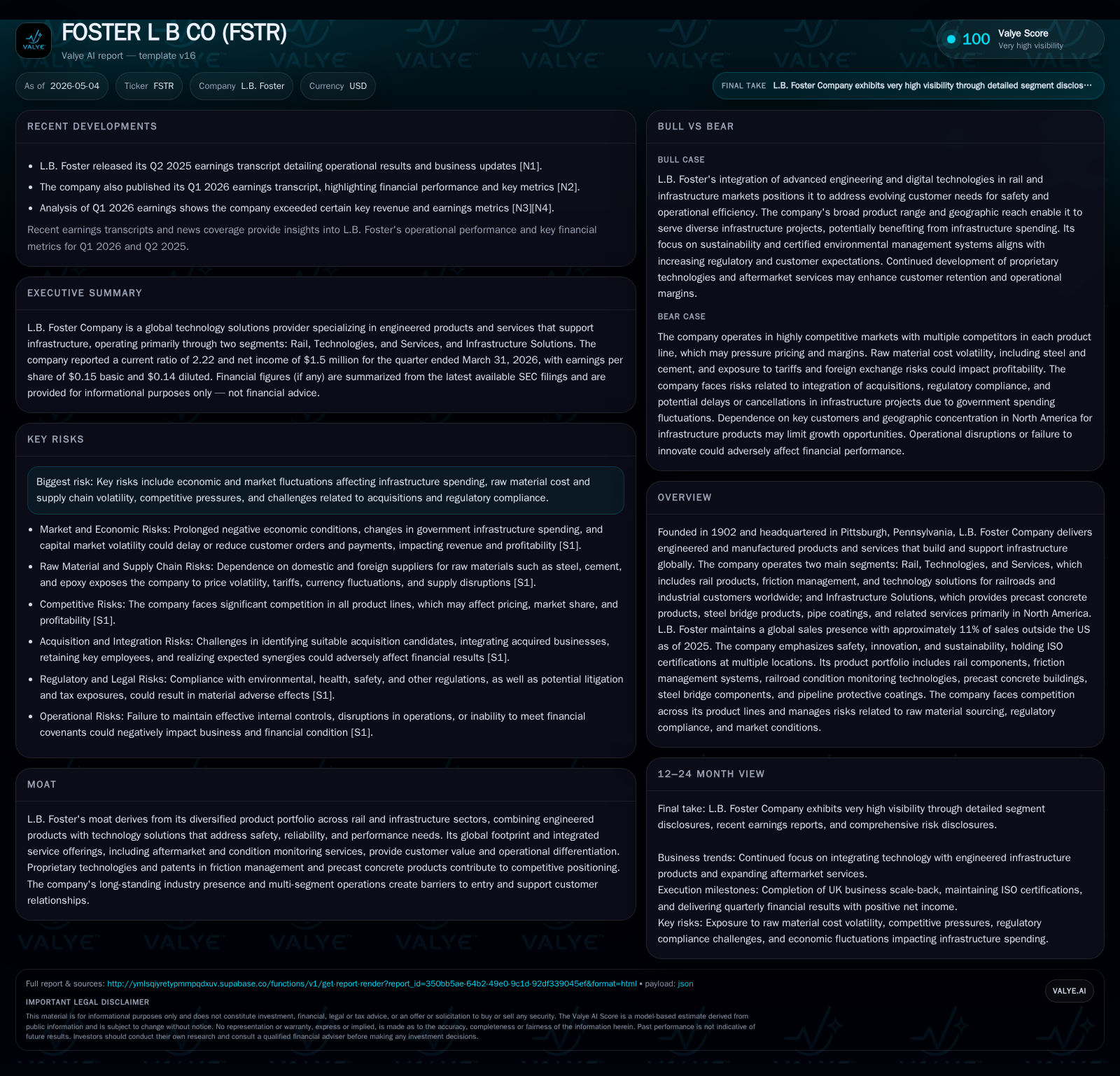
In Q1 2026, L.B. Foster demonstrated continued progress balancing growth across its Rail, Technologies, and Services segment and expanding Infrastructure Solutions business. The company’s core strength lies in engineered rail components combined with pioneering digital condition monitoring and friction management systems, alongside a growing presence in precast concrete and steel infrastructure products. While demand drivers remain robust, especially from North American infrastructure spending and rail safety technology adoption, the firm navigates challenges from raw material inflation, acquisition integration complexities, and cyclicality in infrastructure budgets. Upcoming quarters will be pivotal for order backlog visibility and supply chain stabilization.
Q1 2026 Operating Highlights and Near-Term Developments
L.B. Foster’s first quarter filing dated May 4, 2026 [S2] highlights sustained operational execution amid a mixed macro environment. Though precise revenue figures for the quarter were not specified in the filing excerpts provided, the company's disclosures affirm ongoing strength within both reportable segments—Rail, Technologies, and Services; and Infrastructure Solutions—which together reshaped the sales mix compared to prior periods. Recent event filings [S3] reinforce this narrative with an emphasis on meeting customer expectations through innovation in friction management systems alongside growth investments in precast concrete capabilities.
Notably, the Infrastructure Solutions segment has increased its share of net sales from 38% in 2024 to 43% in 2025 per the annual filing [S1], signaling strategic progress toward diversification away from reliance on rail-centric revenues which represented 57% of net sales in 2025. This transition reflects L.B. Foster’s response to evolving market demand favoring civil infrastructure rebuilding across North America.
Margins continue to face headwinds tied to raw material cost inflation—especially steel prices influenced by global commodity trends—but the company maintains pricing discipline supported by its specialized product lines and service contracts integrated into rail operators’ maintenance ecosystems.
Business Model and Segment Overview: Integrated Rail and Infrastructure Solutions
Founded in 1902, L.B. Foster Company has evolved into a vertically integrated supplier combining engineered products with digital-enabled services that support transportation and infrastructure sectors globally [S1]. The organization is split into two segments:
Rail, Technologies, and Services: This unit designs, manufactures, markets, and services components critical to freight and passenger railroad operations worldwide. It includes track components; global friction management technologies geared toward reducing wear/corrosion; plus high-tech condition monitoring solutions underpinned by proprietary software platforms enabling real-time asset performance tracking. Their comprehensive aftermarket offerings foster switching costs as customers increasingly rely on integrated maintenance regimes that span initial installation through lifecycle service support.
Infrastructure Solutions: Focused primarily on North American markets, this segment manufactures precast concrete products along with steel bridge elements essential for highway bridges, pipelines coatings (notably for oil & gas pipelines), and other civil structural applications. This division leverages a network of production facilities uniquely positioned regionally to meet large-scale infrastructure program demands.
Together these segments generate revenues primarily from direct sales contracts with government agencies (railroads often federally regulated or quasi-public), large industrial customers such as pipeline operators, construction firms managing bridge projects, and maintenance contractors offering specialized services.
Competitive Positioning and Industry Dynamics
L.B. Foster enjoys a defensible positioning owing to proprietary friction management patents granting technological advantages in rail wheel-track interface efficiency—a significant factor reducing operational disruptions for customers. The combination of physical engineered goods with embedded digital technologies creates a hybrid moat uncommon among peers who may focus strictly on manufacturing or purely software solutions.
The industry environment is characterized by stringent regulatory oversight affecting safety standards on railroads alongside cyclical but structurally growing demand associated with national infrastructure investment initiatives in the US. Competitors range from niche specialty manufacturers to larger diversified industrials; however, few match L.B. Foster's breadth across both product manufacturing plus ongoing technology-enabled services.
Supply chain complexity influences operational agility due to exposure to fluctuating raw material costs for steel and cementitious goods fundamental to their product lines [S1]. Additionally, capacity constraints at regional precast concrete facilities can limit rapid scalability absent capital investments.
Growth Drivers: Innovation, Geographic Reach, and Service Expansion
Fundamental growth drivers stem from several vectors:
Infrastructure Renewal Programs: Increased federal spending on highways, bridges, water resources supports growing demand for the Infrastructure Solutions segment’s precast concrete structures and steel bridge products [S1]. These capital projects often entail multi-year contracts accelerating backlog formation.
Rail Technology Adoption: Freight operators prioritizing asset reliability are deploying more advanced condition monitoring tools developed by L.B. Foster's Technology Services unit enhancing predictive maintenance capabilities [N2]. Rising awareness of safety benefits propels aftermarket contracts focusing on friction management extensions beyond initial hardware.
Geographic Expansion: Though approximately 89% of revenue remains domestically concentrated as of 2025 [S1], efforts continue to broaden international sales reach leveraging established offices across South America, Europe, and Asia where rail modernization projects generate pockets of opportunity.
Service Integration: Cross-selling bundled maintenance services alongside hardware installations strengthens customer retention through sticky recurring revenue streams [S1].
Risks and Constraints: Acquisitions, Supply Chains, and Market Cyclicality
A prominent risk outlined relates to acquisition strategy execution [S1].
Material input price fluctuations in steel and concrete can compress margins if passed-through pricing lags behind cost spikes [S1,S2]. Furthermore, infrastructure budget allocations at government levels—though currently supportive—can shift with political winds leading to uneven backlog visibility.
Regulatory compliance across multiple jurisdictions also adds overhead complexity especially given broad geographic scope spanning multiple continents.
Upcoming Catalysts and Monitoring Points
Investors should closely watch next quarterly earnings releases for updates on order backlog momentum within both segments [N2], which serve as forward indicators for near-term revenue sustainability.
Supply chain normalization efforts around commodity availability will be key to margin recovery or stabilization amid persistent inflationary cost dynamics.
Technology deployment successes—especially enhancements in friction management system upgrades or rollout extensions of advanced railroad condition monitoring—will signal execution progress against innovation-led differentiation strategies.
Finally, any explicit commentary regarding acquisition plans or integration progress will materially influence risk perception given historical cautionary disclosures [S1].
Latest Financial Snapshot Supporting Operating Trends
Latest financial snapshot
| Metric | Value | Period |
|---|---|---|
| Cash & equivalents | $4mm | |
| 2026-03-31 | ||
| Total debt | $60mm | |
| 2026-03-31 | ||
| Net debt | $56mm | |
| 2026-03-31 | ||
| Current assets | $162mm | |
| 2026-03-31 | ||
| Current liabilities | $73mm | |
| 2026-03-31 | ||
| Current ratio | 2.22x | |
| 2026-03-31 |
Source: SEC companyfacts cache [F1].
| Metric | Value (USD) |
|---|---|
| Cash & Equivalents | 3.99 million |
| Total Debt | 59.54 million |
| Net Debt | 55.55 million |
| Current Assets | 162.21 million |
| Current Liabilities | 72.95 million |
| Current Ratio | 2.22 |
This liquidity profile as of March 31, 2026 supports operational flexibility while the net debt level reflects continued reliance on external funding sources balanced against cash conversion cycles inherent in project-based industrial supply environments.
Disclaimer: This analysis is based solely on publicly available filings as of May 4, 2026 ([S1], [S2], [S3]) supplemented by independent industry context without investment recommendations or price targets.
Disclaimer: This is research-only, informational analysis and not investment advice. It may include AI-generated interpretation and general industry context. Always verify important details using primary sources.

Comments