
OSI Systems Advances Military and Healthcare Tech with Solid Q3 2026 Execution
Q3 2026 results reflect milestone-driven revenues and sustained service contract growth in diversified technology segments.
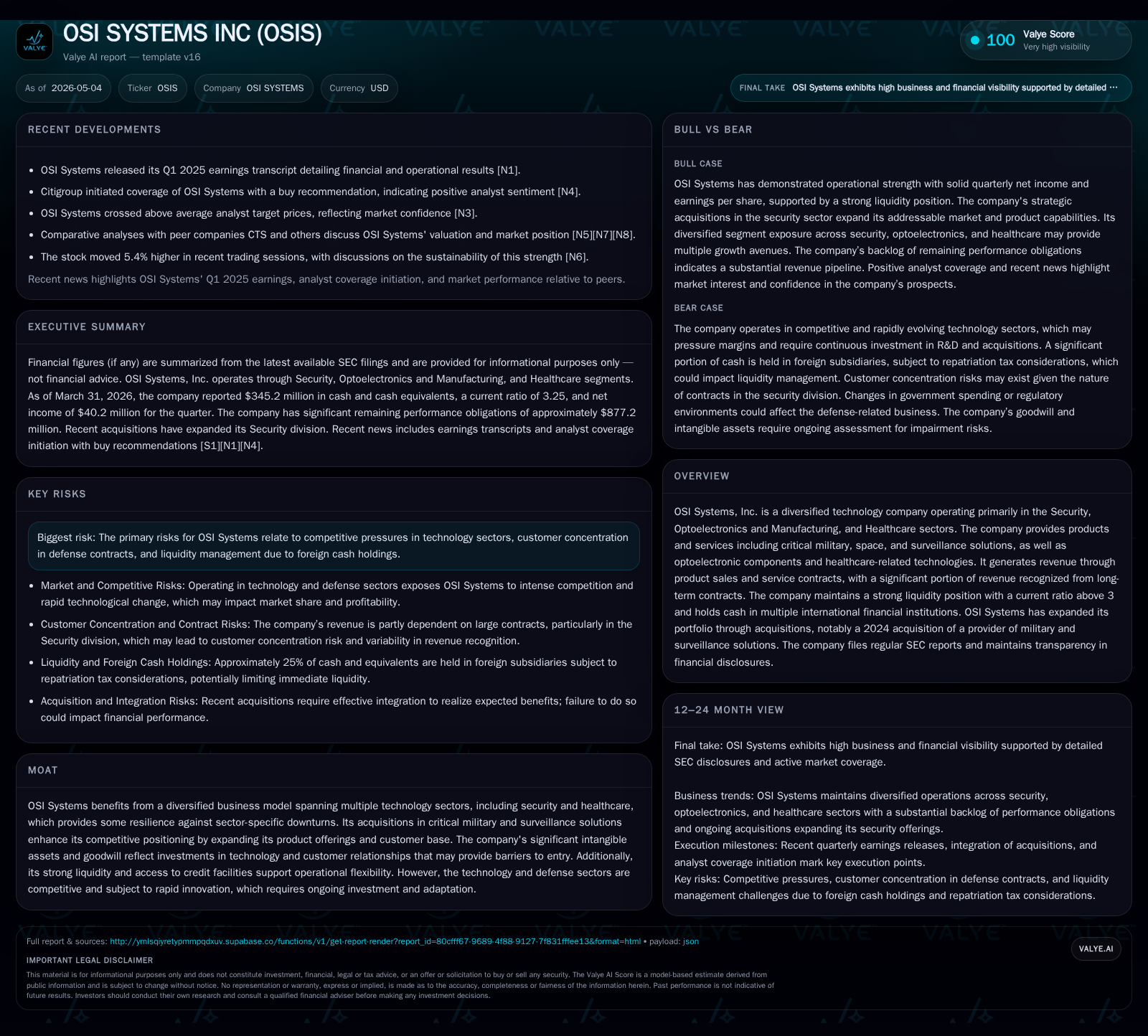
OSI Systems' latest quarterly report shows stable product revenue and growing service contract deferred income, indicative of strong long-term customer agreements. The recent acquisition in military and surveillance solutions strengthens its Security division, complementing steady growth in optoelectronics and healthcare. Solid liquidity and a current ratio above 3 provide operational flexibility despite a net debt position. Competitive dynamics necessitate ongoing innovation investments amid sector pressures. Key near-term indicators will include backlog progression, new contract milestones, and integration success of acquisitions.
Recent Operating Update: Q3 FY2026 Highlights
OSI Systems' recent 10-Q filing for the quarter ended March 31, 2026, reveals nuanced shifts in its operating metrics critical to understanding near-term business momentum [S2]. The company reported total net revenues for the nine months ended March 31, 2026 of approximately $1.30 billion, a rise from roughly $1.21 billion in the prior year period [S8]. This growth was driven primarily by milestone completions within the Security division that reduced contract assets by $67.9 million due to increased rights to invoice customers. Meanwhile, advances from customers (contract liabilities) decreased by $8.2 million as invoicing applied against prior deposits [S2]. However, deferred revenue increased by $12.1 million triggered mainly by the accrual of payments for service contracts where cash is collected upfront but obligations are recognized over time.
This dynamic points to an operational cadence where OSI's contractual engagements secure payments ahead of delivery for many services – a common model in defense contracting and healthcare services that generate predictable recurring revenues once contracts are solidified.
Concurrently, on May 4, 2026, OSI issued a press release confirming results aligned with SEC disclosures while emphasizing continued execution on strategic initiatives including expanding their security-focused military solutions portfolio via acquisitions [S3][N1].
Business Model Overview
OSI Systems operates a diversified technology business split primarily into three segments: Security; Optoelectronics & Manufacturing; and Healthcare. The company's revenue model blends product sales—ranging from critical military equipment to optoelectronic components—with long-term service contracts that generate recurring revenues.
Security Division: Focuses on military-grade hardware and surveillance solutions often sold under long-term government contracts or commercial security agreements. The division’s sales are milestone-dependent with revenue recognition often linked to delivery dates or contract completion phases.
Optoelectronics & Manufacturing Division: Supplies advanced optoelectronic components used across technological applications including aerospace and industrial sectors. Revenue here tends to be more product-sale based with less dependency on service contracts but competitive pricing pressure.
Healthcare Division: Provides diagnostic instruments and related healthcare technologies often bundled with ongoing maintenance or software update services that form the basis for recurring service revenues.
The company’s ability to recognize revenue varies by segment due to differing contract structures—the Security division’s decreasing contract assets signal milestone achievements thus unlocking invoice rights, while increasing deferred revenue from services reveals customers’ upfront payments for future performance [S2]. This mix contributes to margin stability given the higher margin profile generally associated with services versus lower-margin hardware sales.
Industry Structure and Competitive Position
Operating at the intersection of defense technology, electronics manufacturing, and healthcare instruments places OSI Systems in capital-intensive industries characterized by substantial R&D requirements, regulatory oversight, and competitive government procurement cycles.
In Defense & Security technology markets, OSI competes against larger defense contractors but leverages its niche focus on optoelectronic-based surveillance systems and specialized military technologies to maintain differentiated offerings enhanced through the strategic acquisition made in September 2024 [S27]. This move expanded its customer base in critical military space and surveillance solutions—a high-barrier-to-entry sector driven by long procurement cycles but significant government budget allocations.
The company's optoelectronics manufacturing benefits from scale economies but also faces commoditization risks that require constant innovation to maintain pricing power. Healthcare technology increasingly focuses on integrated solutions combining hardware with software-enabled services—a trend OSI taps through its service contracts contributing to deferred revenue growth.
Customer concentration remains notable especially in defense contracts where few large government agencies dominate spend patterns—exposing OSI to cyclical budget shifts but also anchoring business on multi-year awards with switching costs embedded through certification processes and compliance requirements.
Growth Drivers
Several factors underpin OSI's growth trajectory:
Contract Milestones Realization: Contract asset reductions tied to milestone achievement unlock revenue recognition—an indicator of project progress translating into booked sales.
Service Contract Expansion: Deferred revenue growth points to stronger recurring cash flow streams via managed maintenance, software updates, or support services which enhance customer stickiness.
Acquisitions: Integration of complementary providers expands technological capabilities and broadens addressable markets especially within defense-oriented Security products.
Technological Innovation: Sustained R&D investment (~$19M Q3 YTD) supports product differentiation amidst rapid changes in electronic warfare, surveillance sensors, and healthcare instrumentation [S8].
International Presence: Cash reserves held across global financial institutions may facilitate foreign market expansion alongside domestic sales.
Risks and Constraints
Despite positive indicators, several risks bear watching:
Competitive Pressures: Intense rivalry among defense suppliers demands continuous capability enhancements risking margin compression or loss of customer bids.
Customer Concentration: Heavy reliance on key government clients can expose OSI to funding fluctuations or policy changes beyond the company’s control.
Integration Risks: Recent acquisitions require seamless melding into existing operations; failure could disrupt sales pipelines or inflate costs.
Liquidity Management: Significant foreign cash holdings (~25%) subject to repatriation tax considerations potentially reduce deployable capital flexibility [S15].
Regulatory Environment: Compliance burdens vary across defense contracting laws and healthcare regulations requiring robust governance frameworks.
What To Watch Next
Key upcoming indicators for evaluating OSI’s performance will include:
- Updates on backlog levels especially order intake that would signal forward-looking demand strength.
- Progress on integration milestones for newly acquired businesses announced since late 2024.
- Trends in deferred revenue expansion reflecting service contract wins or renewals.
- R&D expenditure trends signaling commitment to innovation versus cost containment pressures.
- Liquidity movements considering debt repayments ($1B debt outstanding vs $345M cash) balanced against capital expenditure needs.[F1][S2]
- Commentary around competitive wins or losses notably within government security contracts reported during earnings calls.[N1]
Financial Profile (Latest Snapshot)
Latest financial snapshot
| Metric | Value | Period |
|---|---|---|
| Cash & equivalents | $345mm | |
| 2026-03-31 | ||
| Total debt | $1003mm | |
| 2026-03-31 | ||
| Net debt | $657mm | |
| 2026-03-31 | ||
| Current assets | $1717mm | |
| 2026-03-31 | ||
| Current liabilities | $529mm | |
| 2026-03-31 | ||
| Current ratio | 3.25x | |
| 2026-03-31 |
Source: SEC companyfacts cache [F1].
*Net Debt = Total Debt - Cash & Equivalents [F1]
The balance sheet indicates manageable leverage with net debt around $657M supported by a strong current ratio exceeding three times suggests sound short-term liquidity positioning balancing working capital needs alongside strategic borrowings related to recent acquisitions.[F1][S15]
Disclaimer: This analysis is provided solely for informational purposes based on public filings as of May 4, 2026 ([S2], [S3], [F1]) without any recommendation or investment advice regarding OSI Systems Inc.
Disclaimer: This is research-only, informational analysis and not investment advice. It may include AI-generated interpretation and general industry context. Always verify important details using primary sources.

Comments