
RCM Technologies Transitions Auditors Amid Internal Control Enhancements and Governance Strengthening
Recent auditor change and internal control disclosures underscore RCM Technologies’ commitment to governance and operational stability.
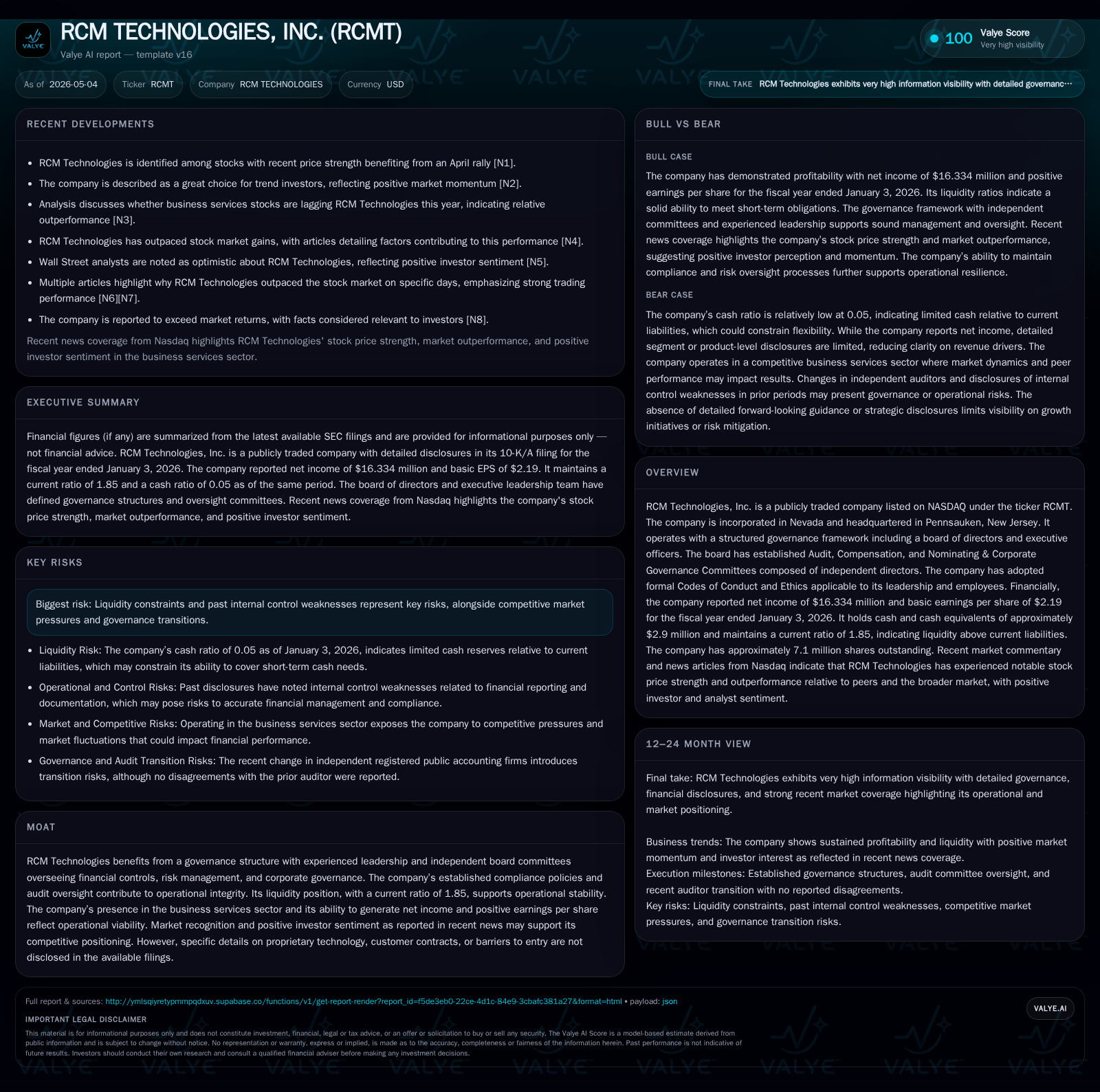
RCM Technologies, Inc. announced a change in its independent registered public accounting firm, replacing EisnerAmper LLP with WithumSmith+Brown, PC effective April 29, 2026. This move follows the identification of material weaknesses in internal controls over financial reporting during fiscal 2025. Despite these challenges, the company maintains solid liquidity with a current ratio of 1.85 and reported net income of $16.334 million for fiscal year 2025. RCM’s governance framework features experienced leadership with an independent board and oversight committees, positioning it for operational integrity amid ongoing business service sector competition.
Recent Operating Update
This auditor change is significant since it reflects a key governance evolution directed by the Audit Committee to strengthen financial reporting reliability while maintaining compliance with Sarbanes-Oxley requirements. Notably, WithumSmith+Brown had previously served as RCM’s registrar auditor for prior fiscal years (2022-2024), which suggests continuity underlying this strategic shift.
Business Model
RCM Technologies primarily generates revenue through providing information technology staffing solutions and business services targeting enterprise clients across various sectors. Clients typically pay fees tied to contract staffing placements or project engagements covering IT consulting and support services [S1]. Revenue dynamics are influenced by contract volume, client retention rates, pricing models tied to skill scarcity or specialization, and project duration.
Operationally, RCM leverages its domain expertise in technology staffing combined with compliance frameworks ensuring accuracy in employee timekeeping and billing—critical given prior identified gaps in internal controls related to these processes [S5]. The company’s investment in formal Codes of Conduct and Ethics alongside Board-constituted Audit and Compensation Committees underscores its focus on regulated governance frameworks supporting sustainable service quality.
Industry Structure and Competitive Position
Operating within the highly competitive business services/staffing industry characterized by numerous mid-sized players targeting niche IT roles, RCM competes on talent placement efficiency, contractual flexibility, geographic reach (headquartered in New Jersey), and adherence to regulatory compliance standards. Market fragmentation places price pressure on services but also creates opportunities for differentiated providers able to integrate technology platforms or develop proprietary workforce solutions.
RCM’s governance strength under Executive Chairman Bradley S. Vizi—whose background includes private equity investing—and board members like Swarna Srinivas Kakodkar—bringing extensive tech sector leadership—deliver a competitive edge in strategic decision-making and go-to-market agility [S19][S27]. However, lacking detailed disclosure on proprietary intellectual property or exclusive customer contracts implies modest barriers to entry relative to larger industry incumbents.
Growth Drivers
Key growth drivers stem from:
- Expanding enterprise client relationships particularly in sectors demanding complex IT talent placements.
- Adoption of technology-enabled platforms facilitating streamlined staffing workflows enhances customer stickiness.
- Implementation of rigorous internal control remediation initiatives predicted to improve operational scalability.
- Performance stock unit incentives aligned with EBITDA targets incentivize management execution excellence over medium term [S23].
The industry’s structural demand for flexible IT staffing remains robust amidst economic cycles as organizations prioritize agile workforce solutions over fixed staffing costs—a secular tailwind benefiting firms like RCM currently honing operational capabilities.
Risks / Watchpoints / Growth Constraints
Despite positive strategic moves, RCM faces risks including:
- Material weaknesses in internal control frameworks could delay financial accuracy or trigger regulatory scrutiny if unremedied promptly [S5].
- Competitive dynamics with many similarly sized players may constrain pricing power or client acquisition efforts.
- Potential liquidity constraints if working capital intensifies due to contract timing mismatches given the reported cash balance of roughly $2.9 million versus current liabilities near $53.8 million requiring careful cash flow management [F1].
- Dependence on key executives like Mr. Vizi whose leadership directly impacts investor confidence.
Careful focus on remediation progress under new auditors will be critical.
What To Watch Next
Market participants should monitor:
- Quarterly updates on the progress of internal control remediation efforts reflecting closing gaps highlighted by prior audits.
- Updates on WithumSmith+Brown’s initial audit findings for FY2026 signaling changes in audit scope or opinion.
- Performance metrics linked to PSUs granted based on EBITDA performance scheduled for determination post-fiscal year end January 3, 2026 [S23].
- Any disclosures regarding shifts in client mix or service innovations aimed at bolstering recurring revenue streams.
- Commentary from Board risk oversight committees about governance maturity progression given their role overseeing material risk exposures across operations [S13].
Financial Profile (Latest Available)
Latest financial snapshot
| Metric | Value | Period |
|---|---|---|
| Cash & equivalents | $3mm | |
| 2026-01-03 | ||
| Current assets | $100mm | |
| 2026-01-03 | ||
| Current liabilities | $54mm | |
| 2026-01-03 | ||
| Current ratio | 1.85x | |
| 2026-01-03 |
Source: SEC companyfacts cache [F1].
RCM exhibits solid profitability metrics reflective of controlled operating costs relative to revenue generation capacity. The liquidity position evidenced by a current ratio above one suggests adequate short-term ability to meet liabilities though cash balances warrant active management given working capital needs typical in staffing firms [F1]. The company does not appear encumbered by significant debt obligations within this snapshot timeframe.
Conclusion
RCM Technologies presents an intriguing combination of steady profitability amidst necessary governance recalibration following recent auditor-led scrutiny on internal controls. The transition back to a familiar auditor signals management’s intent to strengthen transparency and compliance rigor while capitalizing on experienced leadership that blends investment acumen with technological expertise. Industry fundamentals around enterprise IT staffing continue favoring well-governed mid-sized providers positioned to scale through disciplined execution of growth initiatives allied with rigorous risk oversight.
This analysis is based solely on publicly available filings as detailed herein through May 4, 2026. It neither offers investment advice nor market recommendations but aims to provide an informed perspective grounded in verifiable data.
Disclaimer: This is research-only, informational analysis and not investment advice. It may include AI-generated interpretation and general industry context. Always verify important details using primary sources.

Comments