
Dorman Products Strengthens Aftermarket Leadership with Broad Portfolio and Innovation
Dorman's latest quarter underscores its robust aftermarket parts lineup, first-to-market innovation, and balanced supply chain amid competitive and customer concentration risks.
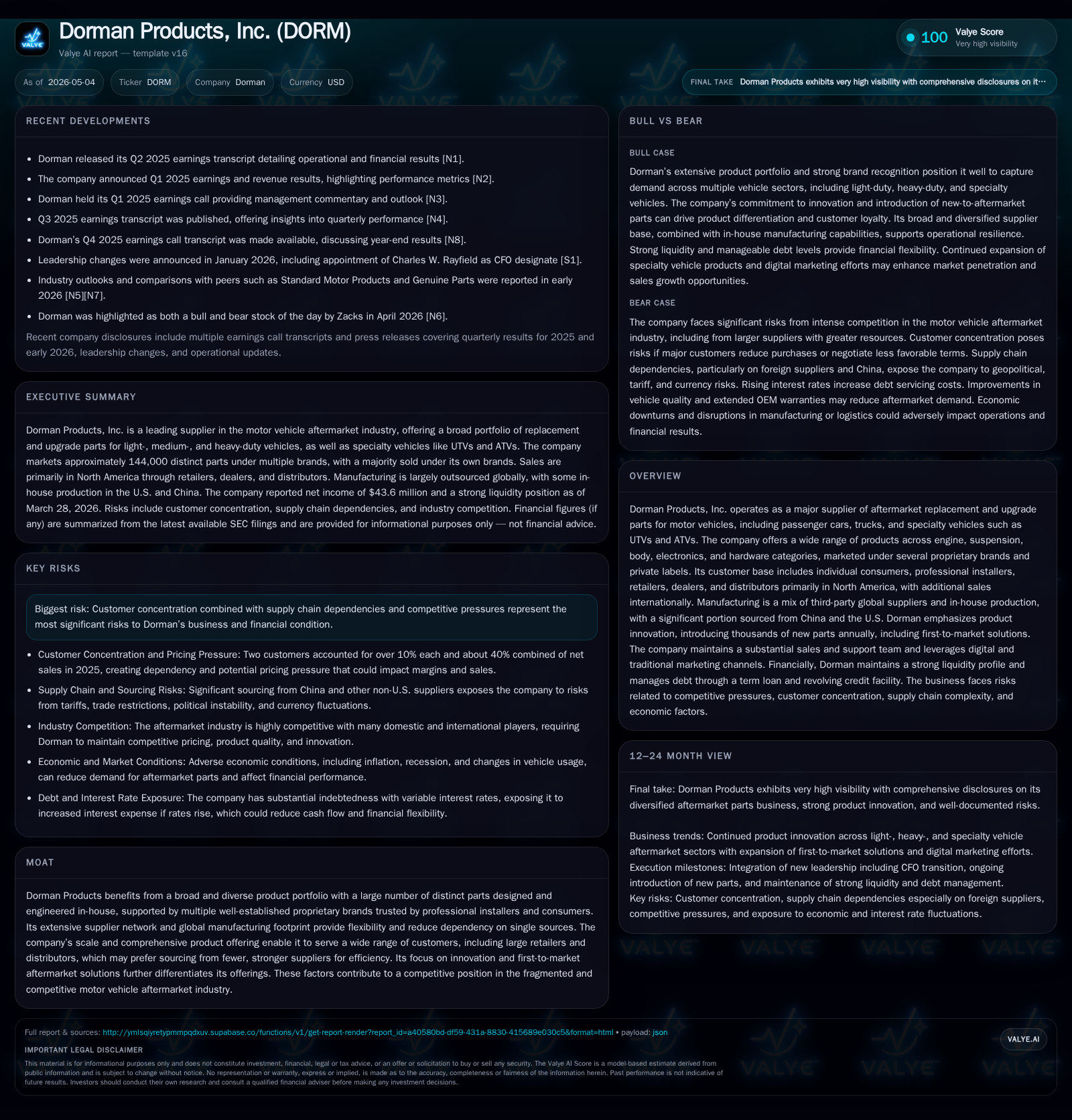
In its Q1 2026 filing, Dorman Products continued to exhibit operational resilience highlighted by sustained product innovation and sales growth across key vehicle sectors. The company leverages a diversified aftermarket portfolio spanning light-, heavy-, and specialty-duty vehicles, supported by proprietary brands and a global supplier base. Despite ongoing pressures from concentrated customer relationships and competitive pricing dynamics, Dorman’s scale, broad SKU footprint, and focus on first-to-market replacement parts position it well in a $165 billion industry. Investors should track upcoming product launches, channel expansion efforts, and supply chain risk mitigation as critical growth indicators.
Latest Quarter Operating Highlights and Strategic Updates
Dorman Products' first fiscal quarter ended March 28, 2026 ([S2], [S3], [N2], [N3]) continued to confirm the company’s steady execution within the motor vehicle aftermarket sector. While no dramatic shifts were reported in risk factors or strategic direction compared to the prior year ([S2]), the firm reported beating Q1 earnings and revenue estimates according to external market commentary ([N2]). This suggests underlying demand stability supported by effective pricing and volume management.
Recent earnings call disclosures ([N3]) underscored Dorman's focus on broadening its product portfolio to capture incremental market share among professional installers and retail e-commerce customers alike. No material changes were reported regarding supply chain disruptions or customer account dynamics during the quarter. The company remains committed to launching innovative first-to-aftermarket solutions that help professional technicians save time while enhancing reliability.
Business Model Overview: Diverse Product Range and Market Coverage
Dorman operates as a leading supplier of aftermarket replacement and upgraded motor vehicle parts including passenger cars, light/medium/heavy trucks, as well as specialty vehicles such as UTVs and ATVs ([S1], ). The company manages an expansive portfolio exceeding approximately 144,000 distinct SKUs designed or engineered internally—a figure that excludes private-label offerings—highlighting its deep catalog breadth.
Products span core functional categories like engine components (e.g., intake manifolds), exhaust systems (including proprietary exhaust manifolds), suspension parts (leaf springs), as well as sophisticated electronic modules like tire pressure sensors and active grille shutters ([S27], ). Approximately 76% of sales come from owner-branded products (e.g., DORMAN®, OE FIX™), which enjoy brand equity among professional installers seeking reliability backed by warranties.
Distribution is multi-channel: aftermarket retailers including online platforms; warehouse distributors; dealer networks; and direct-to-consumer specialty markets ([S1]). Geographically, North America accounts for most sales with additional volumes directed to Canada, Mexico, Europe, the Middle East, and Australia ([S18]). Manufacturing combines outsourced global production—including a substantial Chinese supplier base representing about 38% of purchase volume in 2025—and in-house facilities primarily located in the U.S., especially for heavy-duty and specialty products ([S19], ). This dual sourcing strategy balances cost competitiveness against tariff exposure risks.
Competitive Environment and Industry Positioning
The motor vehicle aftermarket is sizable yet highly fragmented with numerous public companies (e.g., Standard Motor Products) alongside private-label competitors operated by large retail customers ([S21], ). Dorman competes against both OEM dealer parts channels—which often command premium prices but less flexibility—and established aftermarket suppliers offering deep catalogs.
The competitive arena is shaped by several forces: consolidation among distributors expands their purchasing clout; evolving automotive technology demands faster R&D response times; price sensitivity among buyers demands cost control; plus increasing use of AI tools among competitors could accelerate innovation cycles ([S21]).
Dorman’s moat lies in its scale—servicing about 9,000 active accounts—and its comprehensive product range designed with direct input from repair technicians focusing on fitment challenges ([S19], [S27]). Its "OE FIX" branded line uniquely targets problematic OEM parts with enhanced features aimed at improving serviceability—a differentiation that leverages internal engineering capabilities not easily replicated by fast-followers ([S27]). Moreover, relationships built over decades with retailers allow preferred shelf space allocation despite intensifying competition.
Drivers Fueling Growth: Innovation, Channels, and Product Expansion
Innovation constitutes a core growth pillar. In 2025 alone, Dorman introduced over 5,500 new distinct parts combining new-to-the-aftermarket solutions (1,600) plus extensive line extensions (4,000) ([S27]). Noteworthy launches included novel OE FIX exhaust manifolds targeting key late-model vehicles providing superior durability versus OEM replacements. It expanded complex electronics such as advanced control modules for emerging automotive electronic repair niches.
The specialty vehicle sector is growing fast with durable upgrades like polycarbonate windshields featuring proprietary scratch-resistant coatings and rugged utility vehicle doors underscoring Dorman’s penetration into powersports markets ([S29]). Approximately half of specialty vehicle sales comprise nondiscretionary repair parts underpinning stable recurring revenue streams.
Channel-wise, Dorman exploits omni-channel distribution through strong retailer partnerships who increasingly leverage e-commerce platforms. This aligns with shifting consumer behavior toward online ordering for convenience without sacrificing professional-grade product quality incentives. Sales teams numbering roughly 300 employee representatives provide dedicated support facilitating account expansion via targeted SKU introductions across existing customers ([S19], [S29]).
Risks and Challenges: Customer Concentration and Supply Dependencies
Two dominant customers represented approximately 40% of net sales in 2025—a consistent structural vulnerability flagged repeatedly by management ([S1], [S7], [S21]). Not only does this concentration create operational reliance risk if purchasing patterns change abruptly but such clients wield strong negotiating leverage forcing margin concessions via rebates or extended payment terms.
Additionally, dependence on global suppliers—particularly China—introduces tariff risk amid fluctuating trade policies. While Dorman sources roughly one-third of purchases from Chinese third parties balanced by strong U.S.-based manufacturing for specialized products offers some hedging benefits ([S19], ), intense competition urges ongoing diversification efforts nonetheless.
Pricing pressures persist within an increasingly crowded aftermarket environment compounded by private-label incursions from large customers aiming to reduce costs or consolidate supply bases. The resultant margin variability necessitates operational discipline through cost efficiency measures alongside innovation-driven premium product offerings capable of commanding price premiums ([S21], ).
Key Monitoring Points: Upcoming Milestones and Market Signals
Watch carefully for adjustments to quarterly revenue or gross margin guidance emerging from future earnings releases potentially reflecting impacts from escalating raw material costs or disruptive logistics events given current macroeconomic volatility ([N2], [N3]).
New product announcements within rapidly developing specialty segments may materially influence growth trajectories alongside signs of expanding digital commerce penetration measured via direct or indirect channel KPIs. Contract renewals or expansions among top-tier retail partners also serve as critical barometers confirming customer retention strength in a high-concentration context.
Balance sheet covenant compliance indicators found within successive filings will illuminate whether leverage constraints limit capital deployment options essential for acquisitions or expanded R&D initiatives beyond organic growth.[S4],[S5]
Current Financial Snapshot: Leverage, Liquidity, and Capital Structure
Dorman maintains a strong liquidity position with a current ratio of 3.29x as of March 28, 2026, reflecting solid working capital management ([F1]). Total debt stood at approximately $441 million as of December 31, 2025, with net debt around $398 million at the same date ([F1]). Cash and equivalents were $43 million as of March 28, 2026 ([F1]).
This analysis synthesizes publicly filed documents up to May 4th, 2026 without conjecture beyond documented disclosures. It aims to provide a grounded view on Dorman Products’ operating performance, business model strengths & vulnerabilities relative to evolving aftermarket industry dynamics.
Disclaimer: This is research-only, informational analysis and not investment advice. It may include AI-generated interpretation and general industry context. Always verify important details using primary sources.

Comments