
SHORE BANCSHARES Strengthens Liquidity and Profitability in Q1 2026
Shore Bancshares’ latest 10-Q reveals strong quarterly earnings and a robust liquidity position supported by its Tier 2 capital strategy.
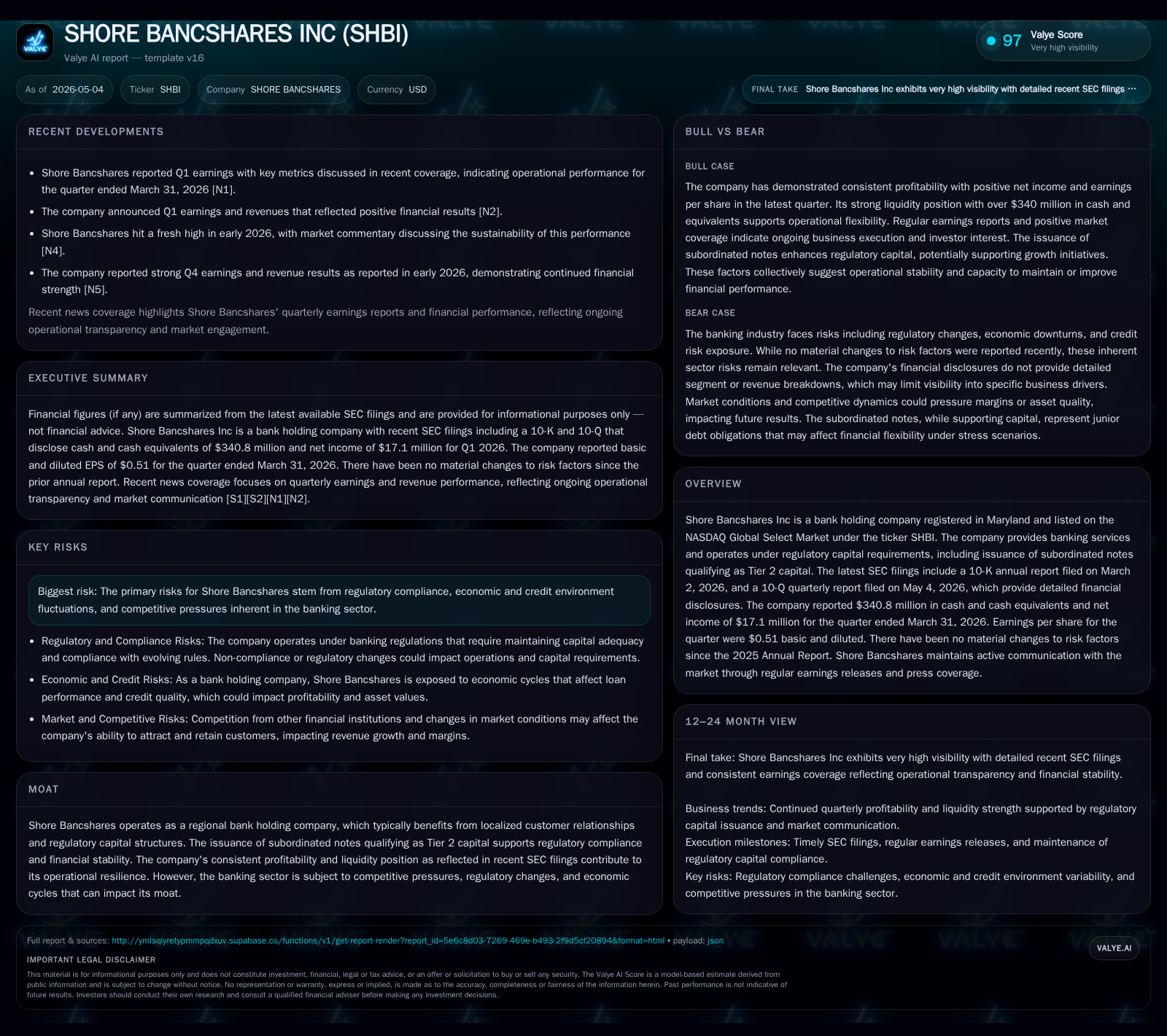
In Q1 2026, Shore Bancshares Inc reported net income of $17.1 million and basic/diluted earnings per share of $0.51, underscoring solid profitability [S2], [F1]. The bank holds $340.8 million in cash and equivalents against total debt of $89.0 million, resulting in a negative net debt position and signaling strong liquidity [F1]. Its issuance of subordinated notes qualifying as Tier 2 capital enhances regulatory capital adequacy, supporting lending capacity. Shore Bancshares remains well-positioned within the regional banking sector, leveraging close customer relationships and prudent balance-sheet management while navigating steady competitive and regulatory pressures [S1], [S4].
Q1 2026 Operating Update: Earnings and Capital Highlights
Shore Bancshares’ latest quarterly filing (10-Q dated May 4, 2026) presents a snapshot of a financially robust regional bank holding company. For the quarter ended March 31, 2026, the company posted net income of $17.1 million with basic and diluted earnings per share both reported at $0.51 [S2], [F1]. The firm maintains a significant liquidity buffer evidenced by cash and cash equivalents totaling $340.8 million alongside relatively modest total debt of approximately $89 million at quarter-end, implying a net cash position of over $250 million when comparing these two balance sheet metrics directly [F1]. This liquidity profile provides substantial operational flexibility for loan growth or other financial opportunities.
Critically supporting its capital structure is the issuance of subordinated notes that qualify as Tier 2 regulatory capital — an important element given the stringent capital requirements imposed on banking institutions to ensure stability and absorb potential losses. These notes contribute to Shore Bancshares’ ability to expand lending capacity within regulatory constraints while preserving financial soundness [S13], [S1]. There have been no material changes in the company's risk factors since the prior year's annual report, indicating consistent risk management during Q1 2026's operating environment [S2].
Business Model and Product Offering Underpinnings
Shore Bancshares operates as a bank holding company domiciled in Maryland with the NASDAQ Global Select Market ticker SHBI [S1], offering traditional banking services primarily centered on deposit-taking and loan origination. This business model relies heavily on generating net interest margin—the spread between interest income earned on loans and investment securities minus interest expense paid on deposits and borrowings.
Revenue is principally driven by lending activities funded through customer deposits and strategic borrowings supported by an appropriately calibrated balance sheet designed to meet regulatory capital standards. The recent issuance of subordinated notes qualifying as Tier 2 capital serves to reinforce this framework by supplementing capital reserves used to support asset growth without breaching regulatory thresholds that could constrain operational expansion or require deleveraging steps [S1], [S13].
Given its status as a regional bank holding company, Shore Bancshares focuses on building enduring local customer relationships underpinning stable deposit bases and repeat lending opportunities, which are crucial for maintaining low-cost funding while managing credit risk prudently.
Competitive Positioning in the Regional Banking Sector
Within the regional banking sector, Shore Bancshares contends with nuanced competitive dynamics characteristic of localized banking markets. Products such as loans, deposit accounts, and basic treasury services tend toward commoditization with limited differentiation possible beyond service quality and relationship depth. Pricing power can thus be constrained by competition from larger national banks or non-bank fintech counterparts offering innovative technology-driven solutions.
Shore Bancshares’ competitive moat stems from its embeddedness in local markets where established customer relationships translate into loyalty benefits—particularly important in credit underwriting given information asymmetries typical of community banks. However, this advantage requires continual investment in maintaining customer satisfaction and operational efficiency amid intensifying industry consolidation pressures.
Economic cycles also present variability in credit quality that can stress provisioning requirements or heighten loss severity risks relative to more diversified national peers. Regulatory scrutiny further adds complexity as compliance costs absorb resources that could otherwise fund innovation or market expansion efforts [S4], [S11].
Key Growth Drivers: Customer Relationships and Regulatory Capital
Growth prospects center strongly on Shore Bancshares’ ability to deepen penetration into its regional client base through enhanced relationship management strategies that solidify deposit inflows and loan book expansions. Leveraging its healthy Tier 2 capital base enables the company to pursue lending growth prudently without compromising regulatory compliance or financial resilience.
Additionally, operational improvements via technology adoption hold promise for improved efficiency ratios—an ongoing challenge for regional banks balancing scale disadvantages against service expectations. Reliable profitability supports reinvestment opportunities while conservative underwriting standards help sustain asset quality amid macroeconomic uncertainties.
This combination of capital strength, customer intimacy, and cost discipline suggests growth driven more by structural advantages than cyclical spikes alone though vigilance remains key given potential shifts in economic or regulatory landscapes impacting credit demand or margin profiles [S2], [S3].
Risks and Constraints: Regulatory and Market Pressures
Primary risks confronting Shore Bancshares include compliance obligations stemming from complex banking regulations that impose capital adequacy monitoring, anti-money laundering protocols, consumer protection rules, among others—all demanding ongoing resource commitments impacting margins.
Interest rate volatility influences net interest margin prospects; prolonged low-rate environments compress spreads while high-rate surges can strain borrower repayment capacity escalating credit losses. Regional banks like Shore Bancshares face particular exposure due to concentrated geographic footprints susceptible to localized economic downturns affecting collateral quality.
Competitive intensity from both traditional banks expanding regional footprints and emerging fintech entrants capable of disrupting payment systems or deposit gathering also constrains pricing flexibility potentially reducing returns on equity unless offset by operational efficiencies or niche specialization.
No new material risk factors emerged in Q1 filings compared to prior disclosures; nevertheless, these persistent risks underline cautious strategic management necessity within dynamic external conditions characteristic of the sector [S4], [S11].
Upcoming Milestones and What Investors Should Monitor
Attention near term should focus on several markers revealed through company communications including the quarterly earnings cadence expected next at Q2 reporting; specifically:
- Loan portfolio growth rates as indicators of demand strength within local markets;
- Trends in net interest margin reflecting interest rate environment effects;
- Credit provisioning levels providing insight into credit quality trajectories;
- Execution progress on technology investments aimed at improving efficiency metrics;
- Any announcements regarding adjustments to capital structure or regulatory developments impacting Tier 2 notes or other financing strategies.
The company’s regular investor presentations filed concurrently with recent SEC reports augment transparency around strategic priorities offering stakeholders timely visibility into performance execution dynamics moving forward [S3], [N1], [N2].
Latest Financial Snapshot
Latest financial snapshot
| Metric | Value | Period |
|---|---|---|
| Cash & equivalents | $341mm | |
| 2026-03-31 | ||
| Total debt | $89mm | |
| 2026-03-31 | ||
| Net debt | $-252mm | |
| 2026-03-31 |
Source: SEC companyfacts cache [F1].
| Metric | Value (USD) |
|---|---|
| Cash & Equivalents | 340.8 million |
| Total Debt | 89.0 million |
| Net Income (Quarter) | 17.1 million |
| Basic/Diluted EPS | $0.51 |
This snapshot highlights Shore Bancshares’ substantial liquidity cushion vis-à-vis relatively contained debt obligations translating into negative net debt—a feature uncommon among many banks balancing growth with prudence—and profitability metrics consistent with sustainable operations underpinned by effective net interest margin management and controlled expenses.
This analysis is based exclusively on available SEC documents including the latest quarterly (10-Q), annual (10-K) filings as well as recent event reports supplemented by current financial data from company facts repositories up to May 2026. It refrains from extrapolation beyond reported facts emphasizing audited disclosures without speculative forecasts or investment recommendations.
Disclaimer: This is research-only, informational analysis and not investment advice. It may include AI-generated interpretation and general industry context. Always verify important details using primary sources.

Comments