
Nuvation Bio Advances Commercialization of IBTROZI and Expands Global Oncology Pipeline
Recent FDA approval and commercial launch of IBTROZI drive near-term focus, while pipeline expansion underscores longer-term growth potential.
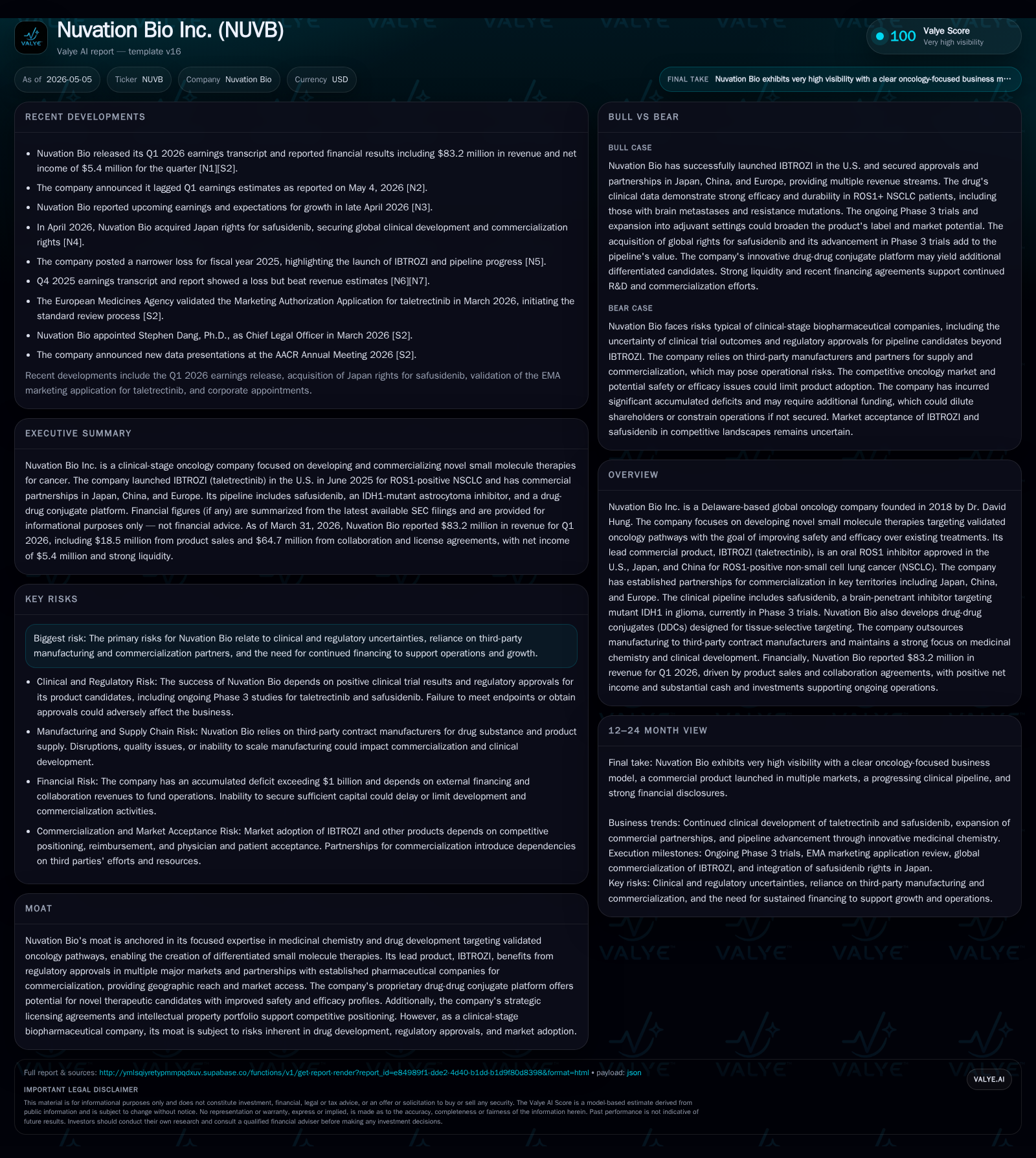
Nuvation Bio marked a key milestone with its FDA approval and U.S. commercial launch of IBTROZI (taletrectinib) for ROS1+ NSCLC in June 2025, complemented by regulatory approvals in Japan and China and partnerships for Asian and European markets. The company’s research pipeline is advancing notable clinical programs, including safusidenib for mutant IDH1 glioma with Phase 3 trials underway. Despite early-stage commercialization challenges and reliance on third-party arrangements, Nuvation Bio leverages expertise in medicinal chemistry and targeted oncology therapies to differentiate its portfolio. Its robust cash position supports ongoing R&D and commercialization efforts, though debt covenants linked to royalty and term loan financing impose operational constraints. Monitoring clinical data from Phase 3 studies and market uptake of IBTROZI will be critical next steps.
Recent Operating Update
Nuvation Bio’s most consequential recent update follows the FDA approval of its lead product IBTROZI (taletrectinib) in June 2025 for adult patients with locally advanced or metastatic ROS1-positive (ROS1+) non-small cell lung cancer (NSCLC) [S2]. The company promptly launched the drug commercially in the United States thereafter. Regulatory gains have also accrued internationally: Japan's Ministry of Health, Labour and Welfare approved IBTROZI for ROS1+ NSCLC in September 2025, with commercialization managed by partner NK [S2][N7]. Similarly, China’s National Medical Products Administration granted approval allowing Innovent Life Sciences to market taletrectinib under the brand name DOVBLERON® [S2]. In January 2026, Nuvation Bio expanded its reach by executing an exclusive license agreement with Eisai Co., Ltd. for Europe and other territories outside North Asia [S2]. Complementing this geographic expansion, the European Medicines Agency validated the Marketing Authorization Application (MAA) for taletrectinib for advanced ROS1+ NSCLC in March 2026 [S2].
Pipeline-wise, taletrectinib undergoes critical ongoing clinical evaluation via two Phase 2 single-arm pivotal studies — TRUST-I in China and TRUST-II globally — alongside an important confirmatory randomized Phase 3 study versus crizotinib in China known as TRUST-III. The global adjuvant indication is being explored through the placebo-controlled Phase 3 TRUST-IV study [S2]. Additionally, safusidenib — targeting mutant IDH1 in glioma — is currently evaluated in the randomized Phase 3 SIGMA trial focusing on maintenance therapy post standard care for high-grade astrocytoma patients exhibiting IDH1 mutation [S2][S26].
Further refining its pipeline strategy, Nuvation discontinued development of its initial drug-drug conjugate candidate NUV-1511 in late 2025 due to inconsistent efficacy across patient cohorts while affirming commitment to the broader drug-drug conjugate platform [S14]. This shift reallocates roughly $100-$150 million projected R&D investment into new candidates expected to build on learnings from NUV-1511.
Business Model
Nuvation Bio operates as a clinical-stage biopharmaceutical company primarily focused on developing targeted oncology therapeutics based on novel small molecules designed to improve safety and efficacy over existing treatments. Revenue generation began recently following IBTROZI's commercial launch post-FDA approval. Revenues stem chiefly from product sales domestically through direct commercialization as well as royalty income from partnered international territories. The company also pursues out-licensing agreements conveying upfront fees, milestone payments, research services revenue, and royalties [S1][S26].
The company's medicinal chemistry-driven approach focuses on oncology targets validated by strong clinical or preclinical evidence. It aims to differentiate through superior molecule design that addresses treatment resistance mechanisms or adverse safety profiles seen with older therapies. Central to the business model is progressing pipeline assets through clinical stages while leveraging partnerships to enhance commercialization reach where direct infrastructure would be inefficient or suboptimal.
Manufacturing is outsourced to contract manufacturers enabling capital-light production capacity consistent with clinical-scale volumes transitioning toward commercial supply. The firm also manages strategic IP licensing arrangements that grant exclusive regional rights or collaborate with partners to deploy global development programs like safusidenib now fully owned after including Japanese rights through amended agreements [S26].
Margins are currently constrained by heavy R&D investment reflective of pre-commercial status outside IBTROZI's limited revenue contribution thus far. The path to profitability hinges on succeeding commercial penetration of IBTROZI coupled with advancing late-stage pipeline candidates toward market authorization.
Industry Structure and Competitive Position
Nuvation Bio competes within the targeted oncology therapeutic segment—a sector characterized by high scientific complexity, lengthy development timelines, regulatory scrutiny, and significant capital requirements. The landscape features major pharmaceutical companies owning established ROS1 inhibitors such as crizotinib but also space for newer entrants demonstrating improved efficacy or central nervous system activity addressing unmet needs.
IBTROZI enters competition where ROS1+ NSCLC patient populations are highly specialized but benefit from expanding biomarker testing capabilities increasingly adopted at comprehensive cancer centers and community oncologists. The incorporation of taletrectinib as a Preferred Agent in NCCN guidelines enhances competitive positioning by signaling endorsement within clinical practice standards [S17].
Strategic partnerships with local leaders like NK in Japan, Innovent in China, and Eisai for Europe lend geographic commercial expertise vital for market access approvals, payer negotiations, formulary placements, medical education outreach, and distribution network establishment—activities difficult for smaller biotech firms to replicate independently.
Beyond lung cancer indications, safusidenib targets an additional niche within precision oncology namely IDH1-mutant gliomas—a domain receiving growing attention due to poor prognosis under existing therapies. Its brain penetrance could provide meaningful differentiation versus competitors such as Agios Pharmaceuticals’ Tibsovo approved for AML but not solid tumors.
Development setbacks like discontinuing NUV-1511 illustrate execution risks inherent to innovative modalities such as drug-drug conjugates that face hurdles proving consistent efficacy across heterogeneous tumor cohorts.
Growth Drivers
Commercial Launch Momentum of IBTROZI
The principal near-term growth driver is accelerating U.S adoption of IBTROZI among oncologists treating ROS1+ NSCLC given FDA approval is relatively recent (June 2025). Key KPIs include physician prescribing rates enhanced by inclusion as NCCN Preferred Agent covering both first-line use including patients with brain metastases—as CNS metastasis management remains a treatment challenge—and later-line contexts where resistance mutations manifest [S17]. Expansion efforts are supported by real-world evidence generation expected to bolster physician confidence amid potentially cautious early uptake due to limited long-term safety data.
Geographic Licensing Partnerships
Commercialization partnerships extend market presence beyond the U.S., tapping into large Asian markets via Innovent (China) and NK (Japan), each with dedicated local expertise critical given fragmented healthcare systems and payer landscapes unique regionally. Eisai’s inbound license for Europe introduces access to broad markets undergoing parallel regulatory reviews led by EMA with recent MAA validation confirming regulatory momentum [S2]. Success here depends heavily on partner execution capabilities plus integration between regulatory approvals timing and marketing launches.
Advancing Clinical Pipeline Candidates
Phase 3 studies like TRUST-III comparing taletrectinib against crizotinib could generate pivotal head-to-head evidence mandating label expansion or increased market share if results confirm superior efficacy or tolerability profiles. Similarly, positive outcomes from SIGMA targeting mutant IDH1-driven astrocytoma maintenance could open novel therapeutic niche beyond lung cancer bolstering diversified revenue streams over longer time frames.
Drug-Drug Conjugate Platform Refinement
Despite halting initial DDC candidate development due to inconsistent efficacy signals demonstrated by NUV-1511 [S14], ongoing platform evolution represents strategic long-term innovation potential offering tissue-selective payload delivery potentially reducing systemic toxicity—an attractive proposition if subsequent candidates translate effectively clinically.
Risks and Watchpoints
Clinical Development Uncertainties
IBTROZI’s adoption may be hampered by physician reticence pending more extensive longitudinal data confirming safety or durability amidst existing competitive alternatives. Failure or delays in progression trial outcomes notably Phase 3 confirmatory TRUST trials could stall label expansions weakening commercial prospects.
Manufacturing and Supply Chain Dependence
Reliance on third-party contract manufacturers introduces risks around maintaining uninterrupted supply needed to meet demand especially crucial during scaling phases post-launch.
Financing Constraints Under Debt Covenants
While liquidity remains ample ($125 million cash/equivalents end Q1 2026) against moderate total debt ($47 million) yielding a robust current ratio (~7.44), synthetic royalty financing tied to tiered payments on US net sales (5.5% up to $600 million sales threshold then reduced tiers) plus interest obligations on term loans adds financial pressure requiring sustainable revenue ramp [F1][S7]. Covenants embedded could restrict operational flexibility impacting timely investments or partnership deals.
Market Access Challenges Including Reimbursement Policies
Pricing pressures at state/federal levels coupled with payor reimbursement variability remain persistent hurdles common across specialty oncology therapies adding complexity to securing volume-based revenue growth—especially relevant given relatively low incidence rate of ROS1+ NSCLC [S24].
What To Watch Next
Key future milestones will include data releases from TRUST-III head-to-head study results versus crizotinib alongside further enrollment progress updates from TRUST-IV adjuvant Phase 3 trial planned for resected early-stage disease patient subsets [S2]. Positive topline data would reinforce market positioning considerably.
Regulatory developments around EMA review outcomes post-MAA validation alongside any emerging decisions regarding label amendments informed by evolving safety/tolerability profiles under ongoing study monitoring will be pivotal.
Market uptake reported voluntarily or via partnered entities will signal real-world prescription momentum particularly for international markets where rollouts have more recently begun.
Additionally strategies around new clinical stage asset nominations within the DDC platform after learnings from NUV-1511 discontinuation will reveal innovation trajectory breadth beyond current core assets.[S14]
Capital markets activity tied to potential equity or additional debt financings may surface depending on cash burn trends relative to clinical advancement pace.[S2][S26]
Financial Profile Overview
Latest financial snapshot
| Metric | Value | Period |
|---|---|---|
| Cash & equivalents | $125mm | |
| 2026-03-31 | ||
| Total debt | $47mm | |
| 2026-03-31 | ||
| Net debt | $-78mm | |
| 2026-03-31 | ||
| Current assets | $592mm | |
| 2026-03-31 | ||
| Current liabilities | $80mm | |
| 2026-03-31 | ||
| Current ratio | 7.44x | |
| 2026-03-31 |
Source: SEC companyfacts cache [F1].
As of March 31, 2026, Nuvation Bio held $125 million in cash and equivalents alongside $47 million in total debt reflecting net cash position approximately $78 million positive supporting near-term funding needs without immediate refinancing concerns [F1]. Current assets stood at nearly $592 million versus liabilities around $79 million yielding a strong current ratio of about 7.44 indicating excellent short-term liquidity.[F1]
The company’s operating model remains unprofitable reflecting continued heavy investment focused on R&D activities ($28-$30 million quarterly range pre-commercialization) alongside selling/general administrative expenses related primarily to commercialization readiness.[S25][S8] These operating expenses outpace revenues which largely derive from early product sales plus collaboration receipts totaling approximately $62.9 million annualized trailing calendar year end latest available figure.[F1]
Financing arrangements include synthetic royalty financing providing up-front capital at structured repayment tiers based on net sales performance alongside secured term loan bearing interest rate floors tied primarily to SOFR plus margin coupons placing fixed obligations present regardless of cash flow variability.[S6][S7]
Given cumulative net losses since inception exceeding $1 billion mark as disclosed ($1.11 billion deficit as of Q1 2026), sustainable profitability awaits successful volume ramp coupled with continued cost discipline balanced against pipeline advancement investments.[F1][S12]
Disclaimer
This report is presented solely for informational purposes applying public disclosures without offering investment advice or recommendations. Readers should conduct further independent diligence before forming financial judgments.
Disclaimer: This is research-only, informational analysis and not investment advice. It may include AI-generated interpretation and general industry context. Always verify important details using primary sources.

Comments