
Eagle Financial Services: Regional Bank Challenges and Growth Trajectories
Eagle Financial Services balances a rich local heritage with evolving demands in the Shenandoah Valley banking sector.
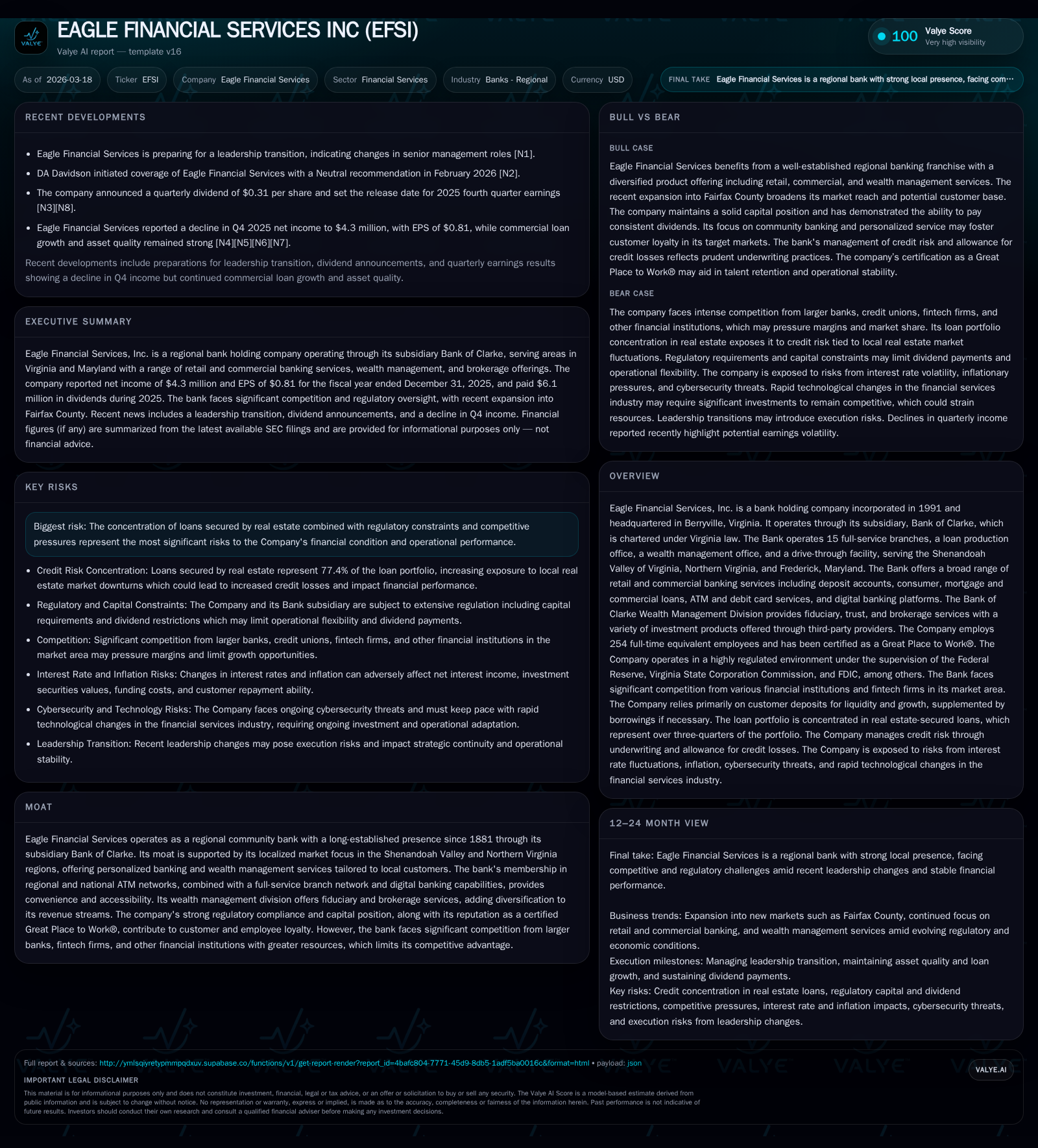
Eagle Financial Services, through its subsidiary Bank of Clarke, has leveraged its longstanding presence in Virginia and Maryland to build a regional community bank footprint centered on personalized banking and wealth management services. Net income grew significantly from FY2023 to FY2024 before declining nearly 30% in FY2025 amid credit risk concentration and competitive pressures. Future growth hinges on optimizing digital transformation, expanding wealth management offerings, and managing loan portfolio risks within regulatory constraints. Capital structure reflects increased equity and robust operating cash flow growth, while leadership transition and external competitive threats frame a cautious outlook.
Legacy and Growth Drivers Behind Eagle Financial’s Earnings Volatility
Founded through its subsidiary Bank of Clarke since 1881, Eagle Financial Services anchors its regional niche via deep local ties across the Shenandoah Valley and adjoining Virginia/Maryland markets [S1]. The financial performance from fiscal years 2023 to 2025 reflects sharp inflections tightly coupled with rising credit risk concentration, particularly within real estate-secured loans that constituted over 77% of the loan book at end-2025 [S13]. Net income climbed substantially from $2.4 million in FY2023 to $6.2 million in FY2024 before retracting by nearly 30% to $4.3 million in FY2025 [F1], pointing to volatility influenced by loan loss provisions amidst economic uncertainties.
Operating cash flow tells a complementary story; it improved markedly by over 37% year-over-year to roughly $25.8 million by fiscal 2025 [F1], indicating stronger collections or balance sheet management efficacy. Meanwhile, capital expenditures increased sharply by about 38%, reaching $1.4 million [F1], potentially aligned with modernization initiatives for branches or enhancements of digital infrastructure—a necessity for contemporary regional banks facing fintech disruption.
Historical performance (annual)
| FY | Net ($mm) | CFO ($mm) | Capex ($) | Net YoY |
|---|---|---|---|---|
| 2025 | 4 | 26 | 1406000 | -29.9% |
| 2024 | 6 | 19 | 1019000 | +158.3% |
| 2023 | 2 | 7 | 1071000 | |
| 2022 | 14 | 838000 |
Source: SEC companyfacts cache [F1].
Capital returns and efficiency (annual)
| FY | FCF ($mm) | ROE% |
|---|---|---|
| 2025 | 24 | 2.3 |
| 2024 | 18 | 5.2 |
| 2023 | 6 | 2.2 |
| 2022 | 13 |
Source: SEC companyfacts cache [F1].
Table reflects recent annual financial performance as basis for assessing growth trends and capital efficiency.
Geographic Footprint and Market Penetration in the Shenandoah Valley and Beyond
Eagle Financial Services deploys its branch network strategically across several Virginia counties—Clarke, Frederick, Fauquier, Loudoun, Fairfax—and extends into Frederick County Maryland [S1,S21]. The subsidiary Bank of Clarke operates fifteen full-service branches supplemented by a loan production office and wealth management presence that combine for localized deposit gathering and customer intimacy native to community banks.
This footprint covers varied demographic profiles with expanding population centers such as Fairfax County presenting new market opportunities albeit with stiffer competition that escalates approximately sixty-six percent the number of competing banking offices relative to Eagle's traditional strongholds [S21]. Regulatory implications stem from its state-chartered status requiring adherence to Virginia law combined with Federal Reserve supervision [S21]. This geographic concentration intrinsically ties the Company’s growth prospects to regional economic cycles characterized by labor markets and inflationary trends affecting both commercial clients and consumer borrowers [S5].
Loan Portfolio Composition and Regulatory Headwinds Shaping Growth Prospects
A defining characteristic of Eagle Financial’s risk profile lies in its concentrated credit exposure—principally commercial real estate non-owner-occupied loans alongside consumer and residential mortgage sectors making up over three-quarters of total loans by collateral type [S13]. This credit risk concentration mandates rigorous underwriting standards yet leaves the bank vulnerable to downturns in local property markets or economic dislocations.
Regulatory frameworks impose further constraints limiting aggressive lending expansion due to capital adequacy norms under Basel III reforms complemented by Dodd-Frank mandates [S18,S19,S20]. Compliance burdens stretch management bandwidth especially when juxtaposed against fintech competitors who often operate with leaner cost bases outside traditional regulatory nets [S4,S16]. Moreover, heightened supervisory expectations regarding Community Reinvestment Act compliance influence growth decisions around branch expansions or loan portfolio mix adjustments emphasizing safe-and-sound practices [S6].
Risks surrounding credit quality erosion derived from inflationary pressures impacting borrower repayment capacity feature prominently among disclosed concerns as customers grapple with climbing input costs amid supply chain frictions [S5,S10]. Such dynamics heighten scrutiny over loan loss provisioning even as prudent monitoring attempts mitigate losses.
Digital Transformation and Wealth Management Diversification as Future Catalysts
Bank of Clarke’s investment into digital platforms—encompassing internet banking with online bill pay capabilities alongside mobile applications—demonstrates acknowledgment of evolving client expectations for seamless omnichannel product delivery [S1]. These capabilities underpin client retention while enabling scalable service models imperative for regional players facing resource constraints.
Parallelly, the Bank’s Wealth Management Division delivers fiduciary trust services plus brokerage offerings through third-party providers that produce a supplementary fiduciary income stream distinct from interest margin dependence [S1]. This revenue diversification supports resilience especially when net interest margins face compression from competitive deposit pricing or yield curve movements.
Cross-selling opportunities between retail banking customers and wealth advisory clients represent tactical levers that could foster organic growth if executed effectively within Eagle Financial’s localized framework.
Financial Health: Capital Structure, Returns, and Cash Flow Trends
Analysis of capital metrics reveals a near doubling of shareholders’ equity from approximately $119 million at end-FY2024 to close to $189 million at end-FY2025 signifying retained earnings accumulation or capital infusions consistent with regulatory expectations for capital adequacy buffers [F1,S19]. Despite this growth trajectory in equity base supporting balance sheet robustness, the approximate return on equity lingers at a modest 2.3%, reflecting squeezed profitability likely due to elevated provisions or operational costs [F1].
Robust positive operating cash flows that outstrip capital expenditure outlays yield substantial free cash flow generation exceeding $24 million annually as of FY2025 [F1]; such liquidity positions empower flexibility but also highlight potential challenges in reinvesting earnings at higher returns amidst competitive pressures.
Interest rate risk management remains critical given impacts on net interest income—a principal profit driver—and sensitivity of securities portfolio valuations especially longer-duration holdings [S10]. Inflation induced expense pressures notably around talent retention further constrain margin improvement prospects.
Capital Allocation Dynamics: Dividends, Buybacks, and Investment Priorities
The dividend policy maintained distributions totaling $6.1 million during calendar year 2025 featuring reinvestment options through stock plans [S12]. Regulatory constraints under Virginia law paired with Federal Reserve guidance enforce circumspection around dividend payouts ensuring capital sufficiency post distribution which tempers pursuit of aggressive shareholder yield enhancements such as buyback programs—a tool Eagle Financial does not appear to currently deploy [S12,S27].
Capital expenditures levels rising over recent years imply deliberate reinvestments focusing perhaps on branch refurbishments or upgrading technological infrastructure—a logical priority aimed at sustaining competitive parity against larger regional banks deploying more automated service models [F1,S12]. This investment aligns with broader industry consensus emphasizing technology as a cornerstone of future-proofing community banks.
Leadership Transition: Implications for Strategic Direction and Investor Outlook
On January 21st, 2026 Eagle Financial announced key leadership changes signaling an impending succession phase within executive ranks potentially influencing governance culture alongside strategic emphasis areas including digital innovation acceleration or refined capital allocation paradigms [N1].
Executive succession risk is non-trivial for regionally-focused institutions where leader familiarity within local markets correlates strongly with business continuity maintaining customer trust—the bank's enduring moat feature [N1,S9]. Emerging leadership styles may recalibrate priorities between conservative loan underwriting versus measured growth initiatives balancing profitability against emerging competitive threats.
Analyst Insights: Neutral Stance Amid Mixed Prospects
DA Davidson’s initiation coverage issued February 26th adopts a neutral rating perspective rooting its stance upon steady but unspectacular earnings visibility constrained by concentrated credit portfolios balanced against solid underlying cash flow generation signaling operational discipline amid external uncertainties [N2]. Valuation multiples may remain compressed reflecting broader investor caution towards regional banks grappling with inflation-induced margin pressures compounded by fintech insurgency encroaching deposit/growth domains.
Analysts highlight the tension between maintaining localized banking identity favored by core customers while pursuing necessary digital upgrades critical for future competitiveness—a balancing act epitomized across many similarly situated small-to-mid sized banks today.
This analysis draws exclusively upon documented financial statements filed with regulators along with public news sources pertaining to Eagle Financial Services Inc., aiming solely at objective company review without recommendation or trading guidance.
Disclaimer: This is research-only, informational analysis and not investment advice. It may include AI-generated interpretation and general industry context. Always verify important details using primary sources.

Comments