
Eledon Pharmaceuticals Stakes Its Future on Tegoprubart Amid Clinical and Capital Challenges
Eledon continues investing heavily in its lead candidate tegoprubart, supported by orphan designations, while managing significant net losses and capital requirements.
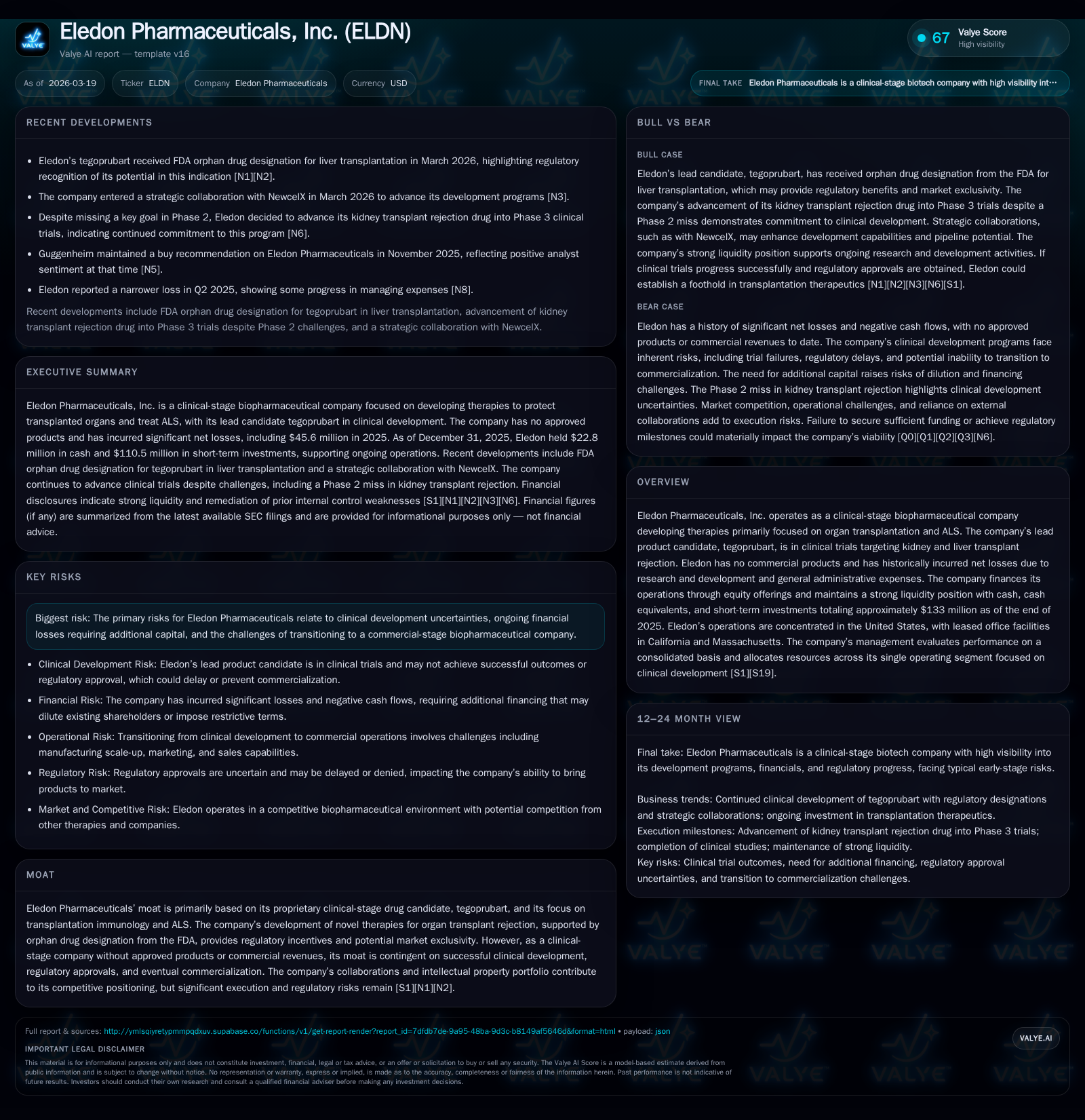
Eledon Pharmaceuticals is at a critical inflection point as it advances its clinical-stage immunomodulatory drug tegoprubart targeting organ transplant rejection and ALS. Despite increasing regulatory incentives such as FDA orphan drug designations, the company remains unprofitable with sizable operating losses driven by R&D expenses and clinical trial costs. With no commercial products yet, growth depends heavily on successful clinical development milestones and financing strategies to sustain operations. Liquidity remains sound with approximately $133 million in cash and equivalents as of end-2025, but continued capital raises pose dilution risks. The path to commercialization is laden with execution complexities typical of clinical-stage biopharma ventures.
Financial Trajectory: Reviewing Losses and Cash Flow Trends
Eledon Pharmaceuticals operates at a financial loss rooted principally in its commitment to developing novel therapies for transplant rejection and ALS indications. Historical financials illustrate a trajectory of widening net losses punctuated by increasingly substantial operating cash outflows. In fiscal year 2025, the company reported a net loss of approximately $45.6 million, worsening by about 26% year-over-year compared to a $36.2 million loss in 2024 [F1]. Operating cash flow (CFO) consumption expanded markedly to a negative $62.3 million in 2025 from negative $47.3 million the prior year, reflecting intensifying clinical trial activity and administrative overheads aligned with scaling operations [S1][F1].
Despite these losses, Eledon has maintained robust liquidity through significant capital raises totaling nearly $54 million via underwritten offerings in late 2025 and earlier placements, providing a necessary buffer against operating deficits [S7][F1]. This infusion supports commitments including contractual payments tied to transplantation programs. The disconnect between negative operating cash flow and investing cash flow positive figures arises largely from the maturities of prior short-term investments counterbalancing fresh purchases—a liquidity management practice common among emerging biotech companies seeking safety in highly liquid government securities [S1][S4].
Historical performance (annual)
| FY | Net ($mm) | CFO ($mm) | OpInc ($mm) | Net YoY |
|---|---|---|---|---|
| 2025 | -46 | -62 | -26.1% | |
| 2024 | -36 | -47 | +69.0% | |
| 2023 | -117 | -40 | -43 | -32.5% |
| 2022 | -88 | -28 | -88 |
Source: SEC companyfacts cache [F1].
Capital returns and efficiency (annual)
| FY | ROE% |
|---|---|
| 2025 | -56.3 |
| 2024 | -57.9 |
| 2023 | -1616.8 |
| 2022 | -104.5 |
Source: SEC companyfacts cache [F1].
Table shows continued net losses without revenue generation consistent with early-stage biopharmaceutical model.
Clinical Pipeline Spotlight: Tegoprubart in Transplantation Immunology
The company's lead candidate tegoprubart underpins its entire developmental narrative—an investigational agent modulating immune response post-organ transplantation to prevent rejection events primarily in kidney and liver transplants. The specificity of tegoprubart’s mechanism addresses a critical area where immunosuppressive regimens still represent an unmet medical need due to toxicity or inadequate efficacy.
Recent successes include FDA awarding orphan drug designation for tegoprubart’s use in liver transplantation rejection—a regulatory accolade that confers seven years of market exclusivity if approval is achieved alongside tax credits during development [N2][N3][S1]. The focus on orphan transplantation indications creates a clearer pathway to potential accelerated approval frameworks plus commercial differentiation advantages given the paucity of novel agents targeting this niche.
Eledon's pipeline also encompasses ALS-focused programs though these appear secondary relative to tegoprubart’s prominence based on corporate disclosures [S1]. The narrow therapeutic focus reflects an intentional strategy to carve out specialization within transplant immunology bolstered by intellectual property protections frequently leveraged in this field.
Strategic Collaborations and Regulatory Incentives Enhancing Prospects
Acknowledging the complexity of drug development beyond discovery stages, Eledon entered a strategic collaboration agreement with NewcelX aimed at augmenting operational capabilities across clinical development and prospective commercialization axes [N1]. Such partnerships are integral for smaller firms lacking extensive internal infrastructure necessary for late-stage trials or launch activities.
Multiple orphan drug designations form regulatory incentives pivotal for narrowing competitive threats by extending exclusivity windows upon emergence into markets. In addition to liver transplantation orphan status granted recently for tegoprubart, prior recognition in kidney transplant indications contributes cumulative layers of protection enhancing valuation prospects should pivotal trials deliver positive results [N2][N3][S1].
These mechanisms constitute components of the company moat—while fragile without approval success—yet vital as they frame Eledon’s competitive positioning within a congested biopharma sector.
Capital Positioning: Cash Reserves, Equity Financings, and Dilution Risks
Financial resilience anchors around Eledon's liquid asset holdings totaling approximately $133 million at December 31, 2025, comprised chiefly of cash ($22.8M) and short-term investments ($110.5M) designed predominantly as U.S. government securities ensuring preservation of principal amid uncertain environments [F1][S4]. This liquidity affords funding runway extending beyond near-term milestones but is susceptible to exhaustion given escalating operating burn rates surpassing $60 million per annum.
Capital formation activities are predominantly equity-based—rooted in offerings including a November 2025 underwritten raise that realized ~$53.6 million net proceeds through issuance of approximately 19.7 million common shares plus pre-funded warrants exercisable into additional shares at nominal strike prices [S7][F1]. Accompanying "at-the-market" program registrations offer flexibility but entail shareholder dilution yielding inherent tension between growth investment needs versus ownership concentration.
Given substantial accumulated deficits exceeding $400 million coupled with recurring yearly net losses yet robust shareholder equity (~$81M end-2025), ongoing financing remains an immediate necessity—and potential dilution hazard—for existing investors [F1][S7]. Successful transition toward commercialization may unlock accretive capital deployment avenues reducing reliance on dilutive financings.
Operating Expenses: Breakdown of R&D Cost Drivers and Investment Priorities
Research and development costs constituted the largest expenditure element fueling reported operating deficits. In-depth segment analysis indicates major components include external contract clinical trial services driving variable payment schedules often milestone-dependent; discrete batch manufacturing agreements for tegoprubart material supply; internal personnel payroll inclusive of scientists and administrative support; plus sizeable non-cash charges linked to stock-based compensation exceeding $10 million annually [S5][S6].
These outlays correspond with typical biotech spend patterns where upfront discovery fades into increasingly capital-intensive clinical experimentation phases requiring costly third-party CRO engagements plus cGMP manufacturing runs with stringent quality controls imperative for trial integrity.
Other operating expenses encompass facilities lease costs across dual-state offices (California & Massachusetts), consulting fees for regulatory compliance guidance plus IT infrastructure—all modest relative to R&D.[S16][S17]
Assessing Short-Term Development Milestones and Orphan Drug Designation Impact
While explicit forward guidance remains limited by cautious disclosure practices typical at this stage,[N2] key events warrant monitoring as barometers of operational success: these include interim or top-line phase trial data readouts for tegoprubart’s kidney and liver transplantation studies; enrollment milestones critical under contractual agreements; FDA interactions potentially upgrading regulatory classifications or facilitating accelerated pathways.
Orphan drug status enhances prospects via reduced marketing competition plus financial incentives aligning development economics favorably should trials culminate positively.[N3] The pathway from designation to approval remains convoluted but is historically marked by valuable exclusivity periods that can incentivize further investment.
Expanding indications such as moving from kidney-centric trials toward broader liver transplantation niches illustrates a strategic attempt to maximize patent-protected market opportunities inherent in transplantation immunology niches.
Future Headwinds: Execution Risks, Capital Requirements, and Market Entry Challenges
Typical biotech risks loom large: uncertainty persists around successful scale-up manufacturing capabilities beyond pilot batches; potential delays or failures within pivotal phase studies remain ever-present; unforeseen regulatory feedback could mandate additional costly investigations impacting timelines or study designs.[S8][S2]
Financially, while current liquidity suffices short term, continued losses necessitate recurrent capital raises threatening founder/investor dilution unless offset by partner licensing arrangements or breakthrough data catalyzing secondary market enthusiasm.
Operational transitions from research-driven entity toward commercialization-ready organization create additional complexity requiring specialized expertise often necessitating external collaborations or hires—any misalignment here could amplify risk profile.
No material legal contingencies jeopardize current standing but indemnification clauses embedded within licensing agreements pose latent contingent liabilities typical across biotechnology sector contracts.[S8]
Evaluating Return Metrics and Investor Returns in a Loss-Making Biotech Model
Reflective of an embryonic-stage biopharma company focused predominantly on value generation via pipeline progression rather than profitability metrics like ROE or free cash flow generation margins remain materially negative—latest calculations suggest an approximate ROE near minus-56%, indicative of routine reinvestment sans dividends or buybacks [F1][S20].
Negative free cash flows exceeding $62 million underscore reliance upon external financings rather than operational earnings—a long-standing industry norm pre-commercialization but one that demands investor endurance anticipating eventual breakthroughs translating into revenue streams.
Absence of dividends aligns logically with growth allocation imperatives characteristic across clinical-stage firms navigating volatile development cycles while attempting capital preservation.
This analysis draws exclusively on reported financials from SEC filings complemented by recent news disclosures regarding collaborations and orphan designations without speculative projections unsupported by current evidence. Past performance highlights structural challenges endemic to biopharmaceutical innovation cycles emphasizing high upfront costs balanced against deferred commercialization prospects. Stakeholders should weigh upcoming clinical developments alongside evolving capital strategies as leading indicators shaping the company's maturation trajectory.
Disclaimer: This is research-only, informational analysis and not investment advice. It may include AI-generated interpretation and general industry context. Always verify important details using primary sources.

Comments