
Tegoprubart’s Path Defines Eledon Pharmaceuticals’ Road to Commercial Transition
Eledon Pharmaceuticals’ future hinges on advancing its lead candidate tegoprubart through clinical trials while managing substantial R&D-driven losses supported by a strong capital base.
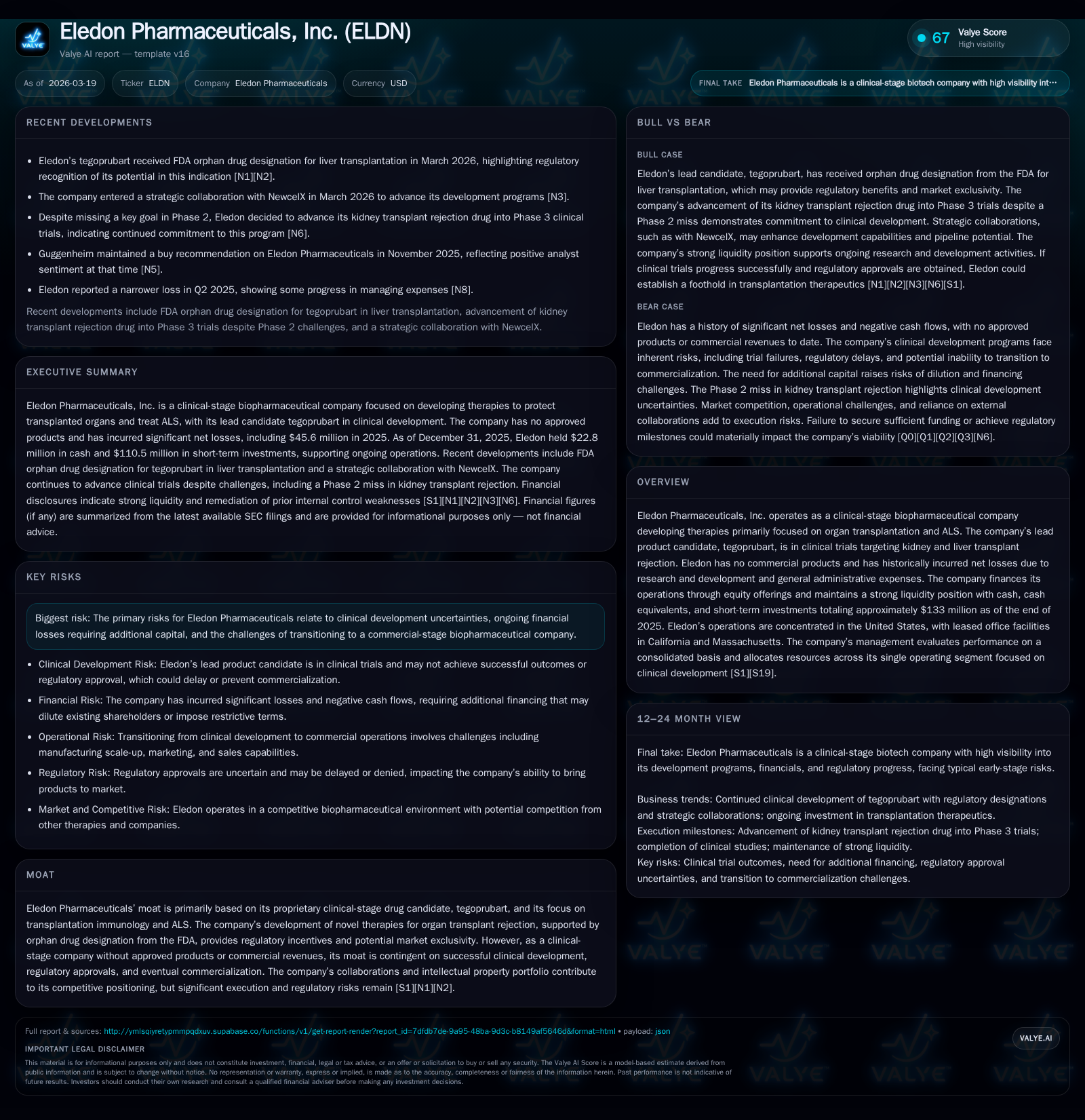
Eledon Pharmaceuticals is a clinical-stage biotech focused on therapies to prevent organ transplant rejection, with no commercial products. Its lead candidate, tegoprubart, recently received FDA orphan drug designation for liver transplantation, enhancing regulatory positioning. The company continues to incur significant operating losses driven by clinical development and finances operations primarily through equity raises, maintaining a solid liquidity buffer but negative free cash flow. Future growth depends heavily on successful clinical milestones, regulatory approvals, and strategic capital allocation amid inherent clinical-stage risks.
Historical Financial Performance: Operating Losses and Cash Flow
Eledon Pharmaceuticals operates as a typical clinical-stage biopharmaceutical company with ongoing net losses due to research-intensive activities. For fiscal year 2025, the company reported a net loss of $45.6 million [F1], reflecting continued high investment in pipeline advancement though with some improvement compared to prior years. Operating income remained negative but improved by approximately 51% year-over-year from deeper losses in prior periods [F1], indicating measured cost management amid expanding clinical development.
Cash flow from operations declined further, with operating activities consuming $62.3 million during 2025 versus $47.3 million in 2024 [F1][S1]. This outflow corresponds closely with rising R&D spend dedicated primarily to tegoprubart development programs and related personnel costs [S5][F1]. Capital expenditures remain minimal relative to operating cash burn but reflect ongoing support for clinical infrastructure.
Historical performance (annual)
| FY | Net ($mm) | CFO ($mm) | OpInc ($mm) | Net YoY |
|---|---|---|---|---|
| 2025 | -46 | -62 | -26.1% | |
| 2024 | -36 | -47 | +69.0% | |
| 2023 | -117 | -40 | -43 | -32.5% |
| 2022 | -88 | -28 | -88 |
Source: SEC companyfacts cache [F1].
Capital returns and efficiency (annual)
| FY | ROE% |
|---|---|
| 2025 | -56.3 |
| 2024 | -57.9 |
| 2023 | -1616.8 |
| 2022 | -104.5 |
Source: SEC companyfacts cache [F1].
Note: Capex detail beyond prior years is limited; focus is on major cash flow trends.
Clinical Pipeline Focus: Tegoprubart and Strategic Collaborations
Tegoprubart is Eledon's lead therapeutic candidate aimed at preventing rejection in kidney and liver transplants. It currently drives the majority of R&D expense and corporate focus [S1][N1][N2]. The success or failure of its clinical trials will largely determine Eledon's commercial trajectory.
The company has entered a strategic collaboration with NewcelX to leverage complementary expertise and accelerate tegoprubart's development timeline [N1]. This partnership aligns with industry practices where biotechs engage specialized collaborators for manufacturing scale-up or complex trial execution.
Eledon has yet to generate any commercial revenue, highlighting its dependence on pipeline progression for value creation [S2]. The concentration of expenses towards clinical development underscores this forward-looking emphasis.
Regulatory Milestone: Orphan Drug Designation
The FDA granted tegoprubart orphan drug designation for liver transplantation indication [N2][N3]. This status provides benefits including seven years of market exclusivity upon approval, reduced regulatory fees, and eligibility for expedited pathways.
Orphan designation creates competitive advantages that can protect market position post-launch and often enhances investor confidence by validating clinical strategy [S8].
Growth Outlook: Advancing Toward Market Entry
While specific revenue forecasts or milestone timelines are not disclosed in filings or news releases [S2][N2], management highlights upcoming key readouts from Phase II/III trials as critical near-term catalysts. Positive data would support regulatory submissions and unlock value inflection points.
Given standard FDA review cycles and potential additional study requirements, the path from trial success to market entry could span multiple years, emphasizing the need for sustained financing.
Capital Structure and Liquidity Position
As of December 31, 2025, Eledon held approximately $133 million in combined cash ($22.8 million) and short-term investments ($110.5 million) [F1][S4]. With current liabilities around $18.3 million, this results in a strong current ratio near 7.4x, providing operational runway exceeding twelve months under existing spending patterns.
The company carries no long-term debt, enhancing financial flexibility [S7][F1]. Recent capital raises include equity offerings netting over $53 million in late 2025 priced around $1.65 per share, supporting continued R&D investment [S9][S21][F1].
Capital Allocation Strategy: Focused on Development
Eledon allocates most operating expenses toward R&D — nearly $27.5 million annually dedicated to leading programs including tegoprubart — consistent with its development-stage profile [S5][F1]. Personnel costs and manufacturing contracts further support comprehensive trial execution.
There are no dividends or share repurchase programs given recurring losses; all available capital is reinvested into pipeline advancement rather than shareholder payouts [S20]. Potential dilution remains a consideration if further financing is required before product revenues materialize.
Risks Related to Development and Commercialization Transition
Eledon's risk profile aligns with typical biotech sector challenges involving high uncertainty:
- Clinical trial outcomes remain uncertain despite orphan status; unfavorable results could materially impair prospects.
- Financial sustainability beyond current cash reserves depends on successful access to capital markets or partnerships under favorable terms.
- Transitioning from a development-focused organization to commercial operations requires managerial expertise and resource reallocation beyond research activities.
These risks embody common hurdles faced by biotechs striving to convert scientific promise into regulatory approval and market success.
Disclaimer: This analysis synthesizes publicly available financial filings and news sources without offering investment advice or recommendations. Forward-looking statements reflect disclosures as of filing dates only and may change.
Disclaimer: This is research-only, informational analysis and not investment advice. It may include AI-generated interpretation and general industry context. Always verify important details using primary sources.

Comments