
Embassy Bancorp Confronts Interest Rate Sensitivity and Regional CRE Concentration in Q2 2026
Latest quarterly filings reveal Embassy Bancorp’s exposure to interest rate volatility and concentrated lending amid a competitive regional banking landscape.
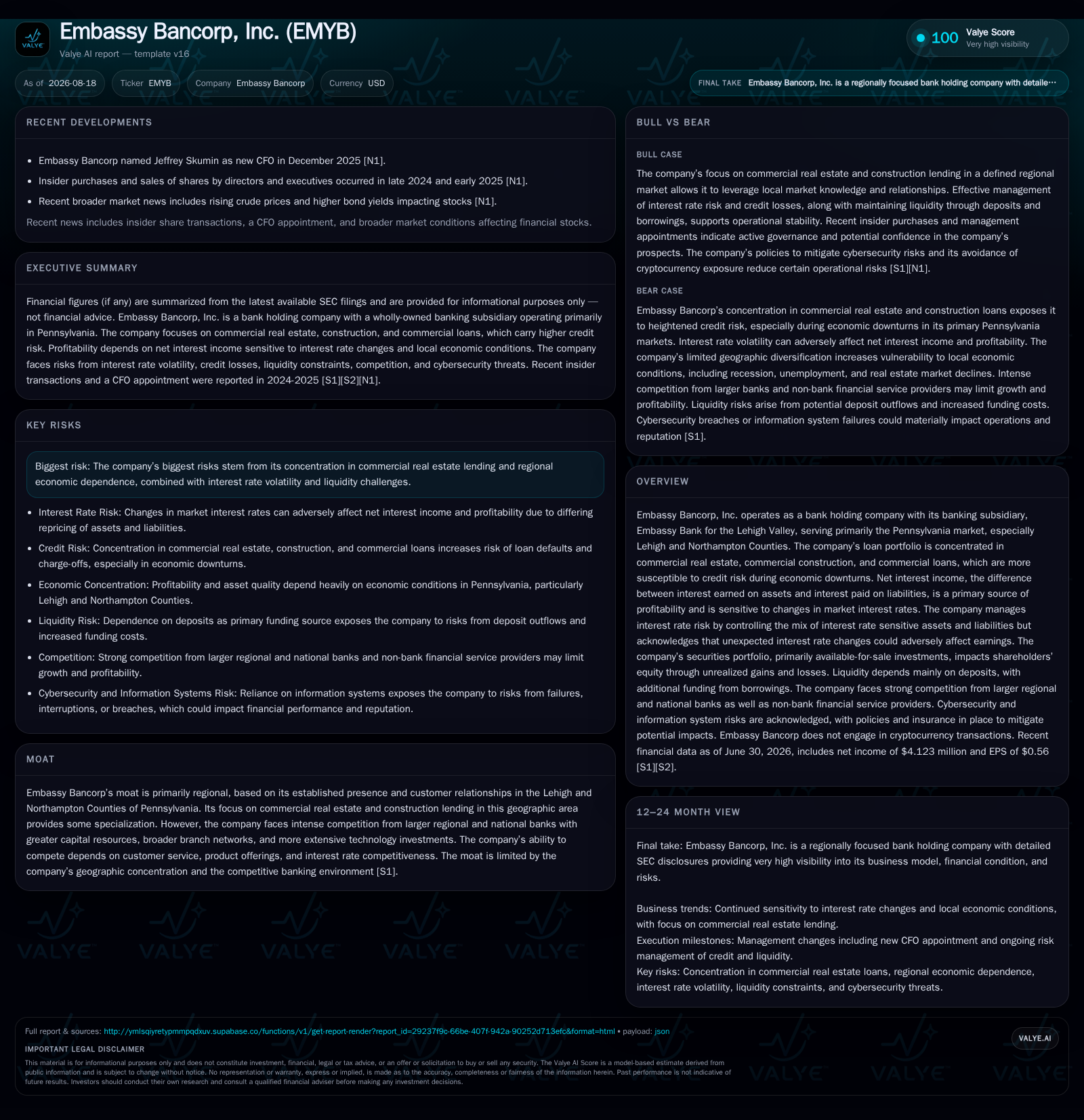
Embassy Bancorp, a Pennsylvania-focused regional bank, operates with a loan portfolio heavily concentrated in commercial real estate and construction loans, making it sensitive to regional economic shifts and credit risks. Its latest quarterly 10-Q discloses an accounting policy change for accrued interest, available-for-sale securities with unrealized losses largely in municipal bonds, and substantial borrowing capacity with no outstanding advances. The bank’s profitability hinges on net interest income, which is vulnerable to rapid interest rate changes. Competitive pressures from larger regional banks limit Embassy’s geographic moat, while liquidity and capital levels remain sound. Monitoring loan loss provisions, non-performing loans, and net interest margin will be key to tracking risk-adjusted performance going forward.
Recent Operating Update: Q2 2026 Filings Highlight Interest Rate Sensitivities and Liquidity
Embassy Bancorp’s August 13, 2026 10-Q filing reveals a noteworthy accounting policy election excluding accrued interest receivable on loans from the amortized cost basis calculation [S2]. This shift aligns with ASU 2022-02 guidance on credit losses and separates $2.6 million of accrued interest receivable as a distinct balance sheet line item. While this does not materially affect the estimated credit losses as accrued interest is excluded from loss estimates, it signifies an increased granularity in financial reporting—potentially enabling clearer measurement of loan yields versus credit risk reserves.
The filing also details the available-for-sale securities portfolio’s unrealized losses. As of June 30, 2026, unrealized losses aggregate primarily within municipal bonds ($11.4 million) versus smaller amounts in U.S. Treasury or agency securities [S2]. These unrealized losses reflect sensitivity to rising interest rates over the period and represent potential volatility to shareholders’ equity. Despite this mark-to-market adjustment risk, the company holds these securities as part of its investment strategy to maintain liquidity buffers and manage asset-liability duration.
Notably, Embassy Bancorp reported no borrowings drawn from its Federal Home Loan Bank (FHLB) credit lines as of the quarter-end despite having $737.1 million of maximum borrowing capacity available [S2]. The absence of short- or long-term FHLB advances suggests reliance on core deposits for funding rather than wholesale borrowings at present.
A sad governance development was detailed in a recent 8-K filing dated August 11, 2026: the passing of Director John G. Englesson who served since Embassy Bancorp’s formation in 2008 and the founding years of Embassy Bank for the Lehigh Valley subsidiary [S3]. This loss could affect board-level experience and institutional knowledge integral to financial oversight.
Business Model: Regional Commercial Banking Anchored in CRE Lending
Embassy Bancorp operates predominantly through its banking subsidiary serving Pennsylvania’s Lehigh Valley area—principally Lehigh and Northampton Counties—with commercial real estate (CRE), commercial construction, and other commercial loans forming the bulk of its loan portfolio [S1]. This lending mix is strategically differentiated by its geographic specificity but structurally exposes the company to heightened credit concentration risk tied to local economic health cycles.
Revenue generation hinges critically on net interest income—the spread between yields on loans/securities versus costs on deposits/borrowings [S1]. In this model, depositors supply low-cost funding whereas lending volume and yield dictate gross earnings. Management controls asset-liability sensitivity by balancing interest-rate sensitive assets against liabilities to mitigate earnings volatility due to rate shifts; however, unexpected or rapid changes can still compress net interest margins (NIM) or reduce asset valuations.
The loan portfolio focus on CRE and construction segments carries both advantages and risks. On one hand, CRE lending often commands higher yields relative to consumer loans; on the other hand, this segment is notably cyclical and susceptible to regional economic downturns that can elevate non-performing loans (NPLs) or increase provision expense. Inflationary pressures or higher benchmark rates also impact CRE borrower capacity and collateral valuations [S1]
Securities holdings classified as available-for-sale supplement earnings stability while providing liquidity but impart equity volatility via unrealized gains/losses that fluctuate with market conditions [S1]. Embedding these securities also allows for diversification beyond loans but requires vigilance on fair-value accounting impacts.
Industry Structure and Competitive Positioning
Embassy Bancorp’s competitive landscape reflects typical pressures confronting small regional community banks: competition from larger regional banks such as M&T Bank Corporation or KeyCorp offering broader branch networks, diverse product suites, superior technology platforms, and greater capital depth. Fintech entrants also pose threats on transactional convenience even if less so on relationship-based CRE lending.
The bank's moat is largely geographic — entrenched relationships within the Lehigh Valley markets foster customer loyalty but concurrently limit economies of scale or cross-regional diversification that might cushion localized downturns. Technology investments are necessary yet costly hurdles for smaller banks attempting to match service expectations set by larger competitors.
Operational efficiency ratios, loan-to-deposit ratios (LTD), NIM trends relative to peers like Fulton Financial Corporation or Regions Financial Corporation provide benchmarks for Embassy’s competitive standing but require granular data typically beyond public filings.
Growth Drivers
Growth prospects rest on several identifiable vectors:
- Regional economic expansion enhancing demand for commercial property financing,
- Rising benchmark rates potentially boosting net interest margins if asset repricing outpaces liability costs,
- Deposit base growth supporting incremental lending capacity while maintaining favorable LTD ratios,
- Potential diversification into new sector lending categories reducing concentration risk,
- Digital banking enhancements aiding acquisition and retention in competitive customer segments,
- Strategic management of the branch network aligned with evolving customer preferences.
Each driver ties back into measurable KPIs such as loan growth rates signaling credit demand; deposit inflows indicating funding strength; NPL ratios revealing asset quality under economic stress; return-on-assets (ROA) gauging operational output; and tier 1 capital adequacy ensuring regulatory compliance during expansion phases.
Risks and Watchpoints
Primary risks impacting Embassy Bancorp stem from:
- Credit concentration in commercial real estate sectors subject to cyclical downturns impacting charge-offs,
- Regional economic dependency magnifying localized shocks without diversification currency,
- Interest rate volatility posing threats to net interest margin stability via asset-liability mismatch,
- Competitive compression forcing pricing concessions or elevated marketing spending,
- Liquidity risk emerging if deposit attrition accelerates leading to reliance on more expensive wholesale funding,
- Regulatory changes altering capital requirements or operational compliance burdens,
- Market risk through valuation adjustments of held-to-maturity or available-for-sale securities,
- Operational risks including cybersecurity threats impacting trust and continuity,
- Governance transition risk following director departures affecting board oversight effectiveness.
Monitoring management’s quarterly commentary around loan loss provisioning trends compared against actual non-performing loan emergence will indicate early stress points in credit quality. Similarly, tracking unrealized security losses across periods offers insight into potential future equity hits.
What to Watch Next
Upcoming milestones include quarterly updates on:
- Net interest margin trend reflecting ongoing rate environment dynamics,
- Loan originations growth rates indicating local business investment climate strength,
- Non-performing assets ratio shifts signaling borrower distress levels,
- Deposit growth trajectory affecting liquidity buffers,
- Capital ratio updates confirming compliance with regulatory thresholds,
- Any management commentary regarding technological investments or geographic expansion plans,
- Further board composition announcements clarifying governance continuity post Director Englesson’s passing.
These indicators will collectively inform whether Embassy can effectively manage its concentrated risk profile while confronting competitive ecosystem challenges.
Financial Profile Discussion
Embassy Bancorp maintains a robust liquidity position highlighted by fully undrawn access to $737.1 million in FHLB advances at quarter-end June 30, 2026 [S2], which includes a $150 million line of credit component. The absence of outstanding borrowings underscores reliance on stable core deposits to underpin funding needs rather than purchased funds.
The securities portfolio carried notable unrealized losses aggregated principally within municipal bonds amounting to roughly $11.4 million at quarter-end June 30 [S2]. This exposure creates potential mark-to-market equity fluctuation subject to changing interest rates but does not immediately impact cash flow or earnings unless realized.
Long-term debt levels are modest relative to assets consistent with typical regional bank capital structures [S1]. The lack of short-term borrowings suggests conservative leverage usage supporting steady capital adequacy ratios above regulatory well-capitalized standards outlined previously.
Though latest net income figures from calendar year-ended 2025 were close to $13.7 million [F1], current quarterly profit drivers will depend heavily on net interest income stability amid rate moves plus provisions for loan losses influenced by CRE sector health.
In sum, Embassy Bancorp exhibits sound financial footing balanced against operational risks inherent in its focused business model. Vigilant monitoring of sectoral credit trends alongside prudent liquidity management will be crucial safeguards going forward.
This analysis is based on publicly filed SEC documents up through August 2026 combined with regional banking industry context as known at this writing. It does not constitute investment advice but aims to provide clarity on Embassy Bancorp’s operating environment and financial profile.
Disclaimer: This is research-only, informational analysis and not investment advice. It may include AI-generated interpretation and general industry context. Always verify important details using primary sources.

Comments