
Estrella Immunopharma’s Quest for Safer T-Cell Therapies: Clinical Milestones and Liquidity Constraints
Estrella Immunopharma advances its novel ARTEMIS® TCR platform with promising early clinical results while confronting pressing liquidity challenges.
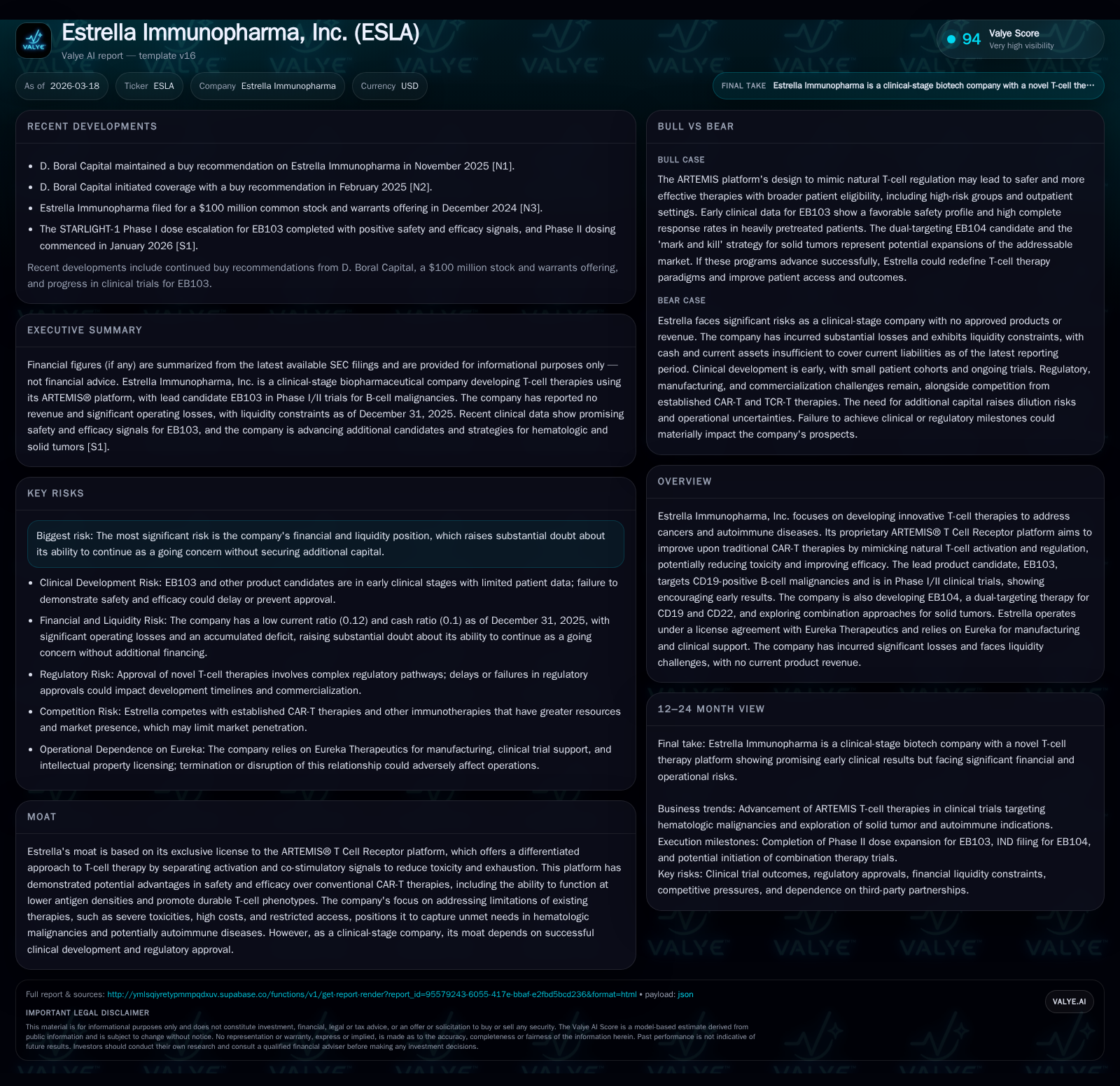
Estrella Immunopharma utilizes its proprietary ARTEMIS® T Cell Receptor platform to develop next-generation T-cell therapies targeting hematologic malignancies, with EB103 showing a 100% complete response rate in Phase I trials at the high dose cohort and an encouraging safety profile. The company’s pipeline also includes a dual targeting candidate EB104 and exploratory solid tumor strategies leveraging combination modalities. However, this clinical progress contrasts sharply with escalating operating losses—nearly tripling from 2024 to 2025—and a severely constrained liquidity position, including a current ratio of just 0.12, raising substantial doubt about continuing operations without additional capital infusion. Regulatory compliance and reimbursement uncertainties compound these financial risks, making forthcoming trial readouts and funding developments critical near-term watchpoints.
Tracing Estrella’s Growth from Early Development to Clinical Progress
Estrella Immunopharma operates as a clinical-stage biotechnology company focused on developing T-cell therapies for cancers and autoimmune diseases. Since its inception, the company has incurred consistent net losses reflecting investments into research, development, staffing, and clinical trials [F1][S1]. Operating income declined substantially from approximately -$249k in FY2021 to -$4.4 million in FY2024 before accelerating to -$13.1 million in FY2025—a near tripling that highlights intensified R&D efforts as the pipeline progressed into advanced clinical stages (operating income YoY decline of 195% from 2024 to 2025) [F1]. Net income mirrored this trend closely due to limited non-operating items.
Operating cash flows remained negative across these years due to ongoing investment outlays necessary for clinical advancement [F1].
Historical performance (annual)
| FY | Net ($mm) | CFO ($mm) | OpInc ($mm) | Net YoY |
|---|---|---|---|---|
| 2025 | -13 | -2 | -13 | -195.1% |
| 2024 | -4 | -3 | -4 | |
| 2022 | -1 | -1 | -2 | -302.1% |
| 2021 | 0 | 0 | 0 |
Source: SEC companyfacts cache [F1].
Capital returns and efficiency (annual)
| FY | ROE% |
|---|---|
| 2025 | 126.0 |
| 2024 | -3080.1 |
| 2022 | 44.2 |
| 2021 | 24.6 |
Source: SEC companyfacts cache [F1].
Table illustrates escalating losses accompanying growing clinical development investment.
Clinical Developments of EB103 and the ARTEMIS® Differentiation Edge
EB103 is Estrella's lead candidate developed on the ARTEMIS® T Cell Receptor platform which mimics natural TCR activation by separating cellular activation from co-stimulatory signals through modular receptor engineering [S1]. This design contrasts with traditional CAR-T therapies that combine activation signals and often cause high toxicity and limited patient eligibility.
In the STARLIGHT-1 Phase I/II trial dose-escalation phase involving nine patients with relapsed/refractory B-cell Non-Hodgkin’s Lymphoma deemed high-risk or ineligible for current approved therapies, no treatment-related serious adverse events were reported. The highest dose cohort achieved a remarkable 100% complete response rate at one month post-infusion [S1]. This outcome supports the platform’s hypothesis of improved safety and efficacy through physiologic signaling modulation.
Pipeline Expansion: Dual Targeting and Solid Tumor Ambitions
Beyond EB103's single CD19 targeting strategy, Estrella is developing EB104 which targets both CD19 and CD22 antigens on B-cell malignancies using ARTEMIS® technology. This dual targeting aims to reduce relapse driven by antigen loss variants that limit single antigen therapies [S1].
For solid tumors—comprising about 90% of all cancers but challenging for cell therapies due to lack of tumor-specific targets—Estrella collaborates with Imugene on a "mark and kill" approach using an oncolytic virus (CF33-CD19t) to induce CD19 expression on solid tumors making them susceptible to EB103 T-cells. These efforts remain exploratory without disclosed timelines but broaden Estrella's therapeutic scope beyond hematologic malignancies [S1].
Financial Performance Trends: Escalating Losses Amid Clinical Advancement
The company’s financials reflect increasing cash consumption typical of late-stage biopharmaceutical firms advancing costly clinical programs coupled with corporate scaling. Operating losses rose from under $250k in FY2021 to over $13 million in FY2025 driven by R&D expansion including milestone payments under licensing agreements with Eureka Therapeutics [F1][S8,S11].
Operating cash flow improved year-over-year between FY24 (-$3.11M) and FY25 (-$1.79M), potentially due to working capital changes or timing effects but remains negative overall [F1].
Liquidity is a critical concern given cash & equivalents totaled only about $1.38 million against current liabilities exceeding $13.5 million as of December 31, 2025—resulting in a very low current ratio near 0.12 that management recognizes as raising substantial doubt regarding continuing operations absent new financing [F1][S11].
Liquidity Challenges and Capital Needs
Estrella faces urgent funding needs aligned with planned Phase II expansion trials for EB103 and ongoing corporate expenses [S11][S18]. The Services Agreement with Eureka requires milestone payments totaling approximately $33 million related to EB103 development services; only $3.5 million has been paid thus far indicating significant upcoming obligations that could exacerbate financial strain without fresh capital or partnering arrangements [S8].
The company has minimal debt but notes potential restrictive covenants associated with future financings that could limit capital raising flexibility if liquidity worsens [S11]. Outstanding warrants exercisable at prices above current market levels provide possible—but uncertain—capital sources given market conditions [S3].
Operational dependency on Eureka for manufacturing also introduces potential risk regarding scale-up or transition post-clinical phases which may require additional resources or alternate arrangements [S11].
Regulatory and Compliance Risks Impacting Business Outlook
Estrella operates under comprehensive regulatory frameworks including FDA biological product approvals alongside state-level pharmaceutical marketing compliance requirements detailed extensively in filings . Compliance involves anti-kickback laws, false claims statutes, health data privacy laws such as GDPR (Europe), CCPA/CPRA (California), and other evolving global standards.
These regulations increase operational complexity and costs particularly around pharmacovigilance post-approval and product liability insurance needs amid rising enforcement actions [S5,S19]. Pricing reforms such as the Medicare Drug Price Negotiation Program introduce reimbursement uncertainties affecting commercial prospects assuming successful approvals years ahead [S6,S16,S24].
Investor Watchpoints: Upcoming Clinical Milestones and Funding Trajectory
Near-term focus includes completion of EB103's Phase II expansion following positive DSMB recommendations on dosing cohorts based on safety and efficacy data reported thus far [S1]. These results will be pivotal for assessing clinical viability.
Explicit regulatory submission timelines remain undisclosed but advancing larger patient cohorts will materially impact capital requirements given historical cost trends [F1][S1]. Investors should monitor announcements related to financing or partnerships which are critical for sustaining operations.
Updates on EB104 dual targeting development alongside solid tumor combination strategies with Imugene serve as secondary technical milestones though remain earlier stage currently.
Conclusion: Scientific Promise Amid Financial Constraints
Estrella Immunopharma presents an innovative approach aiming to deliver safer and more effective T-cell therapies through its ARTEMIS® platform addressing limitations of existing CAR-T technologies.
Early clinical data demonstrate promising efficacy coupled with favorable safety profiles supporting the scientific rationale. However, these advances coexist with severe financial constraints marked by escalating losses quadrupling over five years combined with critically weak liquidity ratios placing survival dependent on imminent capital raises or strategic deals.
Investors must balance the long-term potential inherent in immunotherapy commercialization cycles against immediate operational execution risks compounded by complex regulatory environments.
Successful navigation through these challenges will define Estrella’s ability to translate scientific innovation into sustainable value creation.
Disclaimer: This is research-only, informational analysis and not investment advice. It may include AI-generated interpretation and general industry context. Always verify important details using primary sources.

Comments