
First Choice Healthcare Solutions Advances Wellness Clinic Chain Amid Transition Risks
FCHS is reshaping its healthcare model with a focus on integrated wellness clinics featuring nurse practitioner-led care and compounding pharmacy services.
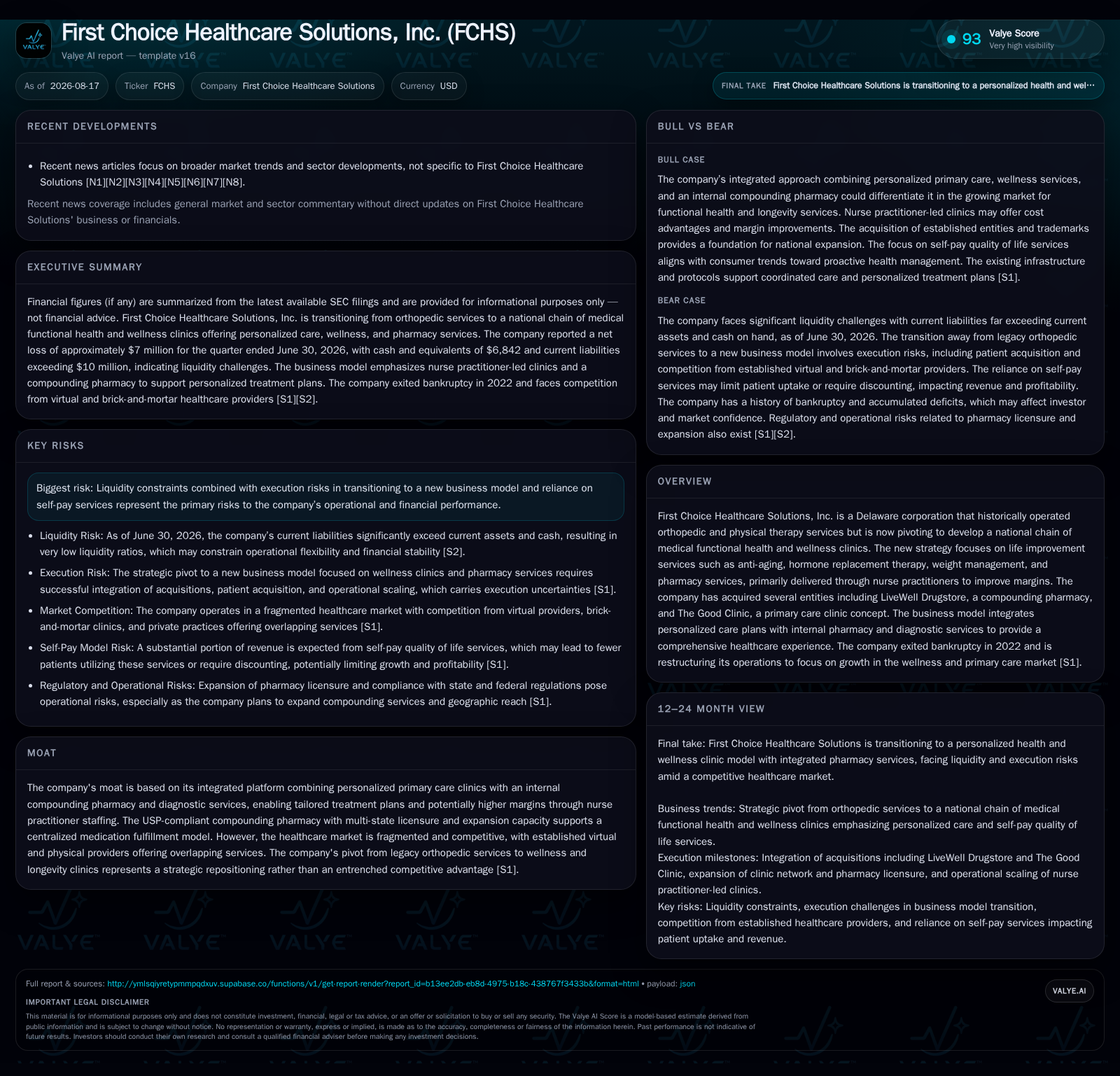
First Choice Healthcare Solutions, Inc. (FCHS) continues executing its strategic pivot from legacy orthopedic services to a national network of medical functional health and wellness clinics. The company centers on life improvement services such as hormone replacement therapy, anti-aging treatments, and integrated pharmacy operations primarily staffed by nurse practitioners to enhance margins. Despite material operating losses and liquidity constraints, FCHS’s acquisitions of LiveWell Drugstore and The Good Clinic underpin its shift toward providing personalized care plans supported by centralized diagnostics and a USP-compliant compounding pharmacy. Execution risks and reliance on self-pay patients remain key challenges as the company seeks to scale in a fragmented and competitive outpatient healthcare market.
Recent Operating Update
First Choice Healthcare Solutions (FCHS) filed its latest quarterly report on August 13, 2026 [S2], reiterating progress in transitioning from its legacy orthopedic and physical therapy services to an integrated network of wellness-focused outpatient clinics. Key developments include entering a Business Combination Agreement with Westin Acquisition Corp., valuing FCHS at approximately $650 million equity value [S3]. This transaction involves domesticating the company as a Nevada corporation and merging it as a wholly owned subsidiary under the acquiring entity [S3]. The business combination signals external validation of FCHS’s strategic refocus toward functional health clinics.
Despite these corporate developments, the quarter reveals continuity in sizable operating losses ($2.7 million for 2025) and very limited liquidity—cash & equivalents stood at merely $6,842 as of June 30, 2026—with current liabilities outstripping current assets substantially (current ratio effectively zero) [F1]. These financial constraints highlight the execution risk embedded in pursuing growth through acquisitions and clinic openings without significant capital infusion or improved cash flows.
Business Model Evolution
Historically oriented around orthopedic diagnostics and rehabilitative care—including surgery support and imaging—FCHS has divested most legacy services except for select physical therapy adjuncts [S1][S12]. The strategic pivot centers on developing a national chain of medical functional health and wellness clinics offering life improvement therapies such as anti-aging treatments, hormone replacement therapy (HRT), weight management programs, peptide therapies, compounded medication regimens, and integrated diagnostic assessments [S1][S9][S12].
Revenue is predominantly generated through fee-for-service mechanisms targeting largely self-pay (cash-paying) patients seeking personalized medicine solutions outside traditional insurance reimbursement frameworks [S9]. This shift reduces dependency on complex third-party payors but heightens exposure to patient volume fluctuations linked to discretionary spending. The company emphasizes employing primarily nurse practitioners (NPs) rather than physicians—aiming to lower provider costs while maintaining care quality. This NP-driven clinical staffing model aligns with market trends favoring cost-effective primary care delivery [S9][S12].
Ancillary services form an integral part of revenue mechanics: proprietary compounding pharmacy operations—embodied by the LiveWell Drugstore acquisition—permit customized medication dispensing while generating higher-margin prescription volumes within their branded clinic network. The USP-compliant multi-state licensure of this pharmacy supports economies of scale via centralized drug fulfillment [S1][S7][S9]. Additionally, diagnostic testing capabilities enable FCHS to create detailed patient profiles that inform tailored treatment plans integrating lab results with clinical care.
This vertically integrated approach—connecting primary care clinics with internal pharmacy and diagnostics—aims to improve patient retention by delivering comprehensive health optimization packages under one roof [S12]. Such integration is strategically important given competitive pressures from virtual providers offering fragmented service lines.
Industry Structure & Competitive Position
FCHS operates downstream in the healthcare delivery value chain with direct patient interaction via physical clinic sites complemented by internal pharmacies—a business model paralleling established peers like Surgery Partners (SGRY) in outpatient multi-specialty networks and Accendra Health (ACH) in integrated care models.
The broader healthcare services industry is characterized by fragmentation—numerous regional primary care providers coexist alongside growing specialty wellness clinics focused on longevity, anti-aging, and functional medicine. Competition arises from traditional health systems expanding outpatient footprint; virtual care platforms leveraging telehealth modalities; large-scale compounding pharmacies licensed across multiple states; plus boutique specialty providers targeting affluent consumer segments interested in proactive health management.
Within this landscape, FCHS’s nurse practitioner-led staffing offers margin advantages but requires achieving adequate clinic utilization rates to cover fixed costs spread across leased facilities held by The Good Clinic Properties subsidiary [S12]. Scaling challenges include establishing brand recognition amidst well-funded competitors; navigating complex multi-state billing landscapes; ensuring regulatory compliance especially around compounding pharmacy standards; managing patient acquisition costs; and integrating recent acquisitions effectively to realize synergies without operational disruptions [S20][S25].
Growth Drivers
Market tailwinds support FCHS’s pivot: the aging U.S. population’s increasing appetite for hormone replacement therapies (targeting menopause symptoms or low testosterone) combined with rising interest in anti-aging peptides fuels demand for personalized health optimization services. Moreover, expanded scope-of-practice laws enabling nurse practitioners to deliver more autonomous primary care increases scalability potential while lowering labor expense ratios compared to physician-centric models.
Rising chronic disease prevalence also drives demand for metabolic weight management and inflammation-related diagnostic testing offered via integrated clinic visits: these services attract self-pay consumers willing to pay out-of-pocket for proactive interventions where traditional insurers may provide limited coverage [S9].
Geographic expansion into underserved markets presents growth opportunities as well: deploying standardized protocols across multiple states leverages existing administrative infrastructure housed under Leading Primary Care Inc. with supporting subsidiaries managing leases (The Good Clinic Properties) and pharmacy operations (Live Well Drugstore) [S12].
Centralizing compounding pharmacy capabilities enhances operating leverage via prescription volume growth without proportionate clinic-cost increases. This internal supply chain differentiation can widen margins relative to specialty clinics dependent on third-party pharmacies.
Risks & Growth Constraints
Liquidity constraints are paramount given minimal cash reserves juxtaposed against current liabilities exceeding $10 million as of June 2026 [F1], compounded by recurring net losses close to $7 million in 2025 [F1]. Without new capital influx through equity or debt markets—as implied by prior warnings about necessity for additional financing—the company faces existential risks curtailing expansion investments or forcing operational cutbacks [S1][S5][S8].
Execution risk looms large in successfully transitioning away from unprofitable orthopedic businesses towards profitability in wellness clinics—a domain requiring effective marketing to new patient segments accustomed to self-pay models along with efficient billing operations amid varying state rules [S1][S20]. Regulatory compliance complexity intensifies given compounding pharmacy obligations: sterile environments with specialized equipment must meet stringent USP standards subject to audit failure penalties potentially harming reputation or incurring fines [S1][S20].
Patient acquisition costs could rise steeply if competitive pressures intensify from virtual healthcare platforms offering similar personalized wellness packages virtually or through hybrid models inclusive of remote monitoring. Additionally, payer mix concentrated heavily in cash-pay customers introduces revenue volatility correlated with macroeconomic consumer spending patterns affecting elective service volumes [S9]
Acquisition integration risks also persist: blending corporate cultures, standardizing clinical protocols across recently acquired entities like Pointe Medical Services or LiveWell MD demands managerial bandwidth which may be constrained given company size [S7][S24]. Negative past impacts from former CEO legal issues underscore reputational fragility influencing referral sources or partnerships [S1].
What to Watch Next
Near-term milestones include the closing of the announced Business Combination Agreement expected later in 2026 facilitating reorganization as Wellgevity 360 Inc., which may unlock access to larger capital pools necessary for scaling clinic count nationally [S3][N12]. Monitoring announcements regarding new clinic openings or acquisitions will indicate pace of network expansion.
Operating metrics such as patient visit volume growth within core clinics under Live Well Medical Group should be tracked closely alongside average revenue per patient—key indicators of market acceptance for cash-pay hormonal therapies versus insured primary care visits. Prescription volumes processed internally via LiveWell Drugstore represent another actionable KPI signaling successful cross-selling of ancillary high-margin products enhancing total revenue per patient.
Cost efficiency improvements driven by nurse practitioner staffing ratios relative to total visits will reveal margin expansion potential. Progress in reducing headcount redundancies after pivot closure of legacy orthopedic units will also contribute positively if sustained [S1].[N9] Lastly, any commentary surrounding liquidity improvements post-Business Combination closing will be critical given historical balance sheet constraints evident mid-2026.
Financial Profile Discussion
The financial snapshot underscores significant solvency concerns. As of June 30, 2026, FCHS held only $6,842 in cash against current liabilities nearing $10.1 million leading to a current ratio effectively at zero—an acute liquidity mismatch compromising operational flexibility [F1]. Total debt was reported as zero per the latest available data, indicating no formal borrowing lines outstanding at this time [F1]. Large accrued liabilities or payables likely represent vendor obligations tied to ongoing restructuring efforts rather than debt.
Nonetheless, successful completion of the intended Business Combination transaction planned mid-late 2026 may provide needed financing relief enabling infrastructure investments essential for scaling the national wellness clinic platform efficiently while maintaining regulatory compliance oversight consistent with multi-state operations requirements [N15][N13][N14].[N12]
This analysis is based solely on publicly available SEC filings dated through August 13, 2026 ([S1],[S2],[S3]) supplemented by industry context pertaining to healthcare services integration strategies and known sector dynamics. It reflects factual disclosures without projecting specific financial forecasts or investment research views.
Disclaimer: This is research-only, informational analysis and not investment advice. It may include AI-generated interpretation and general industry context. Always verify important details using primary sources.

Comments