
Firefly Aerospace’s Financial Trajectory: Capital, Losses, and Growth Plans
Firefly Aerospace maintains strong liquidity despite significant losses while focusing on operational scaling under new leadership.
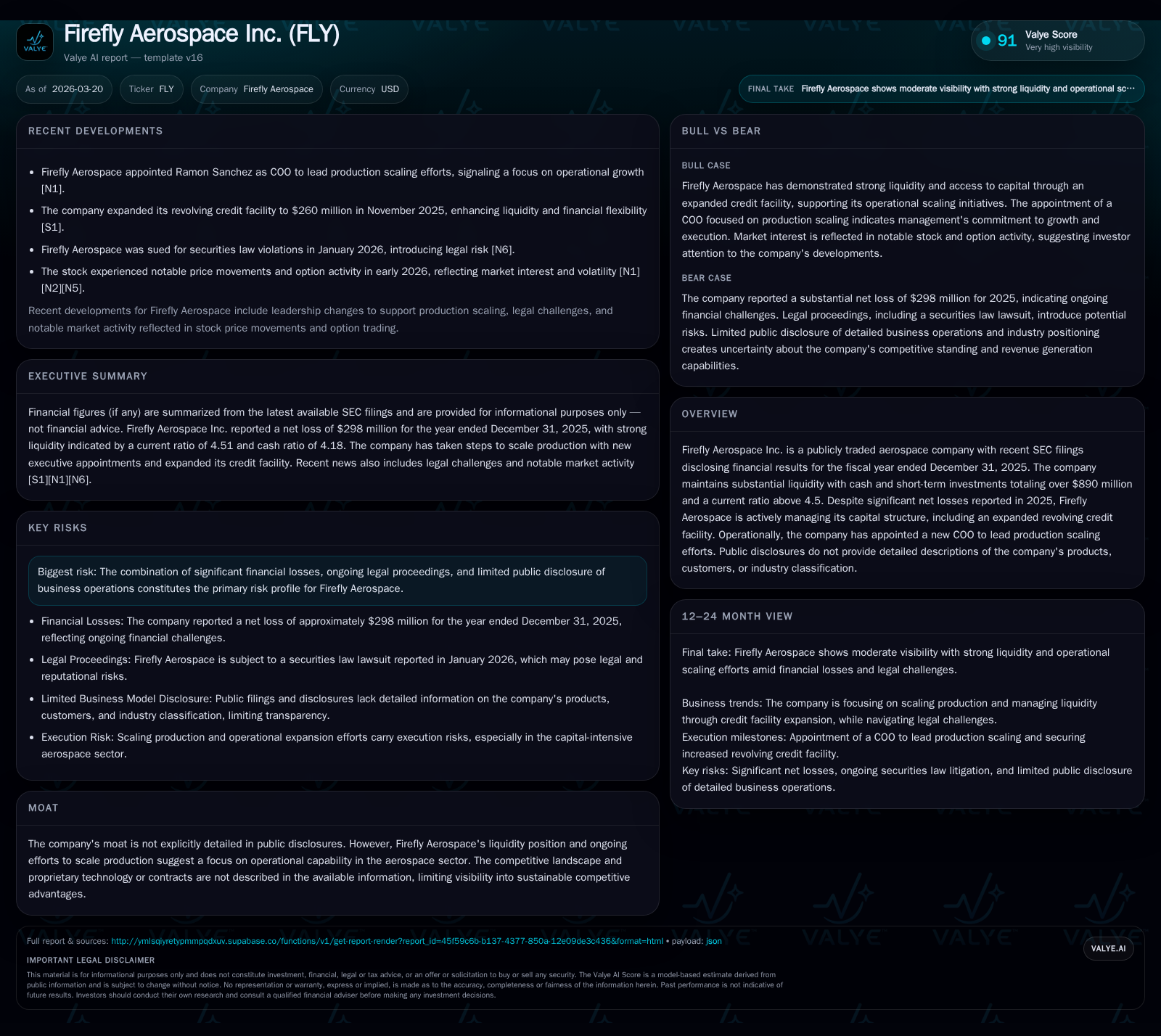
Firefly Aerospace reported substantial operating and net losses for fiscal 2025, reflecting the high-cost phase typical of aerospace manufacturing scale-up. The company holds over $890 million in cash and short-term investments, underscoring a robust liquidity position with a current ratio of approximately 4.5. Key developments include an expanded revolving credit facility and the strategic appointment of a new COO tasked with accelerating production capabilities. However, ongoing legal challenges and limited public disclosure on proprietary technologies add to the risk profile. Monitoring execution on launch programs, capital deployment efficiency, and legal resolutions will be critical to assessing future growth prospects.
Historical Financial Performance and Operating Results
Firefly Aerospace’s fiscal year ended December 31, 2025, was marked by continued operational investment resulting in sizable losses. The company posted an operating loss of $260.7 million alongside a net loss of $298.3 million [F1]. This magnitude of negative income reflects the heavy fixed-cost base associated with aerospace manufacturing scale-up, including research, development, testing, and facilities overhead that precede steady-state revenue generation.
Free cash flow also remained negative at approximately -$237.75 million (computed as cash flow from operations minus capital expenditures) evidencing sustained cash burn tied to growth efforts [F1]. Despite these losses, Firefly's reported current ratio stood at a healthy ~4.51, underscoring adequate short-term asset coverage over liabilities [F1].
Historical performance (annual)
| FY |
|---|
| 2025 |
Source: SEC companyfacts cache [F1].
Note: CFO and Capex absolute values unavailable from current disclosures; free cash flow derived directly from provided figures.
The absence of revenue line items or growth rates in disclosures suggests Firefly remains predominantly pre-commercial or early commercial phase, consistent with a launch systems developer still validating technology platforms.
Liquidity Position and Capital Structure Developments
Firefly Aerospace holds a strong liquidity position with over $792.97 million in cash and equivalents as of year-end 2025 [F1], supplemented by short-term investments bringing total readily available liquid assets beyond $890 million according to recent filings [N1][S23]. This sizable reserve supports operational continuity through high cash burn intervals typical of aerospace startups.
Critically, the company expanded its revolving credit facility from an initial $125 million commitment by an additional $135 million in November 2025 to a total $260 million facility maturing August 8, 2028 [S8][S9][S16][S23][S26]. The loans carry interest rates based on either term SOFR plus a spread of 3% or an alternative base rate plus 2%, with commitment fees applied to unused portions [S8]. This enhanced credit capacity supplements liquidity buffers without immediate obligational strain.
Current liabilities remain contained at approximately $213.6 million versus current assets near $963.2 million, reinforcing solid short-term financial flexibility [F1]. The capital structure appears oriented toward balancing debt provision for working capital needs against equity funding to preserve financial runway amid operating deficits.
Operational Initiatives and Leadership Changes
December 2025 marked a pivotal operational shift with the appointment of Ramon Sanchez as Chief Operating Officer [S24][S27][N1]. Sanchez brings more than two decades of aerospace operations expertise from Boeing, having held senior director roles overseeing space systems and manufacturing scale operations including positions at Kennedy Space Center—an indicator of Firefly’s intent to strengthen production capabilities.
This leadership change follows the departure of the prior COO and signals management’s focus on overcoming typical aerospace scale-up bottlenecks such as supply chain integration, quality control refinements, and automation ramping—all essential to commercial launch readiness [S24][N1]. While product specifics remain undisclosed publicly, this executive hire suggests prioritization of manufacturing throughput improvements critical for revenue generation.
Risk Profile: Legal Proceedings and Disclosure Gaps
Firefly faces notable risk exposure from ongoing legal proceedings detailed in multiple regulatory filings [S4][S5][S6]. Though specific claims are not fully elaborated publicly, the company's SEC disclosures emphasize litigation as a material factor possibly affecting business continuity or financial results.
Additionally, public filings provide scant detail about proprietary technologies, key contracts, customer base composition, or competitive advantages [S7]. This opacity obscures assessment of Firefly’s sustainable moat or defensibility against dominant industry competitors.
These factors heighten uncertainty around execution risk common among emerging aerospace firms striving for market foothold amid established incumbents.
Growth Prospects Amid Market and Competitive Uncertainty
No explicit forward guidance was issued by Firefly for revenue or profitability milestones [N1][S1]. However, news analysis contextualizes Firefly’s position within a competitive launch sector influenced by landmark events like the SpaceX IPO which is expected to reshape investor appetite across aerospace stocks [N4].
Growth prospects hinge on successful scale-up execution under new operational leadership alongside securing commercial launch contracts that underpin order book visibility—a core metric for aerospace integrators transitioning into revenue phase.
The pace at which Firefly can convert technological developments into routine missions will determine its trajectory against aggressive peers seeking volume efficiencies through repeatable production runs.
Capital Allocation Priorities and Shareholder Returns
In alignment with an intensive investment phase characteristic of space launch companies, Firefly did not declare dividends or initiate share repurchase programs during the period under review [S10][S11][S13][S17]. Instead, capital allocation has oriented towards extending revolving credit availability and maintaining sufficient liquidity buffers to fund ongoing development expenditures.
This strategy corresponds with an approximate negative return on equity of -25.1%, reflective primarily of heavy net losses relative to shareholder equity base amid early commercialization stage dynamics [F1].
Preservation of flexibility via increased credit lines combined with cautious capital deployment exemplifies prioritization of sustaining operations over near-term capital returns.
What Investors Should Monitor Next
Absent formal guidance or detailed outlook disclosures from Firefly management [N1][S3], investors should focus on several key performance indicators going forward:
- Progress in commercial launch scheduling and frequency indicating improved production throughput under new COO leadership.
- Efficiency metrics capturing cash burn trends versus revenue recognition or backlog formation.
- Resolution status on legal proceedings potentially influencing financial contingencies or reputational risk.
- Any increased transparency regarding customers, contracts won or pipeline visibility signaling market traction.
- Shifts in financial ratios reflecting improvement in operating leverage or movement toward break-even levels.
Progress along these dimensions will be critical barometers for assessing whether Firefly Aerospace can temper significant losses while scaling effectively in a volatile yet opportunity-rich sector.
Disclaimer: This report provides analysis based exclusively on publicly available information up to March 20, 2026. It is intended for informational purposes only without constituting investment advice or recommendation.
Disclaimer: This is research-only, informational analysis and not investment advice. It may include AI-generated interpretation and general industry context. Always verify important details using primary sources.

Comments