
Fidelity Solana Fund: Passive SOL Exposure Meets Staking Yield and Blockchain Volatility
Fidelity Solana Fund offers investors regulated, exchange-traded access to Solana (SOL) with added staking yield, but its performance is tightly linked to the volatile SOL market and the evolving risks of blockchain technology and regulation.
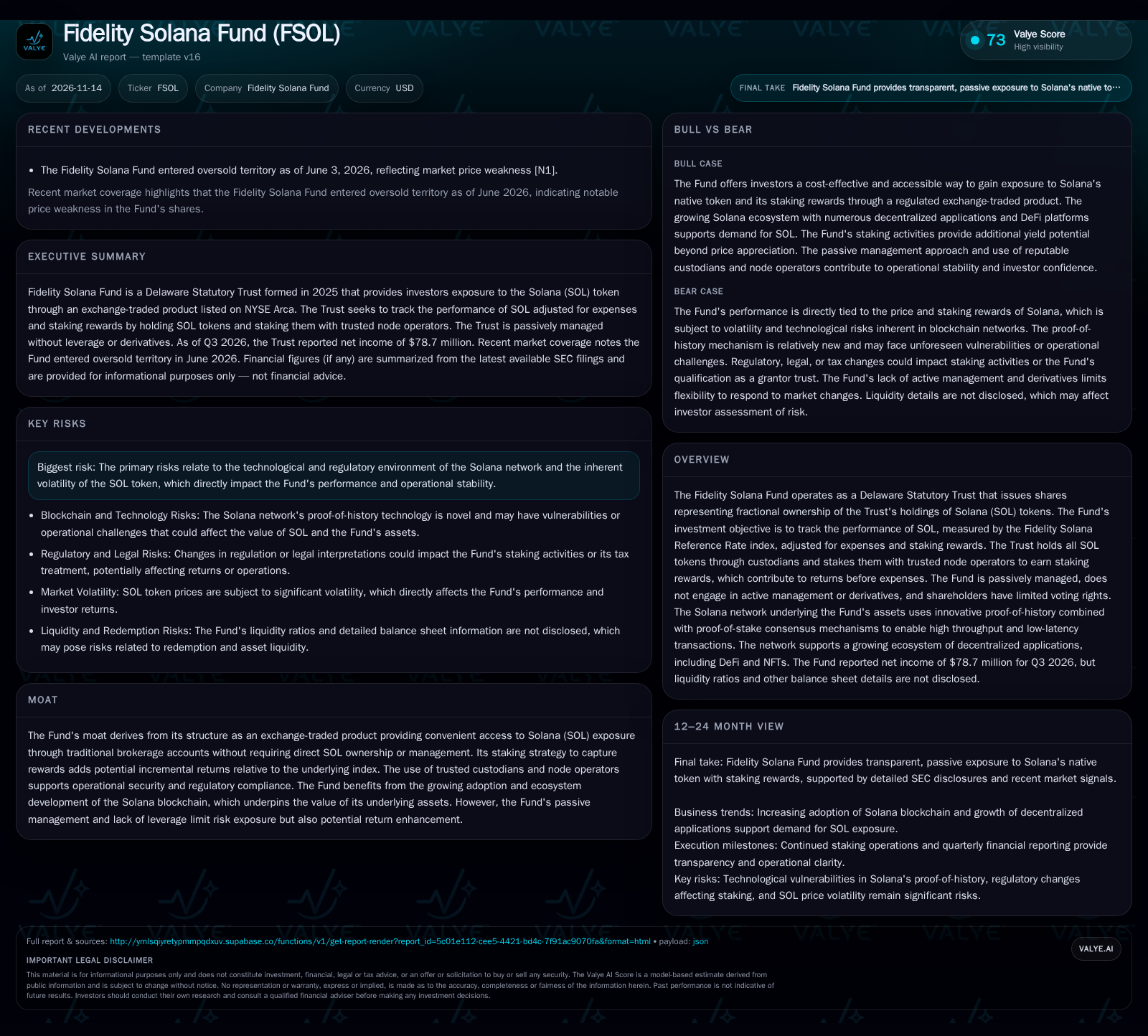
Fidelity Solana Fund (FSOL) provides passive exposure to Solana through an ETF-like structure, including staking rewards. The Fund reported $78.7M in net income for Q3 2026 and recently entered oversold territory, highlighting price risk. Its structure offers operational transparency and yield, but its fortunes are inseparable from Solana’s price swings, technological reliability, and regulatory landscape. [S1] [S2] [N1]
Fidelity Solana Fund delivers regulated, exchange-traded access to Solana’s growth story, combining direct token exposure with the incremental yield of on-chain staking. This structure appeals to investors seeking the upside of blockchain innovation without the friction of self-custody. Yet the Fund’s fortunes are fundamentally linked to the price, technological resilience, and regulatory standing of Solana itself—a volatile asset class with evolving risks. Recent net income and oversold trading signals underscore both the potential and the hazards in this high-beta, passively managed vehicle.
Recent Performance and Market Signals Shape the Fund’s Risk Profile
The Fidelity Solana Fund reported net income of $78.7 million for the quarter ended September 30, 2026, driven by its holdings in SOL and staking rewards during a period of strong token performance [S2]. However, by June 2026, the Fund’s shares were flagged as entering oversold territory, reflecting notable price weakness and highlighting the inherent volatility of SOL [N1]. The Fund operates as a Delaware Statutory Trust, passively tracking Solana’s price (plus staking yield) through fully backed custody, with shares listed on NYSE Arca since November 2025 [S1]. [S2] These facts set the table for FSOL’s risk/reward dynamics: transparent, regulated access to SOL’s upside and staking yield, but with exposure to sharp market swings and operational unknowns.
How FSOL Earns: Tracking SOL, Capturing Staking Yield, and Managing Costs
FSOL’s business model is structurally simple: it issues tradable shares representing fractional ownership of a pool of SOL tokens, which are held with institutional custodians and staked to earn rewards [S1]. The Fund’s revenue is a function of two variables: (1) the market price of SOL, as measured by a reference index, and (2) the aggregate staking yield achieved by delegating SOL to trusted node operators. Expenses, including custody, administration, and fund management, are deducted before net income accrues to shareholders via share price appreciation (there are no dividends or direct cash distributions).
The Fund does not use leverage, derivatives, or active trading; it is a fully passive vehicle designed to closely match the total return of SOL plus staking, less expenses [S1]. This model minimizes operating complexity and risk but also caps potential upside from tactical positioning or derivative hedging. Operating leverage is limited: expenses are largely fixed or scale linearly with AUM, while revenue is dictated by SOL price and staking performance. Capital requirements are modest, as the Fund’s only assets are the fully-funded SOL holdings; there is no borrowing or margin activity.
ETP Access, Staking Yield, and the Battle for Crypto-Linked Flows
FSOL’s primary advantage lies in its regulated, exchange-traded structure, which allows mainstream investors to gain direct exposure to Solana and its staking yield without managing wallets, private keys, or tax complexity. This lowers the barrier to entry for institutions and retail investors compared to self-custody or offshore exchanges.
However, the competitive landscape is evolving. Other Solana-backed exchange-traded products (ETPs), mutual funds, and structured notes may offer similar access, often competing on expense ratios, liquidity, and operational transparency. The incremental staking yield is a differentiator—if net rewards after fees outpace those of rival funds or direct staking alternatives, FSOL could attract greater flows. Conversely, if staking yields compress due to network changes, validator rewards dilution, or higher fund fees, this edge erodes.
Substitution risk is also significant: investors can choose direct SOL ownership (via wallets or exchanges), Solana-based DeFi protocols, or competing blockchain ETPs (such as those tracking Ethereum, Bitcoin, or emerging high-throughput chains). The passive structure means FSOL cannot adapt to SOL-specific risks or opportunities beyond its index-tracking mandate, making it vulnerable to technological or regulatory shocks in the Solana ecosystem.
When Blockchain Growth and Staking Economics Align: The Bullish Chain Reaction
A favorable scenario for FSOL hinges on a sustained increase in Solana adoption—driven by the launch of new decentralized applications, DeFi protocols, and NFT platforms—leading to increased demand for SOL and upward price momentum. As more activity takes place on Solana, staking yields may remain attractive, especially if the network’s proof-of-history and proof-of-stake mechanisms continue to deliver high throughput and reliability.
In this environment, FSOL’s net asset value would appreciate both from SOL price gains and the compounding effect of staking rewards, potentially resulting in net income growth and tracking outperformance versus non-staking competitors. Confirmation of this scenario would come from recurring financial reports showing robust net income, sustained or rising staking yields, and growing AUM as investors allocate to the Fund. Additional evidence would include Solana network data showing rising active addresses, transaction volumes, and DApp launches.
Falsification would be signaled by declining staking rewards, stagnating or falling Solana adoption, or a relative underperformance versus direct SOL holdings or rival ETPs.
A Volatile Ride: Tracking SOL with Staking as a Modest Cushion
The most plausible trajectory for FSOL is a close tracking of SOL’s volatile price, with staking rewards providing a modest offset to expenses and drawdowns. The Fund’s passive design means its performance will mirror the ups and downs of Solana’s token market, with net income and share value rising or falling in tandem with the underlying asset.
Staking rewards are likely to persist as a source of incremental yield, but may fluctuate based on network participation rates, protocol changes, and validator performance. Expenses are expected to remain relatively stable as a percentage of AUM. The absence of active management means the Fund cannot hedge, reposition, or respond dynamically to market or technological shocks.
Evidence confirming this scenario would be quarterly reports showing net income fluctuating in line with SOL price movements, stable (but not exceptional) staking yields, and AUM growing or shrinking with market sentiment. Falsification would come from a decoupling of FSOL performance from SOL (due to operational issues, tracking error, or regulatory intervention), or a sudden change in staking rewards that significantly impacts returns.
Technological, Regulatory, or Market Shocks Could Trigger a Confidence Crisis
The most adverse scenario for FSOL would involve a material decline in SOL price, combined with a negative technological or regulatory event affecting the Solana network or the Fund’s staking operations. A critical bug, network outage, or exploit in Solana’s proof-of-history consensus could trigger a loss of confidence, rapid price depreciation, and reduced staking rewards.
Regulatory action—such as restrictions on staking, changes to grantor trust tax status, or tighter fund oversight—could impair returns, force changes in Fund operations, or even suspend trading. In the absence of disclosed liquidity ratios or redemption mechanisms, a sharp drop in market value could lead to wider bid-ask spreads or forced asset sales, compounding losses for shareholders.
This scenario would be confirmed by a combination of sharp, persistent declines in net income, adverse regulatory filings or enforcement actions, network instability, or a marked increase in redemptions and trading volatility for FSOL shares.
Evidence That Would Validate or Challenge the FSOL Thesis in the Months Ahead
Quarterly net income and AUM growth, to test whether staking rewards and SOL price appreciation are translating into tangible shareholder returns.
Disclosed staking reward rates (if provided), to evaluate the Fund’s ability to capture incremental blockchain yield versus peers or direct staking.
SOL network health and adoption metrics—such as active addresses, DApp launches, and transaction throughput—to gauge the sustainability of underlying asset demand.
Any new SEC or regulatory filings indicating changes in custody, staking practices, or tax treatment that could impact the Fund’s structure or returns.
Disclosure (if any) of redemption mechanisms, liquidity provisions, or balance sheet details to assess operational resilience during periods of volatility.
Comparative tracking error between FSOL’s share price and the underlying SOL reference rate over time.
Announcements of new competing Solana ETPs or shifts in expense ratios that could erode FSOL’s competitive advantage.
Updates on Solana network upgrades, forks, or security incidents that may affect the stability or attractiveness of staking and token ownership.
Disclaimer: This is research-only, informational analysis and not investment advice. It may include AI-generated interpretation and general industry context. Always verify important details using primary sources.

Comments