
San Juan Basin Royalty Trust: Income Stability Hinges on Upstream Production and Commodity Cycles
San Juan Basin Royalty Trust delivers royalty-based cash flow from Hilcorp-operated oil and gas properties in the San Juan Basin. Its dividend-paying model appeals to income-focused investors, but future payouts remain tightly tethered to commodity prices and the operator’s production choices—two variables outside the trust’s control.
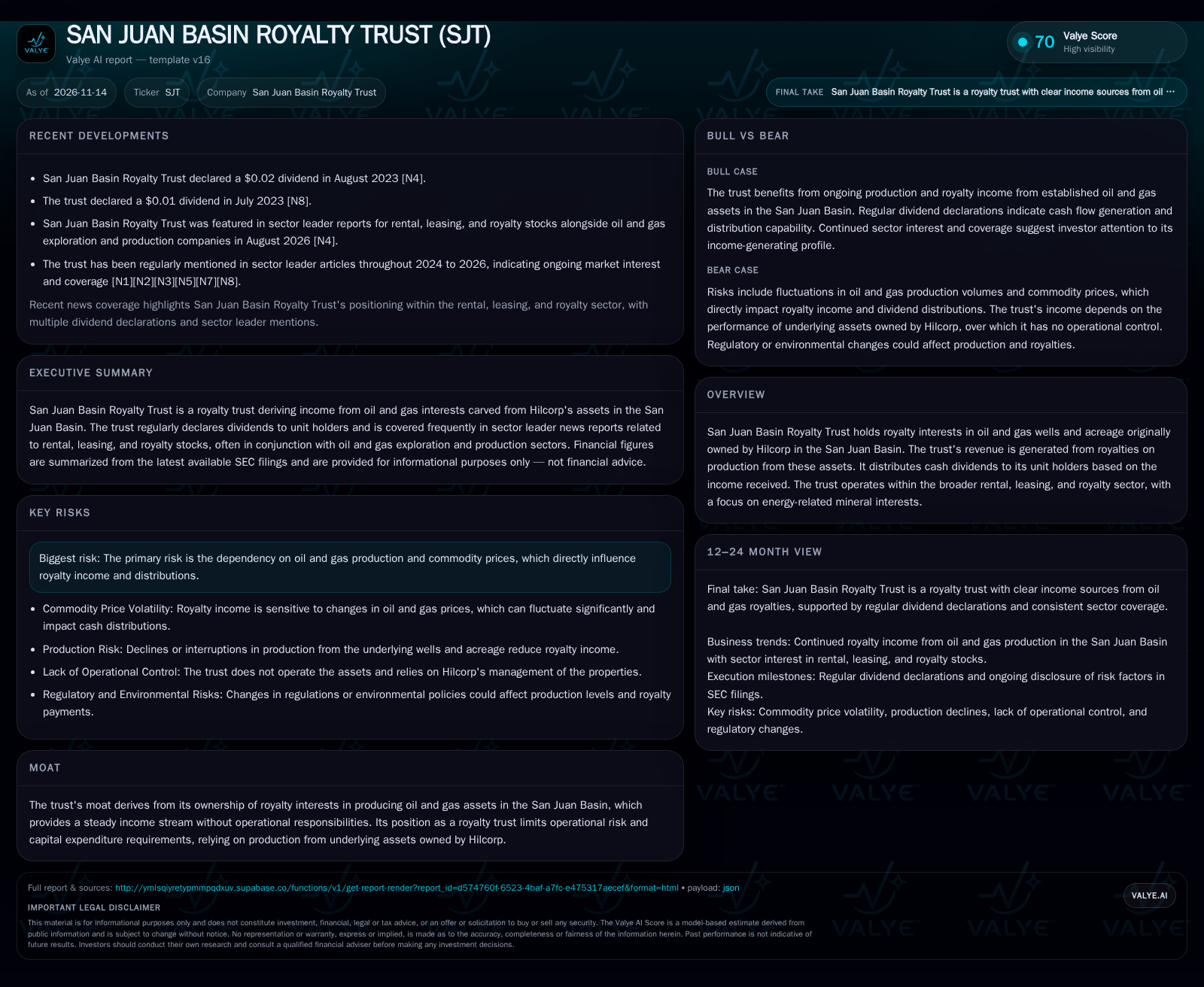
San Juan Basin Royalty Trust generates distributable income by holding royalty interests in oil and gas assets managed by Hilcorp. While the trust’s structure shields it from direct operating costs or capital expenditures, its distributions are exposed to swings in production and commodity prices. Regular dividends and sector coverage underscore its income profile, but lack of operational control and commodity price volatility remain central risks. Investors must weigh the trust’s passive cash flow appeal against its inherent sensitivity to upstream dynamics and regulatory shifts. [S1] [N4]
San Juan Basin Royalty Trust stands as a pure-play royalty trust, distributing to unit holders the proceeds from oil and gas production on acreage operated by Hilcorp in the San Juan Basin. Its appeal lies in the steady flow of royalty income and the avoidance of direct operating risk, making it a favored vehicle among income-oriented investors. However, this passive model also exposes the trust to factors it cannot control—most notably, fluctuations in commodity prices and the operational decisions of its upstream partner. As sector coverage and regular dividends continue to highlight its relevance, the trust’s future cash flows remain tied to external production and market dynamics. [S1] [N4]
Recent Coverage, Dividends, and the Reliance on Hilcorp’s Output
San Juan Basin Royalty Trust continues to be featured in sector leader reports for rental, leasing, and royalty stocks, with coverage spanning from 2024 through late 2026. This persistent attention reflects its profile as a consistent distributor of royalty-derived income. The trust’s revenue stream is generated solely from royalties on oil and gas production in the San Juan Basin, specifically from acreage and wells owned and operated by Hilcorp. Regular dividend declarations further reinforce its role as an income-generating vehicle for investors. However, the trust’s fortunes are directly tied to the production levels and operational decisions of Hilcorp, over which it has no control. This dependency makes the trust highly sensitive to both commodity price cycles and the operator’s field management. [S1] [N1] [N4]
Royalty Streams: Passive Income, Variable Payouts, and No CapEx Burden
San Juan Basin Royalty Trust’s business model is built on collecting a fixed percentage of the revenue from oil and gas produced on its underlying mineral interests, after subtracting certain post-production costs. The trust does not own the physical assets or operate the wells; instead, it is entitled to a share of the proceeds. This results in a cost structure with minimal fixed expenses and virtually no capital expenditure requirements, as all operational and development costs are borne by Hilcorp.
Unit holders benefit from this lean model through monthly or quarterly cash distributions, which can be sizable when commodity prices and production volumes are high. However, the flip side is extreme sensitivity to both volume and pricing: a decline in either can rapidly depress distributable income. The trust’s lack of operating leverage—meaning little ability to influence production or costs—means that its variable payouts are a direct pass-through of upstream performance. While this structure shields investors from capital calls or unexpected maintenance costs, it also limits upside participation in production enhancements unless Hilcorp independently chooses to invest in the assets.
Royalty Trusts in the Oil Patch: Structural Advantages, but Inevitable Decline Curves
Within the universe of royalty trusts and income-focused resource vehicles, San Juan Basin Royalty Trust is distinguished by its exposure to mature, long-lived assets in a historically prolific basin. Its competitive edge lies in its low-cost, pass-through structure and the absence of direct operational risk. Unlike exploration-and-production (E&P) companies, it does not face the volatility of drilling results or the burden of ongoing investment.
However, this structure is common among U.S. royalty trusts, many of which are also exposed to legacy oil and gas fields operated by third parties. The main counterforce is the natural production decline of mature wells—unless the operator undertakes new development or enhanced recovery, output (and thus income) will decrease over time. The trust’s inability to initiate or fund new drilling or optimization projects means it cannot directly offset these declines. In the broader competitive landscape, substitutes include other royalty trusts, master limited partnerships (MLPs) with mineral interests, and even dividend-paying E&P stocks, each with different risk/reward profiles and sensitivities to commodity cycles.
How Strong Production and Commodity Prices Could Drive Surplus Distributions
The most favorable scenario for San Juan Basin Royalty Trust involves a sustained period of high oil and gas prices coinciding with stable or even improved production from the underlying Hilcorp-operated assets. If Hilcorp invests in infill drilling, workovers, or enhanced recovery techniques, production declines could be slowed or reversed, boosting royalty income. In this scenario, the trust would likely deliver above-average distributions, attracting income-focused investors and potentially leading to premium trading multiples.
Evidence that would confirm this scenario includes public announcements of new operational investments by Hilcorp in the San Juan Basin, production reports showing stable or rising volumes, and sector news highlighting strong regional commodity pricing. Conversely, a lack of operator investment or declining production trends would falsify this upside case.
Anticipating Gradual Decline and Volatile Payouts Amid Operator Status Quo
The most plausible outcome is one where Hilcorp maintains existing wells without significant new investment, leading to a gradual, natural decline in production from the San Juan Basin assets. Royalty income would fluctuate in line with commodity prices, and distributions would remain variable but trend downward over time, punctuated by occasional spikes or dips depending on market cycles.
This middle path is confirmed if production volumes and dividend declarations remain relatively steady but show a slow erosion year-over-year, with no material announcements regarding new drilling or field development. Evidence of declining well counts or shrinking gross production would further corroborate this scenario, while any indication of major new capital investment by Hilcorp would challenge the base case.
Production Shocks or Regulatory Headwinds Could Threaten Income Stream
A negative outcome could materialize if Hilcorp curtails production, either due to persistent low commodity prices, operational setbacks, or unfavorable regulatory or environmental developments. In this scenario, royalty income would drop sharply, leading to reduced or suspended distributions. New regulations or environmental restrictions could also force well shut-ins or increase post-production costs, further eroding the trust’s distributable income.
Signs of this scenario would include public disclosures of production interruptions, regulatory actions impacting the San Juan Basin, or operator statements about scaling back activity. A sudden drop in declared dividends or a spike in sector coverage around negative production or regulatory news would also support the downside case.
Future Dividend Stability Hinges on These External and Operator-Driven Factors
Reported monthly or quarterly production volumes from Hilcorp—if disclosed—would provide direct insight into the trajectory of future distributions.
Announcements or evidence of new drilling, workovers, or field investments by Hilcorp could signal potential for stable or increased royalty income.
Trends in regional oil and gas prices, as these directly influence the trust’s royalty receipts and payout variability.
Changes in regulatory or environmental policy affecting San Juan Basin production, which could alter the trust’s income profile.
Declared dividend amounts and payout frequency, as these are the direct output of operational and commodity dynamics.
Any legal or contractual developments affecting the trust’s royalty interests or the underlying leases.
Sector news highlighting shifts in operator strategy or basin-level activity, which may precede changes in production or cash flow.
Disclaimer: This is research-only, informational analysis and not investment advice. It may include AI-generated interpretation and general industry context. Always verify important details using primary sources.

Comments