
Spark I Acquisition Corp’s Critical Phase in Finalizing Its Business Combination
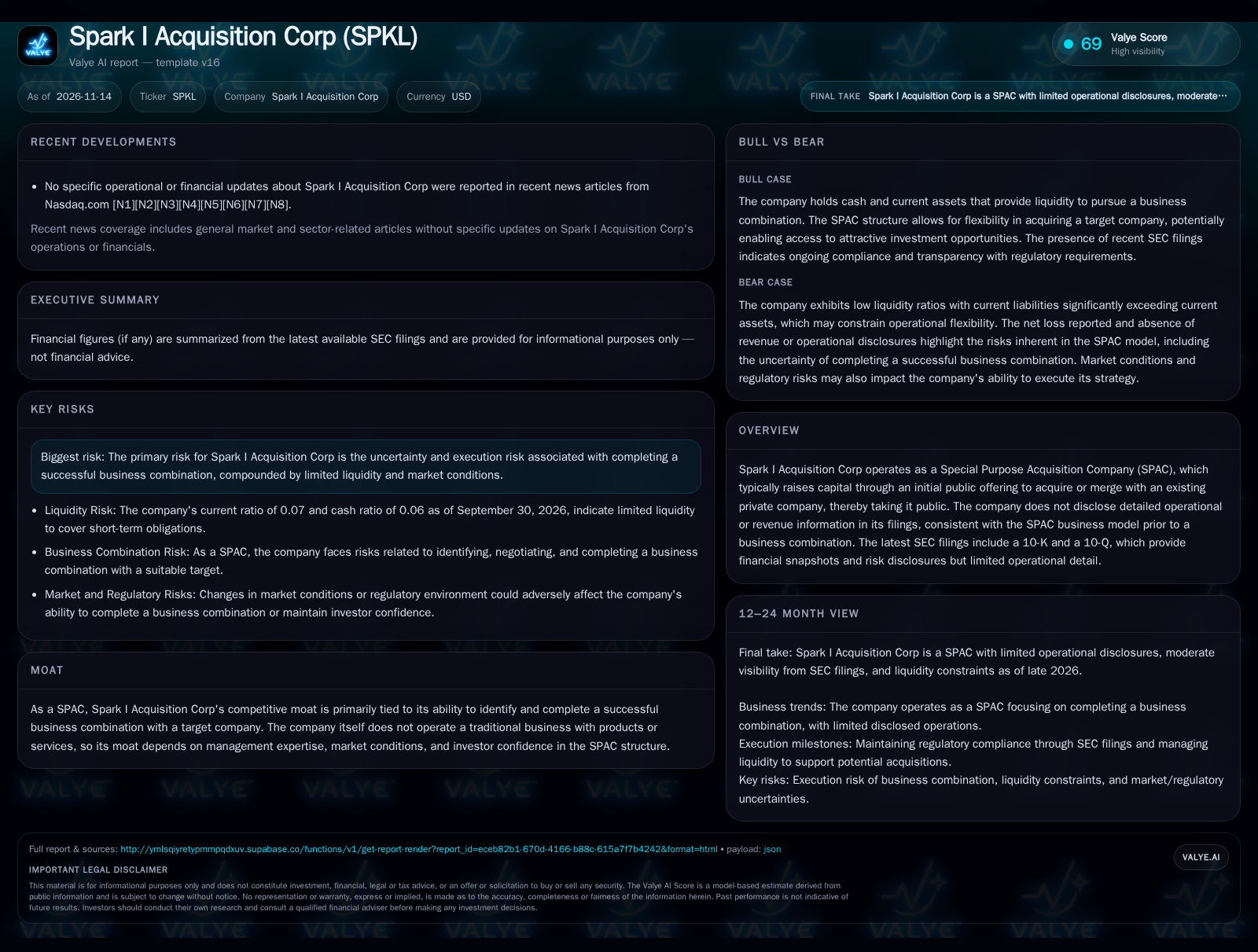
Spark I Acquisition Corp (SPKL) is a SPAC that, as of September 30, 2026, reported very low liquidity and a net loss, with no operating revenue and current liabilities far outpacing its assets.
Spark I Acquisition Corp (SPKL) is a SPAC that, as of September 30, 2026, reported very low liquidity and a net loss, with no operating revenue and current liabilities far outpacing its assets. After securing shareholder approval to extend its business combination deadline to March 2027, SPKL’s survival and value proposition now depend on closing its announced merger with ZincFive, Inc. The company’s ability to secure additional working capital from its sponsor, manage creditor pressures, and navigate market or regulatory hurdles will determine whether it can avoid liquidation.
Spark I Acquisition Corp (SPKL) exemplifies the late-stage SPAC conundrum: with current liabilities vastly exceeding its cash, a ticking deadline, and no operating revenues, the company is racing to consummate its merger with ZincFive, Inc. before its extended March 2027 deadline. The company’s fate now rests on sponsor support, the successful closing of its business combination, and the ability to stave off creditor or regulatory setbacks—highlighting the precarious economics and execution risks inherent to the SPAC model at this stage of the lifecycle. [S2]
Recent Developments in SPKL’s Financial Status and Deadline Extension Implications
As of September 30, 2026, Spark I Acquisition Corp reported $473,001 in cash and cash equivalents, $562,327 in current assets, and $8,535,218 in current liabilities, resulting in a cash ratio of 0.06 and a current ratio of 0.07. The company posted a net loss of $1,620,979 for the period, with no operating revenue disclosed. The company reported cash and liquidity metrics for the period; these figures do not by themselves establish operating runway, investment capacity, financial flexibility, or financing capacity. [S2]
On September 25, 2026, shareholders approved an extension of the business combination deadline from September 29, 2026, to March 29, 2027—providing a narrow window for the announced transaction to close. [S2] The company continues to depend on sponsor loans for working capital, with $1.9 million outstanding in a convertible unsecured promissory note as of September 30, 2026. [S2] The clock is now ticking: if the business combination does not close by the new deadline, SPKL will be forced to liquidate, per SPAC charter requirements.
Understanding SPKL’s SPAC Funding Model: Cash Flow, Sponsor Backing, and Deal Leverage
SPKL’s business model is typical of late-stage SPACs: it generates no revenue and incurs ongoing operating losses while searching for and closing a merger target. Its primary assets are the IPO proceeds held in trust and its ability to draw on sponsor loans when needed. The $1.62 million net loss for the latest period reflects the fixed costs of regulatory, legal, and administrative expenses that accumulate regardless of deal progress. [S2]
The economics hinge on two levers: (1) the ability to close a value-creating business combination before the deadline, and (2) the sponsor’s willingness and ability to provide sufficient bridge financing to cover operating expenses and any deal-related costs. The $1.9 million sponsor loan, which is convertible and non-interest-bearing, is vital for covering SPKL’s negative working capital position. [S2] If the merger with ZincFive, Inc. is completed, the trust proceeds and any additional PIPE (private investment in public equity) financing would typically fund the transaction and provide the combined company with growth capital. However, if the deal fails or is delayed, the SPAC faces the prospect of liquidation and the return of trust proceeds to public shareholders, wiping out sponsor equity and any residual value for non-redeeming shareholders.
Analyzing SPKL’s Role Within the SPAC Landscape: Competitive Advantages and Challenges
Spark I Acquisition Corp does not compete in a traditional product or service market; its competitive position is defined by its ability to source and close a compelling business combination. In this context, its edge (if any) comes from sponsor reputation, deal-sourcing networks, and the ability to execute under tight deadlines with limited capital. The SPAC market has become crowded, with many vehicles competing for a limited pool of attractive private targets, leading to more challenging negotiations and, in some cases, target companies demanding better terms or walking away.
SPKL’s announced merger with ZincFive, Inc. suggests it has identified a viable target, but the question remains whether it can close the transaction under current liquidity constraints. The company’s reliance on sponsor loans is common in the SPAC space but can signal financial strain to both targets and PIPE investors. If the sponsor’s network and reputation are strong, SPKL may retain a marginal advantage in deal execution; otherwise, it risks being seen as a commodity vehicle in a saturated market.
Potential Outcomes from a Successful ZincFive, Inc. Merger
If SPKL closes its merger with ZincFive, Inc. before the March 2027 deadline, it could unlock value for public shareholders and sponsors, bringing a new operating company to the public markets. The upside scenario assumes the deal is completed on favorable terms, with sufficient PIPE or follow-on financing to shore up the combined entity’s balance sheet and fund post-merger growth.
Confirmation of this scenario would include regulatory approval of the merger, successful redemption management (i.e., limited redemptions by public shareholders), and evidence that ZincFive, Inc. is a credible, growth-oriented business with clear public-market appeal. Additional PIPE commitments or partnership announcements would further validate the deal’s viability. Falsification would come from deal collapse, inability to raise necessary capital, or an adverse shareholder vote.
Expected Path Forward: Operating Under Pressure Until Deal Completion or Dissolution
The most plausible near-term path is that SPKL operates in survival mode: minimizing expenses, relying on sponsor loans, and working to close the ZincFive, Inc. merger before the March 2027 deadline. The company will continue to incur operating losses and face mounting creditor pressure as working capital remains deeply negative. [S2]
This scenario is confirmed by ongoing sponsor support, continued regulatory compliance, and incremental progress toward the merger (such as proxy filings, target company disclosures, or regulatory milestones). It would be falsified by sponsor withdrawal, failure to meet regulatory requirements, or the collapse of merger negotiations—any of which would likely trigger liquidation proceedings.
Consequences of Declining Liquidity or Failed Deal on SPKL’s Continuity
The downside scenario is driven by the confluence of liquidity exhaustion, sponsor fatigue, or an inability to close the ZincFive, Inc. transaction. If sponsor loans dry up or a material creditor demands payment, SPKL could face technical insolvency even before the March 2027 deadline—forcing a preemptive wind-down or a fire-sale of any residual assets.
This outcome would be confirmed by a lack of further sponsor financing, default notices, or regulatory filings indicating the company’s intention to liquidate. High redemption rates by public shareholders, a failed shareholder vote on the merger, or regulatory obstacles could also precipitate liquidation, resulting in a return of trust proceeds to public shareholders and a wipeout for the sponsor and any late-stage investors.
Factors Influencing SPKL’s Outcome as the Business Combination Deadline Nears
Progress updates on the merger with ZincFive, Inc., including regulatory filings, proxy statements, and public disclosures from either party.
Any new sponsor loan agreements, amendments to existing notes, or evidence of sponsor willingness to provide additional working capital.
Redemption rates by public shareholders at the time of the merger vote—high redemptions would weaken the capital base of the post-merger entity.
PIPE (private investment in public equity) commitments or other third-party financing announcements to support the transaction and post-merger balance sheet.
Material changes in current liabilities or creditor actions, which could signal mounting liquidity risk or operational distress.
Shareholder communications regarding the timeline, likelihood, or terms of the business combination.
If disclosed, updates on regulatory or market conditions that could delay or derail the merger process.
Disclaimer: This is research-only, informational analysis and not investment advice. It may include AI-generated interpretation and general industry context. Always verify important details using primary sources.

Comments